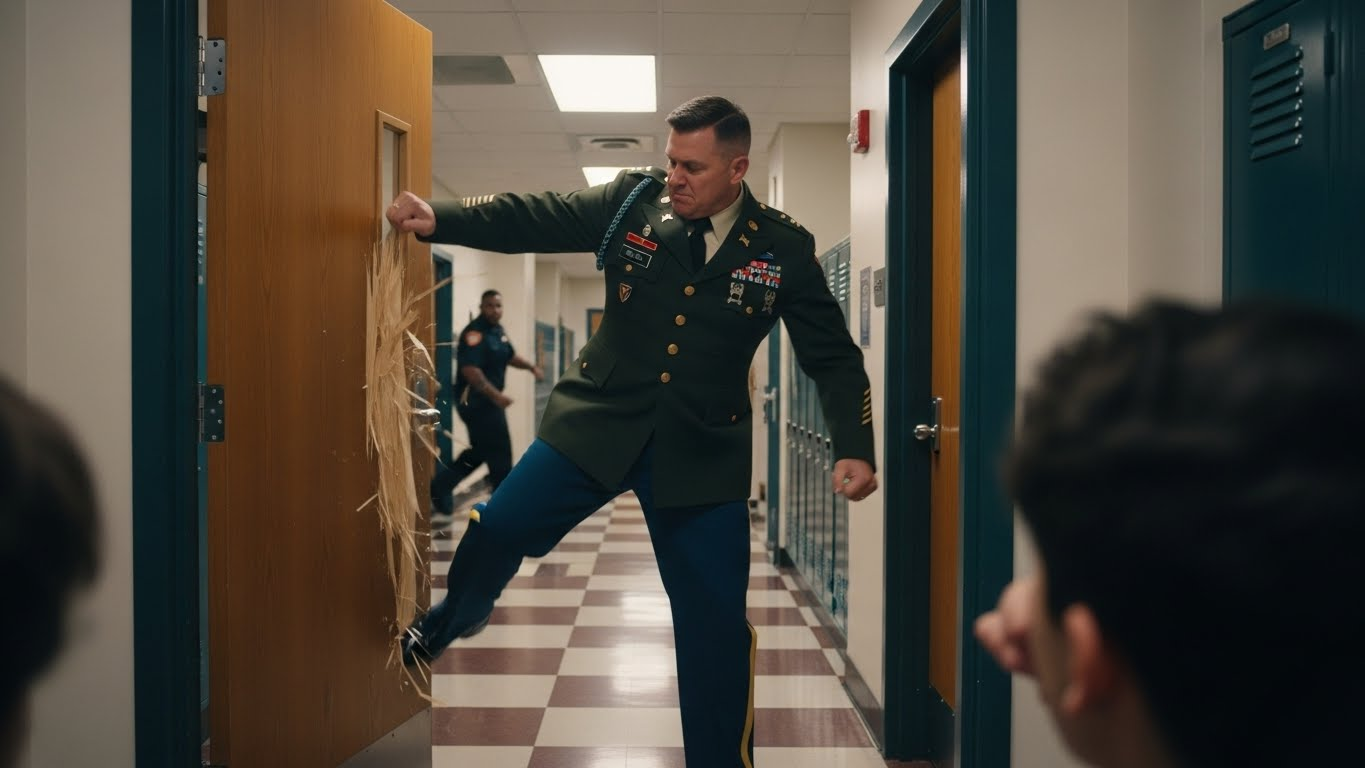
For General Marcus Sterling, life was a series of high-stakes decisions in service to his country. But his most sacred duty was coded in a simple rule for his daughter, Maya: call the burner phone only if you are in immediate danger. When that phone vibrated during a critical national security meeting, no strategic analysis compared to the urgency of that single word message: Bathroom. In that instant, the General became just a father, and the Pentagon’s crises faded into background noise. His dramatic exit was less an act of defiance than a primal recalibration. Some lines cannot be crossed, and for Sterling, his child’s safety was that line.
The drive to Arlington Prep was a journey from one world into another. Maya attended the school as a scholarship student, her father’s towering rank a secret to foster normalcy. But normalcy had curdled into nightmare. Finding her, with her head being held under water while others watched, was a vision that will forever haunt him. His response—shattering the door, disarming the attacker—wasn’t a general’s tactic, but a father’s unleashed instinct. The real heartbreak came later, in the car, when a shivering Maya apologized for calling him, for being a bother, for revealing his secret. She had endured months of torment because she wanted to be strong like him, not wanting to trouble him with “high school drama.”
This moment defines the story’s core truth. Sterling had to teach his daughter that strength isn’t silent suffering. “Being strong doesn’t mean taking abuse in silence,” he told her. “Strength is knowing when to fight, and knowing when to call in air support.” He reassured her that she was not a distraction from his duty, but its very purpose. “You are the most important mission I have,” he said, reframing his entire identity for her. This was the real victory—not the confrontation in the bathroom, but the restoration of his daughter’s sense of safety and self-worth.
The following day’s meeting with school officials was the operational clean-up. It secured consequences and accountability, but its deeper function was to publicly affirm Maya’s value. As they walked out together, she carried her cello case like a shield, her posture transformed. She was no longer hiding. The quiet exchange by the car was the true resolution. “Thanks, Dad. For kicking the door down,” she said. His simple “Anytime, kid,” held the weight of a lifetime promise.
The tale closes with Sterling holding his daughter’s hand in the car, choosing that connection over the buzzing demands on his phone. It’s a powerful reminder that behind every title—General, CEO, President—is a person whose world can shrink to the size of a child’s fear in a second. True leadership isn’t just about commanding armies; it’s about knowing what you’re ultimately fighting for. For Marcus Sterling, that was, and always would be, the girl in the passenger seat.