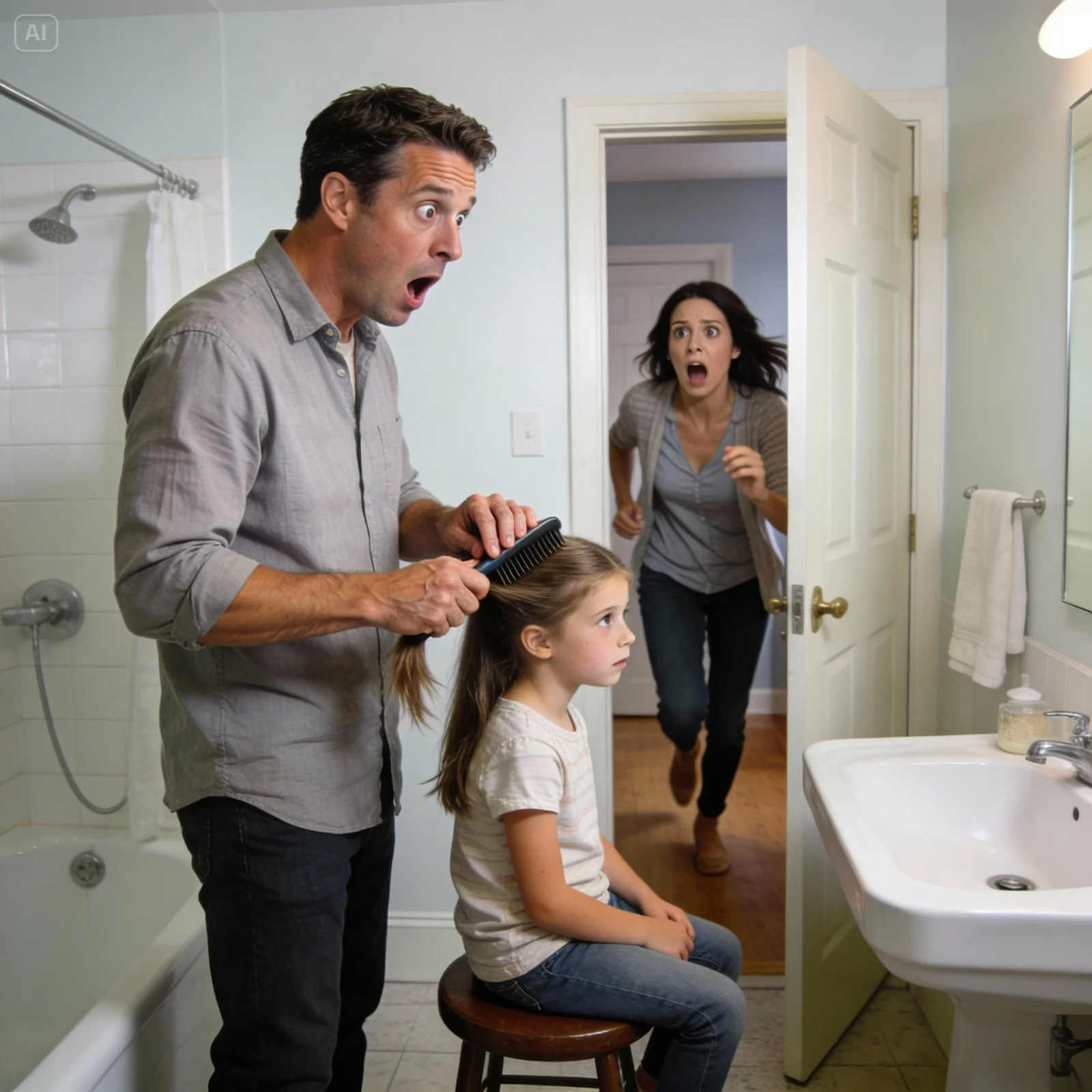
Parenting is built on a thousand small routines. For my husband and our daughter Lily, it was the evening hair-brushing, a time of soft chatter and tangles smoothed away. One night, that routine revealed a horror. I heard my husband’s whispered call, urgent and shaky. In the bathroom, his face was ashen. He showed me a mark on Lily’s scalp—a circular impression with bruising in straight, deliberate lines. It was the kind of mark left by sustained pressure, not a playground accident. Our questions to Lily were met with confused denial, which only amplified our dread. The atmosphere in our home shifted from cozy to charged in an instant, a prelude to the disturbance that was literally knocking at our door.
The knocking was polite but persistent. Through the frosted glass, we saw the silhouette of a man in a uniform. He had a package for Lily, but no visible delivery truck, and his demeanor turned cold when we asked who sent it. His focus locked onto our daughter with an intensity that felt invasive and wrong. After a tense exchange, he left a small envelope on our mat. Inside was a single, glittery pink hair clip, bent out of shape. Lily identified it as hers, taken from her backpack. This wasn’t a lost item returned; it was a trophy, delivered back to us with a chilling message. As our porch light eerily flickered out, we saw his dark sedan had not left; it was parked down the street, watching. Our safe, suburban night had become a tense standoff.
With the threat physically present outside, we moved Lily upstairs, creating a fortress of our presence. In the safety of her room, we gently encouraged her to share anything she remembered. Through tears, she confessed a terrifying secret: a familiar father from school had hurt her. Under the guise of helping, he had pressed a hard object into her scalp and instructed her to be quiet. He had groomed her silence with a promise of secrecy. The man in the sedan was no longer just a suspicious delivery driver; he was connected to a predator we had welcomed into our circle. The violation was twofold: of our child’s innocence and of our communal trust.
Action was our only recourse. We called the police, who responded quickly. Their calm presence was a balm. They listened to Lily with incredible care, collected the evidence, and assured us they would pursue the matter. The physical proof—the patterned bruise, the delivered hair clip—gave weight to our daughter’s words. Only after the patrol cars arrived did the lurking sedan finally retreat. In the aftermath, holding our sleeping child, my husband and I were left with a mixture of fury, relief, and a sobering new understanding of the world. The ordinary act of brushing hair had become our most critical line of defense.
This experience forever altered our perception of safety. It underscored that danger doesn’t always announce itself with a scream; sometimes it arrives with a polite knock and a familiar face. Our greatest lesson was the absolute necessity of fostering open communication with our child and trusting those gut feelings that scream when something is amiss. The hair clip, a trivial accessory, became a symbol of a threat intercepted. We now move through the world with quieter but sharper eyes, knowing that protection is woven from daily attention, courageous conversations, and the unwavering decision to believe a child, and ourselves, when something feels unthinkably wrong.