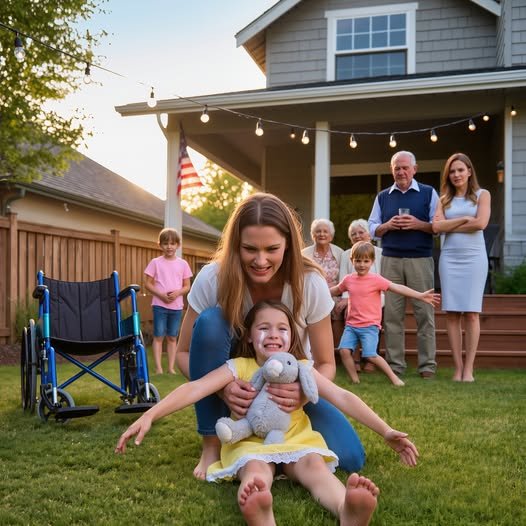
We are taught that family is our sanctuary, the one place where we are safe and accepted. But what happens when that sanctuary becomes the source of your deepest pain? This is the story of the day I learned that blood relation does not excuse cruelty, and that the most powerful word a parent can say is “enough.” It began with a family reunion, an event I attended against my instincts, hoping to offer my daughter, Mia, a sense of normalcy. Confined to a wheelchair after an accident, she deserved to feel the joy of family, or so I thought.
The atmosphere at my parents’ house was superficially warm, but I could feel the undercurrents of judgment the moment we arrived. My sister, with her performative kindness, immediately whisked Mia away to the backyard where the other children were. I allowed it, silencing the inner voice that screamed it was a mistake. I wanted to believe in the fantasy of a happy family so badly that I ignored the reality staring me in the face. That decision, that momentary lapse in my protective duty, is something I would regret deeply.
The sound of her screams broke through the facade like shattering glass. I found my daughter on the ground, being used as a trampoline by her own cousins. They were jumping on her legs—the very legs that carry the memory of her trauma—while the adults who were supposed to be supervising did nothing. The image of her terrified face, contorted in pain, is seared into my memory forever. In that moment, my daughter wasn’t a beloved niece or granddaughter; she was a target for their callousness and a problem for their comfort.
When I confronted them, their responses were a masterclass in toxic dismissal. I was told to “calm down,” that it was “just kids playing,” and that they were merely “trying to toughen her up.” Their laughter as my child cried was the final, unforgivable betrayal. It was in that chorus of cruelty that I found my clarity. I was not overreacting; I was underreacting by ever bringing her into that environment. I picked up my daughter, placed her safely in her chair, and we left. That was the moment I stopped being a daughter and a sister and fully embraced my role as a protector.
The aftermath was not pretty, but it was necessary. I took legal and financial actions that ensured they could never harm us again. I built a wall of boundaries so high they could never scale it. Protecting my child meant burning those family bridges to the ground, and I have never looked back with regret. Some may call it harsh, but I call it love in its purest, most ferocious form. My peace and my daughter’s safety are worth more than any hollow tradition of family loyalty.