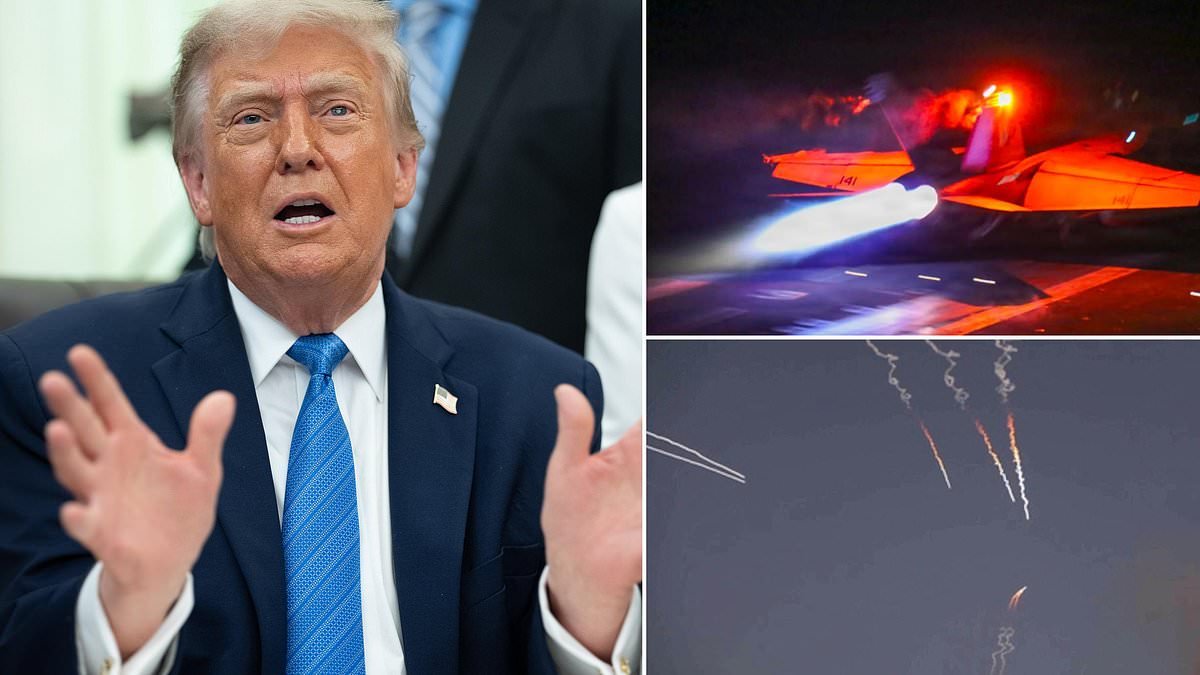
Donald Trump has hit Iran with fresh strikes before vowing to ‘bomb the s*** out of them’ if a peace deal is not signed.
On Wednesday, the US launched a new round of ‘self-defense’ strikes on the country, with US Central Command saying the strikes came at the ‘Commander-in-Chief’s direction’ and were ‘in response to Iran’s unwarranted and continued aggression.’
The head of the Iranian Guards’ aerospace force responded by threatening to ‘make the region hell’ as Tehran launched retaliatory strikes.
Iran’s Islamic Revolutionary Guard Corps said they had struck US targets on bases in Kuwait and Bahrain, and that they also ‘hit and destroyed Sheikh Isa air bases’, according to the state-run IRNA news agency.
America’s attack yesterday struck ‘military surveillance capabilities, communication systems, and air defense sites,’ CENTCOM said.
More strikes may also be forthcoming, Trump warned. ‘We will bomb the Iranians again tomorrow night if they refuse to sign the proposed deal,’ he told Fox, adding that the bombing would stop soon but if Tehran did not sign a peace deal ‘we’ll bomb the s*** out of them.’
Trump has grown increasingly frustrated with the stalled efforts to negotiate a peace deal and was hoping the bombing efforts would push Iran to strike a deal.
He even told his aides after approving the strikes on Tuesday to deliver a message to Tehran via the mediators in Qatar, that the attacks were in response to Iranian forces downing an Apache helicopter with two crew members on board – and were not meant to be the start of another all-out war.
The attack on Iran was described as ‘self-defense strikes’ after Iran struck US assets
The strikes on Wednesday came at President Donald Trump’s direction
Iranian missiles are pictured being launched earlier in the day
Yet, he said, military pressure would only increase until Iran ceded to his demands.
The US fired nearly 50 Tomahawk missiles at the country on Wednesday night.
Iranian state media has reported that explosions were heard around Minab and Sirik in the southern part of the country, near the Strait of Hormuz.
Air defense systems in Asaluyah were also activated – though no attacks have occurred thus far in the key energy hub that houses refineries and petrochemical complexes, CNN reports.
As the strikes then continued, Iran’s Khatam al-Anbiya military command headquarters warned that the Strait of Hormuz would be closed to all marine traffic – and all ships seen passing through the waterway through would be struck down.
‘Following the continued provocations of the criminal United States and in light of the beginning of attacks by that country’s invading military against certain areas in southern Hormozgan Province, the Strait of Hormuz is, from this moment, declared closed to all vessels, including oil tankers and commercial ships, due to insecurity in the region, and any transit will be targeted,’ the military command said in a statement.
Two ‘non-compliant’ oil tankers have already been struck down in accordance with the closure, the Iranian Revolutionary Guard Navy claimed on social media.
US Central Command, however, has disputed the claims that the strait is closed.
‘Commercial ships are continuing to transit in and out of the Strait of Hormuz tonight,’ it posted on social media.
In response to the US strikes, Iran’s Islamic Revolutionary Guard Corps said they had struck US targets on bases in Kuwait and Bahrain and had conducted drone strikes targeting communications antennas and radar facilities belonging to the US Fifth Fleet in Bahrain.
An air raid alert was issued in Bahrain and residents were urged to ‘head to the nearest safe place’, the Gulf nation’s interior ministry said on X.
Kuwait closed its airspace temporarily as its military said its air defence systems were working to intercept ‘hostile aerial targets’.
Trump’s renewed US strikes on Wednesday came just hours after the president met with his advisors in the Situation Room to discuss options for a massive bombing raid.
He was considering an operation ‘that is big in scale but short in duration,’ sources told Axios.
Defense Secretary Pete Hegseth told reporters following the meeting that the US would be striking ‘key facilities’ inside Iran.
‘CENTCOM will be busy tonight because we are going to hit Iran hard,’ Hegseth said, while noting that the strikes were meant to push Iran toward diplomacy.
‘They are going to have tap, tap, tap bombs dropping on key facilities in Iran from the US. It is not to restart the war but to set the terms for a deal.’
Trump also warned: ‘We hit them hard yesterday, and we’re going to hit them hard again today.’
But Tehran had threatened to broaden the conflict to other countries if the strike took place on Wednesday.
The Iranian regime has claimed it struck down two ‘non-compliant’ oil tankers in the Strait of Hormuz (pictured)
Ebrahim Azizi, head of the national security commission in Iran’s parliament, promised retaliation on X, writing: ‘This time, the war won’t be limited to the region.’
Ambassador Amir Saeid Iravani also told the United Nations Security Council on Wednesday that his country ‘has never negotiated under threats and pressure, and never will submit to pressure or question.’
Meanwhile, Qatari mediators were holding talks with Iranian officials in another effort to bring about a deal.
Trump has been insistent that any deal to end the war in Iran sees the country give up its stockpile of highly enriched uranium, which is just one short technical step from weapons-grade levels.
Iran, though, is refusing to give up the uranium – which it claims is being used for peaceful purposes – and is demanding relief from US-imposed sanctions.
Iranian officials also want frozen assets to be released even before a final agreement is in place, something Trump has rejected.
Additionally, Iran has insisted that any deal to end the war must also end the fighting between its ally Hezbollah and Israel – but Israel has instead intensified its military campaign against the Lebanon-based militant group.