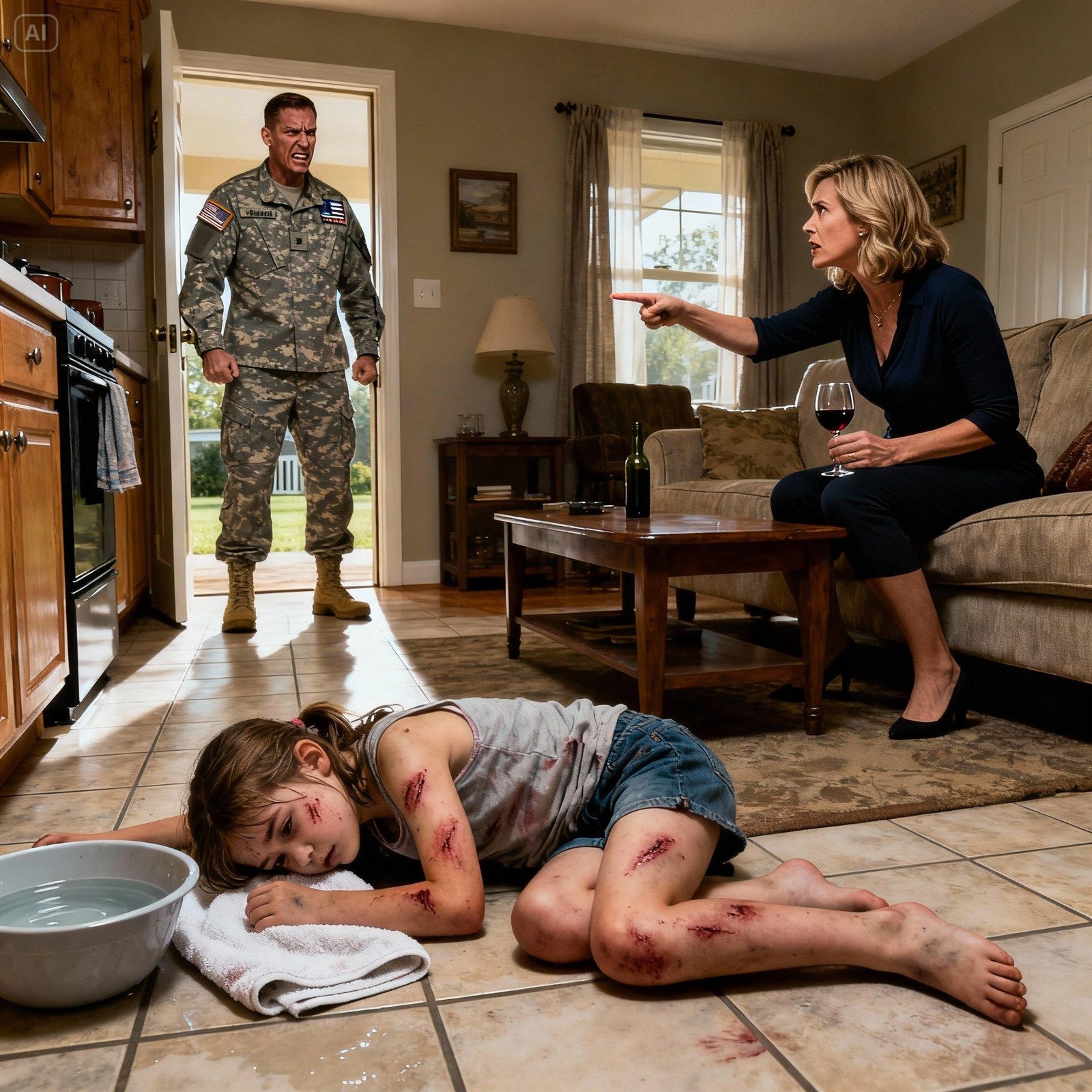
It was the sound that struck him first—the faint, rhythmic scrape of a brush on wood, a sound that didn’t belong in his home. Captain Lucas Hartley, still dusty from his long journey, pushed the front door open and stepped into a scene that would forever be seared into his memory. There, in the hallway, was his seven-year-old daughter, Lena. She was on her knees, her small frame trembling with effort. Her hands, which should have been holding toys or coloring books, were red and raw. And standing over her was his wife, Marissa, her voice a cold whip. “If you can’t do it properly, you don’t eat,” she said. The words hung in the air, cruel and absolute.
Lena’s world had narrowed to the grain of the wood and the burning in her muscles. The dizziness had been building for a while, a swirling fog at the edges of her vision. When the brush finally slipped from her numb fingers, she didn’t have the strength to pick it up. She simply folded, collapsing onto the floor in a small, silent heap, her breath catching in her throat. It was in this moment of utter defeat that the door burst open and a familiar silhouette filled the frame. Hope, a feeling she had almost forgotten, flickered weakly inside her.
Lucas’s mind, trained for combat and crisis, processed the scene in an instant. The collapsed child. The indifferent woman. The raw hands. The pieces clicked together with horrifying clarity. “My daughter,” he boomed, his voice echoing with a fury that made the walls seem to shake. “Who did this to her?” Marissa’s face transformed from stern overseer to frightened culprit in a heartbeat, her complexion draining to a sickly white. But Lucas was already moving past her, his entire being focused on the small form on the floor. He knelt, his large hands impossibly gentle as he gathered Lena up. She nestled into the rough fabric of his uniform, and her whisper was a blade to his heart: “Daddy… it hurts.”
What happened next was a quiet, determined unraveling. Lucas tended to his daughter with a soldier’s precision and a father’s tenderness, wiping her face and helping her drink. Once she was settled, he turned his attention to Marissa. The confrontation was not loud, but it was final. He spoke with the calm authority of a man used to giving orders that would be obeyed. He gave her a simple directive: to leave. When she protested, he reached for the phone, his intention clear. The law would become involved. The truth would be documented. Faced with the consequences of her actions, her defiance crumbled, and she fled the home she had poisoned.
Later, with the house silent and still, Lucas sat on the sofa with his daughter curled against him. He wrapped a blanket around her shoulders, creating a cocoon of safety. The terrible silence of the house was gone, replaced by the soft, even sound of her breathing as she fell into a peaceful sleep. She whispered her thanks, and he kissed her forehead, making a promise to the night that he would never again let the world be so cruel to her. The soldier had returned from one battle only to fight the most important one of his life, and in doing so, he had finally come home.