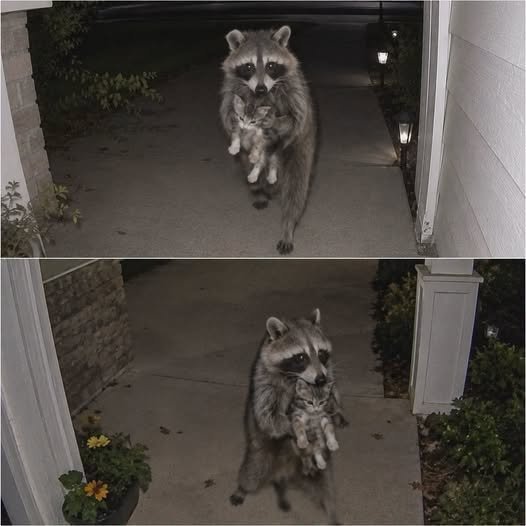
A strange story spreading across social media claims that residents of an unnamed neighborhood received the same mysterious visitor night after night: a raccoon walking upright while holding a tiny kitten in its front paws.
According to the posts, doorbell cameras recorded the pair approaching several houses. At every porch, the raccoon supposedly stopped, looked toward the door, and waited as if hoping someone would respond. It never released the kitten, and neither animal appeared distressed.
The scene sounds like a modern animal fable—a masked creature moving through the darkness, protecting a helpless baby and searching for one compassionate person willing to open a door.
There is only one problem: no reliable news organization, animal-control agency, wildlife center, named witness, location, or original unedited recording has verified that it happened.
The story currently appears to exist primarily through nearly identical Facebook posts. Those posts do not identify the neighborhood, residents, wildlife experts, or authorities allegedly involved. Their wording is repeated almost exactly across different pages, a common warning sign that a viral animal story may be invented, generated by artificial intelligence, or detached from its original context.
That does not make the image any less emotionally powerful. It does mean it should be presented as an unverified viral claim—not established news.
Why the Story Captured So Much Attention

The idea of a raccoon rescuing a kitten combines two animals people already associate with vulnerability, intelligence, and mischief.
Raccoons have remarkably dexterous front paws. Their upright posture and masked faces can make their movements appear almost human, particularly in nighttime security footage. Kittens, meanwhile, immediately activate protective instincts in many viewers.
Place the two together on a porch in the middle of the night, and an ordinary wildlife encounter becomes a story about compassion.
The raccoon is no longer merely carrying something. Viewers imagine that it is asking for help. Its pause at the door becomes a request. Its movement from house to house becomes a mission. The kitten’s apparent calmness becomes evidence of trust.
Humans naturally interpret animal behavior through familiar emotional narratives. We look for motives we understand: love, friendship, rescue, grief, loyalty, or sacrifice. Sometimes animals genuinely demonstrate complex social behavior. At other times, viewers assign a human explanation to actions driven by food, fear, maternal instinct, curiosity, or environmental pressure.
A short video rarely provides enough context to distinguish among those possibilities.
That ambiguity is part of what makes stories like this spread so quickly. Viewers do not simply watch what happened. They help complete the story.
Would a Raccoon Actually Rescue a Kitten?
Raccoons are intelligent and adaptable mammals, but there is no established evidence that a wild raccoon would normally carry a domestic kitten from home to home while deliberately seeking human assistance.
A raccoon might interact with a cat or kitten under unusual circumstances. Raccoons living near houses frequently encounter outdoor cats around porches, garbage containers, sheds, and feeding stations. Young animals raised together can sometimes become tolerant of one another. A habituated or formerly captive raccoon might also behave differently from a completely wild animal.
But those possibilities do not prove the rescue interpretation.
Wild raccoons are opportunistic omnivores. They eat fruit, insects, eggs, aquatic animals, small vertebrates, pet food, and discarded human food. Although they generally avoid unnecessary conflict, they can injure cats—especially kittens—during competition over food or if they feel threatened.
The posture described in the viral story is also questionable. Raccoons can stand and move briefly on their hind legs, but carrying a kitten for an extended distance in their front paws while repeatedly walking upright would be an unusual and physically awkward behavior.
A mother raccoon normally transports her own young with her mouth, often grasping them by loose skin around the neck. Domestic cats carry kittens in a similar way. Holding another animal against the chest like a human carrying a baby would be far less typical.
Unusual does not always mean impossible. It does, however, mean that strong evidence would be needed before wildlife specialists could interpret the behavior confidently.
The Missing Details That Matter

Authentic local animal stories usually contain several verifiable elements: a city, date, resident’s name, animal-control report, original video owner, or statement from a licensed wildlife rehabilitator.
This story contains none of them.
It refers only to “one neighborhood,” “several doorbell cameras,” unnamed “residents,” and unidentified “wildlife researchers.” No researcher is quoted. No agency explains whether officers attempted to locate the pair. No one says what ultimately happened to the kitten.
The lack of resolution keeps audiences emotionally engaged, but it also prevents verification.
If the same raccoon had genuinely appeared at multiple homes over several nights, residents would probably have contacted animal control or a wildlife rescue organization. A domestic kitten repeatedly transported by a raccoon would require an urgent welfare assessment. Authorities would also be concerned about possible exposure to rabies, parasites, injuries, or other diseases.
The absence of any identified response is therefore significant.
A genuine series of recordings should also be easy to compare. Investigators could examine timestamps, weather, house layouts, the raccoon’s markings, the kitten’s position, lighting, shadows, and movement. If the footage were generated or manipulated, inconsistencies might appear between clips.
Without the original files, viewers cannot perform that analysis.
They are being asked to believe a complete narrative based on a description alone.
Could the Images Have Been Generated by AI?
AI-generated animal footage has become increasingly convincing.
Videos now circulate showing animals ringing doorbells, rescuing babies, bringing injured companions to hospitals, delivering food, or performing other highly humanized actions. Many are designed to trigger strong emotional reactions before viewers pause to consider whether the behavior is plausible.
Common warning signs include unnatural paws, objects changing shape, inconsistent fur patterns, distorted limbs, impossible shadows, and background details that appear or disappear. Animals may move with strange smoothness or maintain postures that would be difficult to sustain physically.
Narrative structure can also expose fabricated content.
AI animal stories often begin with a startling but adorable incident, introduce anonymous witnesses, offer several speculative explanations from unnamed experts, and conclude by saying the mystery remains unresolved. This formula creates curiosity while avoiding details that could be checked.
The raccoon-and-kitten account closely follows that pattern.
That does not conclusively prove that every associated image or video is artificial. The footage could be staged, miscaptioned, edited, or taken from an unrelated event. But until an original source is identified, AI generation remains a reasonable possibility.
What Residents Should Actually Do
If anyone genuinely sees a raccoon carrying or closely interacting with a kitten, the safest response is not to open the door and attempt a dramatic rescue.
Raccoons are wild animals. Even one that appears calm can bite or scratch when frightened, trapped, or separated from something it is carrying. Direct contact may expose people and pets to disease.
Residents should remain indoors, keep children and domestic animals away, and record the encounter from a safe distance if possible. They should contact local animal control, a licensed wildlife rehabilitator, or another appropriate authority and provide the location and footage.
People should not leave food outside to persuade the raccoon to return. Feeding wildlife can make raccoons associate houses with food, increasing future conflicts and encouraging them to approach humans. Outdoor pet food, unsecured garbage, and accessible animal doors should be removed or secured.
If a kitten is later found alone, injured, cold, or unresponsive, an animal professional should assess it. Anyone whose pet has direct contact with a raccoon should contact a veterinarian and confirm that vaccinations are current.
Humane World for Animals recommends never intentionally feeding raccoons, keeping small pets indoors, and avoiding conventional pet doors that allow wildlife to enter. Its raccoon guidance is available here.
A Beautiful Message Does Not Require a False Story
People are drawn to the raccoon story because its emotional message is worth preserving.
A vulnerable creature needs help. An unexpected protector refuses to abandon it. Door after door remains closed, but the protector continues searching.
That image reflects something deeply human: the hope that compassion can appear where we least expect it.
But preserving that message does not require claiming that an undocumented event definitely occurred. Fiction, folklore, and symbolic animal stories have always helped people explore kindness. The problem begins when a parable is presented as breaking news.
False animal stories may seem harmless compared with political misinformation or medical deception. Yet they still weaken trust, exploit viewers’ emotions, and can promote unsafe interactions with wildlife.
The most responsible way to share this particular story is to label it clearly:
“A viral, unverified story imagines a raccoon carrying a kitten from porch to porch while searching for help.”
That sentence keeps the wonder without misleading the audience.
Perhaps a genuine video will eventually emerge with a named witness, clear location, original footage, and confirmation from animal authorities. Until then, the story should remain what the available evidence supports: a moving online mystery, not a verified rescue.
The raccoon may never have walked from door to door. The kitten may exist only inside a generated image or repurposed clip. But the reaction reveals something real about the people sharing it.
We want to believe that even in darkness, someone will carry the helpless toward safety.
And we want to believe that eventually, one door will open.