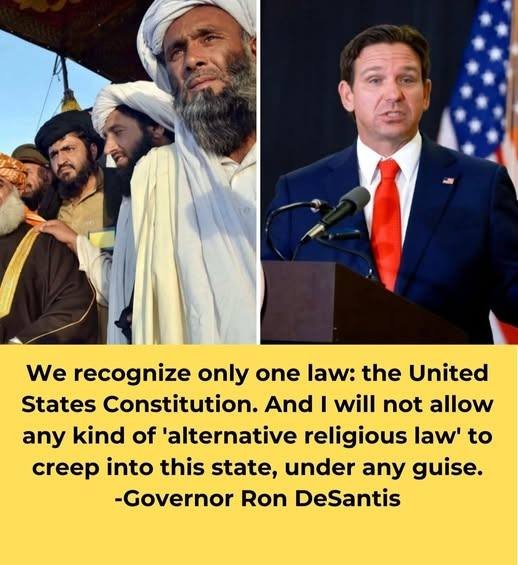
In a recent public address, Florida Governor Ron DeSantis articulated a strict boundary between religious practice and civil law, emphasizing that the U.S. Constitution is the singular legal authority for the state. His comments, which specifically rejected the application of “alternative religious laws” such as Sharia, highlight a continuing national conversation about the intersection of faith and governance. DeSantis’s declaration serves to reinforce the secular foundation of American jurisprudence, a system designed to ensure equal treatment under a universally applicable legal code, rather than one influenced by specific religious tenets.

The Governor’s stance is rooted in the constitutional principle of the separation of church and state, a cornerstone of American democracy that prevents the government from endorsing or enforcing religious doctrines. This separation is what allows for robust religious freedom; individuals may practice their faith privately and in community without fear of state interference, but they cannot invoke that faith to create binding civil law for others. DeSantis’s position asserts that this separation is non-negotiable, framing any introduction of religious legal systems into state affairs as a fundamental threat to the cohesive, secular rule of law that binds a diverse society together.
While the practical scenario of a religious court overriding a U.S. court is a legal improbability, the political and symbolic weight of DeSantis’s statement is considerable. It resonates with voters who are concerned about cultural preservation and national identity. By taking this stand, the Governor positions Florida as a defender of a specific vision of American legality—one that is uniform, predictable, and derived from a constitutional tradition rather than religious interpretation. This reinforces a key conservative viewpoint that values the Constitution not just as a historical document, but as an active, overriding framework that must be vigilantly protected from competing ideologies.
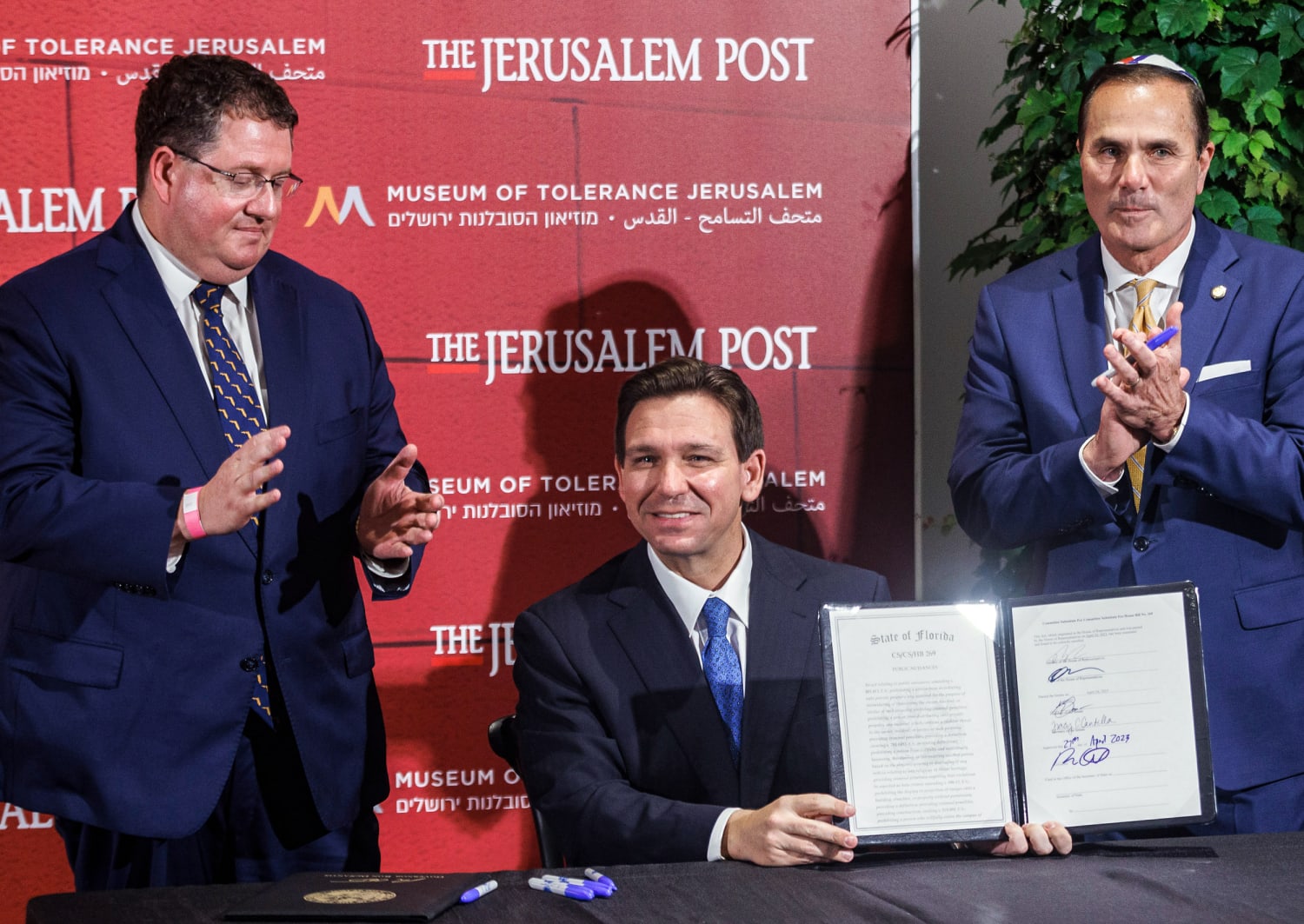
The broader implication of this position extends beyond any single religious law. It is a reaffirmation of a classic American liberal ideal: that the state governs all citizens equally through laws made by representative institutions, not by divine mandate or religious authority. DeSantis’s framing presents a choice between constitutional order and potential legal pluralism, arguing that the former is essential for unity and fairness. In doing so, he participates in a defining national debate about the very source of legal authority in a pluralistic society, coming down firmly on the side of a secular, constitutional republic where personal faith is protected but is not a source of public law.