Russia has lost almost half a million soldiers in the war in Ukraine, the head of GCHQ revealed yesterday.
Anne Keast-Butler disclosed the staggering scale of the military losses yesterday as she piled pressure on Russian leader Vladimir Putin.
In her inaugural annual lecture, the spy chief said: ‘Putin is going backwards on the battlefield with new intelligence showing that almost half a million Russian soldiers have now been killed since the conflict began.’
The figure is far higher than previous estimates of 350,000 deaths, which was calculated earlier this month by the Centre for Strategic and International Studies, a Washington-based think-tank.
It is the first time that a GCHQ boss has publicly revealed the number of Russian troops killed, in what will be perceived as a stark message to the Kremlin.
It means that more than 300 soldiers a day have lost their lives since Moscow launched the invasion on February 24, 2022.
Ms Keast-Butler did not reveal the number of Ukrainian soldiers killed in the last four years, which president Volodymyr Zelensky estimated at 55,000 in February.
She suggested that while struggling to secure decisive military gains in Ukraine, Russia is intensifying its campaign of hybrid activity against Britain.
GCHP chief Anne Keast-Butler (pictured) disclosed the staggering scale of the military losses yesterday
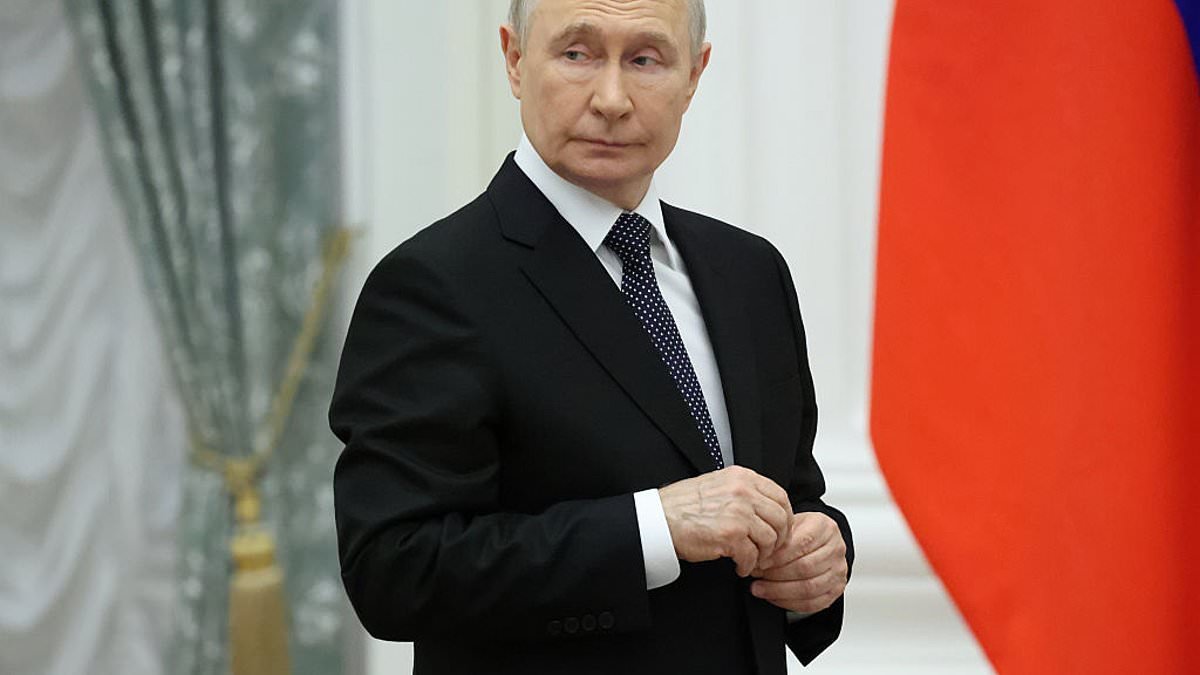
In her inaugural annual lecture, the spy chief said: ‘[Vladimir] Putin (pictured) is going backwards on the battlefield with new intelligence showing that almost half a million Russian soldiers have now been killed since the conflict began.’
‘One area in sharp focus for us is protecting the data and energy flowing through the critical cables and pipelines in and around British waters – we do this by exposing Russia’s intent, motive and underwater capabilities,’ she said.
Her remarks come amid heavy fighting across Ukraine and growing concern among Western intelligence agencies over Russia’s aggressive cyber operations and sabotage campaigns targeting the UK and Europe.
In a wide-ranging speech, Ms Keast-Butler stressed that international warfare was no longer just about human combat, and battles are now being waged with new technology, saying: ‘Warfare is being reconfigured; increasingly data-driven, AI-enabled, and automated.’
Against this background, plans for a national ‘cyber shield’ using AI ‘agents’ to defend Britain from cyber attacks were announced.
It is hoped that within five years, a network of GCHQ-trained AI bots will be able to discover threats to key companies and automatically communicate with the firm’s in-house AI systems to halt attacks.
Speaking at GCHQ’s wartime spy hub, Bletchley Park, the spy chief said: ‘As we draw on decades of expertise in machine learning to re-imagine cyber security, we’re also embedding frontier AI deeper into our operations to enhance algorithms, translate foreign language, and find needles in haystacks quicker than ever before.
‘AI is an unstoppable force with great opportunity. But it’s also a force with risks. The AI revolution is now fully upon us – with ever faster pace of model releases, increasingly sophisticated agents and greater system autonomy – transforming the world with both promise and peril.’
Ms Keast-Butler also warned that space represented the next frontier in which battles would be fought between nations for supremacy.
Yova, a commander of the 15th Operational Brigade Kara-Dag, leaves a bunker at an artillery position near Pokrovsk in the Donetsk region on May 27, 2026 in Pokrovsk, Ukraine
Firefighters work at the site of a Russian drone strike on May 27, 2026 in Odesa, Ukraine
‘We must look to space,’ she said. ‘Since I became director three years ago, over ten thousand new objects have been launched into space, each new constellation of satellites adding to the volume and speed of data passing across our planet.
‘This is only going to grow. Both China and Russia are investing heavily in space to support both peace and war ambitions.
‘And in the last few months, we’ve seen reports of satellite imagery underpinning Iranian attacks in the Gulf.
‘Space-based tech is critical to both our way of life and our national security – and that’s why GCHQ is working with partners to harness, secure and defend against it.’
Spy chiefs are developing a ‘national shield’
By REBECCA CAMBER
Spy chiefs are developing a national ‘cyber shield’ using artificial intelligence ‘agents’ capable of detecting threats faster than any human.
Plans are being drawn up for the world’s first national AI cyber defence system which will use automated bots to detect and flag threats to critical national infrastructure, the military and other economically critical sectors such as telecoms.
GCHQ boss Anne Keast-Butler announced yesterday (WED) that GCHQ was developing a ‘blueprint’ in which cyber defence will depend on AI agents instead of humans.
It is hoped that within five years, a network of GCHQ trained AI bots will be able to discover threats to key companies and automatically communicate with the firm’s in-house AI systems to halt attacks.
The idea is to make hacks of major firms like Jaguar Land Rover less likely.
In a world where humans will effectively be just ‘on the loop, not in the loop’, AI agents will be given the power to mount the first critical defence of Britain’s cyber security.
It is envisaged that human spies will still have a ‘strategic influence’ and retain the power to shut off the cyber shield, but AI technology will have the capability to identify and repair security vulnerabilities at lightning speed.
In her inaugural annual lecture at Bletchley Park, the wartime headquarters of GCHQ, Ms Keast-Butler said: ‘In the past few months, GCHQ has developed the blueprint for a new national cyber defence capability that will hardwire cutting-edge agentic AI into machine-speed cyber defence.
‘And as we draw on decades of expertise in machine learning to reimagine cyber security, we’re also embedding frontier AI deeper into our operations – responsibly and ethically – to enhance algorithms, translate foreign language, and find needles in haystacks quicker than ever before.
‘AI is an unstoppable force with great opportunity. But it’s also a force with risks.
‘As AI gains increased autonomy, we all have an intergenerational duty to harness and secure it for good; to protect our national security, our economy and our way of life.’
She went on: ‘The AI revolution is now fully upon us – with ever faster pace of model releases, increasingly sophisticated agents and greater system autonomy – transforming the world with both promise and peril.
‘That’s equally true for intelligence and security, where the latest frontier AI is rapidly unearthing the fault lines in technologies that our society relies on every single day.
‘The ground beneath our feet is shifting, and shifting fast.’