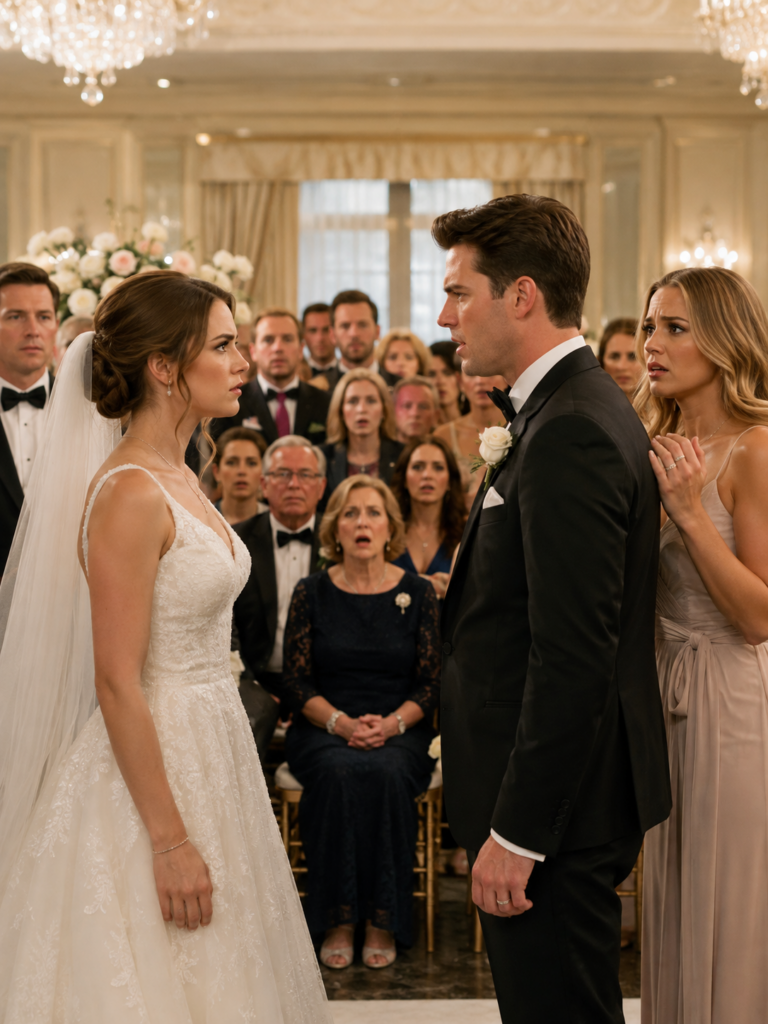
On our wedding day, my fiancé took my ring, slipped it onto his childhood friend’s finger, and mocked, “Behave yourself, or I’ll marry her instead,” expecting me to break down in front of everyone, but I simply smiled and said, “Go ahead,” because he had no idea I was about to make his cruel little joke permanent.
My mother’s fingers tightened around my wrist.
I turned slightly.
Her face had gone pale.
She was wearing a navy evening gown and the old pearl brooch I had given her after receiving my first real paycheck. She had spent years refusing to wear it because she said the clasp was unreliable.
She had fixed it for my wedding.
That nearly undid me.
Not Harrison.
Not Khloe.
My mother.
Because I could feel her trembling.
Harrison noticed the silence and apparently mistook it for surrender.
“Eleanor.”
His voice softened into the patient tone he used whenever he wanted an audience to believe I was the unreasonable one.
“Are you actually okay with this?”
A few people shifted in their seats.
Somebody near the second row lowered a phone.
Another person raised one.
The officiant stood frozen beside us, still holding his notes.
Harrison stepped closer.
“Because I’m giving you one chance to think about how we got here.”
I almost laughed.
How we got here.
That was his favorite phrase whenever he wanted responsibility to become communal property.
If he came home four hours late and I asked where he had been, we needed to discuss how we had gotten to a place where I was so suspicious.
If he ignored a dinner with my mother, we needed to discuss how we had gotten to a place where he felt pressured by family obligations.
If I questioned a contract that gave him access to my company’s proprietary systems after marriage, we needed to discuss how we had gotten to a place where I could not trust my future husband.
And now, apparently, we needed to discuss how we had gotten to a place where he had placed my wedding ring on another woman’s hand.
I looked at Khloe.
She would not meet my eyes.
Interesting.
“Harrison,” I said, “do you want me to ask for it back?”
His mouth tightened.
“I want you to understand something.”
“That wasn’t my question.”
There was a small movement among the guests.
Harrison hated being interrupted.
His jaw shifted.
“Khloe has been in my life for more than twenty years. She understands me. She doesn’t analyze everything. She doesn’t treat relationships like spreadsheets. She doesn’t turn every disagreement into a negotiation.”
Khloe whispered, “Harrison, please.”
But she still did not remove the ring.
He continued.
“You always need control, Eleanor. Everything has to be documented. Everything has to be calculated. Everything has to happen your way.”
I studied him.
Seven years.
Seven birthdays.
Seven Christmas mornings.
Countless Sunday breakfasts.
Two apartments.
Three job changes for him.
One startup for me.
I had once crossed Manhattan at midnight because he had called and said he had the flu.
I had spent four hours making soup he barely touched.
I had rearranged investor meetings to attend his father’s retirement dinner.
I had learned the names of his mother’s preferred florists because Harrison always forgot her birthday arrangements until the last minute.
I had made a thousand tiny accommodations.
And somewhere along the way, every accommodation had become an expectation.
My patience had become his proof that I would stay.
My silence had become his evidence that there was no limit.
“Are you finished?” I asked.
His eyebrows rose.
“Excuse me?”
“I asked whether you were finished.”
Khloe finally looked at me.
For the first time, I saw uncertainty beneath the tears.
Good.
Harrison scoffed.
“You’re doing it again.”
“Doing what?”
“Acting cold.”
“No.”
I looked around the ballroom.
My coworkers.
His relatives.
My mother.
The flowers.
The champagne glasses.
The cake waiting beneath a spotlight near the far wall.
The little cards with our names printed together in gold.
Eleanor Mercer and Harrison Sterling.
Everything looked perfect.
That was almost funny.
“I’m not cold,” I said. “I’m clear.”
Then I looked directly at him.
“All right.”
He blinked.
“What?”
“You said that if I couldn’t fall in line, you would make Khloe your wife.”
I nodded toward her hand.
“You’ve already given her the ring.”
Khloe instinctively curled her fingers.
“So,” I continued, “all right.”
The expression on Harrison’s face changed.
Only slightly.
But I knew him well enough to see it.
The confidence disappeared first.
He had expected tears.
Perhaps anger.
Perhaps an emotional scene followed by a private apology from me for embarrassing him.
What he had not expected was permission.
“Eleanor.”
“No explanation necessary.”
I reached behind my head and loosened my veil.
The pins came free one at a time.
My mother whispered my name.
I placed the veil gently over her arm.
Then I turned.
The ballroom seemed twice as long as it had when I walked down the aisle.
Nobody stopped me.
Nobody knew what to say.
I heard whispers beginning behind me.
I heard Harrison call my name once.
Then twice.
I kept walking.
At the edge of the room, I passed the table where several members of my company’s leadership team were seated.
My COO, Rachel, stared at me.
I gave her the smallest nod.
Her expression changed immediately.
She understood.
Three months earlier, I had given her a sealed instruction sheet with one sentence written across the front.
OPEN ONLY IF THE WEDDING DOES NOT HAPPEN.
She had asked why.
I had said, “Insurance.”
She had not asked again.
I reached the bridal suite, stepped inside, and locked the door.
Then I leaned against it.
For exactly five seconds, I allowed myself to feel everything.
The embarrassment.
The disbelief.
The grief.
The fury.
The humiliation of knowing that somewhere outside that door, more than two hundred people were discussing the most private failure of my life.
Then the five seconds ended.
I walked to the mirror.
The woman reflected there still looked like a bride.
Her makeup was perfect.
Her shoulders were straight.
Her hands were trembling.
I stared at them.
That mattered.
Strength did not mean my hands had to stop shaking.
Strength meant they could shake while I still used them.
I opened my clutch.
Inside sat a heavy cream envelope sealed with dark red wax.
Three months earlier, I had prayed I would never need it.
Beside the envelope was a second ring box.
Harrison’s ring.
I picked it up.
Under the box sat the handwritten card I had intended to give him that night.
I had rewritten the final sentence five times before choosing:
Let us keep looking in the same direction, side by side.
For several seconds, I stared at the words.
Then I folded the card once.
Twice.
I placed it back beneath the ring.
I did not tear it.
I did not throw it away.
Some things did not deserve a dramatic ending.
They simply needed to stop mattering.
I picked up my phone and called Beatrice Lawson.
She answered on the second ring.
“Eleanor?”
“You don’t need to cancel the reception.”
There was a pause.
Beatrice was a corporate attorney in her early forties who had represented my company for almost five years. She rarely hesitated.
This time she did.
“Are you sure?”
“Yes.”
“And Plan B?”
I looked at myself in the mirror.
“Begin it.”
Another pause.
Then her voice became crisp.
“Understood.”
“I’m done being quiet because silence makes other people comfortable.”
“Then we proceed exactly as discussed.”
I ended the call.
A knock came from the door.
“Eleanor?”
My mother.
I opened it.
She stood alone in the hallway.
For one terrible second, she looked much older than she had that morning.
Her lips pressed together.
“You don’t have to explain,” I said.
“I know.”
“Mom—”
“Let’s go.”
That was all.
No lecture about seven years.
No warning about what people would say.
No request that I reconsider.
She simply reached for my hand.
Together, we walked away from the wedding I had spent fourteen months planning.
I did not leave that hotel because Harrison had chosen Khloe.
I left because, for the first time, I had finally chosen myself.
A black Lexus waited in the underground garage.
Beatrice stood beside it wearing a gray pantsuit, holding a leather portfolio.
She took one look at my wedding dress and said, “You kept the shoes.”
I stared at her.
She pointed toward my feet.
“I expected you to change.”
A laugh escaped me.
It surprised all three of us.
“I paid too much for these shoes.”
“Good,” she said. “Then let’s get our money’s worth.”
My mother actually smiled.
That tiny moment saved me.
We left Manhattan and headed toward Brooklyn.
My mother sat beside me in the rear seat.
For several blocks, neither of us spoke.
Finally she said, “Your father would have been proud of you.”
I looked out the window.
My father had passed away when I was nineteen. For years afterward, my mother had carried both grief and responsibility without ever making either one visible.
She worked.
She paid bills.
She smiled at relatives who offered advice without offering help.
When I launched my company, she tried to sell two old family rings to give me extra money.
I found out before she could.
I refused.
That had been the first major argument of our adult lives.
“You were trembling in there,” I said.
She stared at her hands.
“I was afraid.”
“For me?”
“For you. For me. For what everyone would say. For what the Sterling family might do. For everything.”
She looked ashamed of the admission.
I squeezed her fingers.
“So was I.”
Her head lifted.
“You?”
“Mom, I’m wearing a wedding dress in a car going to Brooklyn with a lawyer.”
That made her laugh through her tears.
“Yes,” she admitted. “That is not generally considered a relaxed afternoon.”
The Lexus crossed into Brooklyn.
The streets became narrower.
The buildings less polished.
Eventually we stopped outside a tired seven-story warehouse building with faded brick walls.
My mother frowned.
“Why are we here?”
“Because this is where I kept the truth.”
Three years earlier, this building had housed my first real office.
Eight hundred dollars a month.
One desk.
Three folding chairs.
An old coffeemaker.
Windows that leaked cold air in January.
An air conditioner that gave up every July.
Harrison had visited exactly once.
He had stood in the doorway for less than five minutes and said, “You seriously work here?”
Then he had laughed.
I laughed too.
At the time.
Now the memory felt different.
Beatrice and I took the freight elevator to the seventh floor while my mother waited downstairs with the driver.
When I opened the old office, Beatrice stepped inside and stopped.
A whiteboard covered the far wall.
Photographs.
Printed emails.
Company registration records.
Contract revisions.
Receipts.
Dates.
Notes.
Not dramatic strings connecting everything like a television detective show.
Just organized information.
Rows.
Folders.
Timelines.
Three months of questions I had finally allowed myself to ask.
Beatrice approached the board.
“You added more.”
“A lot more.”
“When?”
“Mostly at night.”
She studied one set of documents.
“What happened on March twelfth?”
I took off my wedding shoes.
My feet immediately thanked me.
“That was the first night I stopped pretending.”
I sat at the old desk.
“Harrison texted at three in the afternoon and said he would be working late. I was making dinner. Around five, I left the office early because I wanted to surprise him.”
Beatrice listened without interrupting.
“I happened to pass the parking garage beneath Khloe’s design firm in Tribeca. His car was there.”
“You photographed it.”
“Yes.”
“What did he say?”
“That Khloe’s car had a problem and he was helping her.”
“And you believed him?”
I thought about that.
“No. I decided not to challenge him.”
There was a difference.
That evening, Harrison had come home after eleven.
The short ribs I made were cold.
He took one bite and frowned.
“This is cold.”
“It was warm several hours ago.”
He stared at me.
“What’s that supposed to mean?”
I placed the photograph of his car on the table.
For a few seconds, neither of us spoke.
Then he sighed.
Not guilty.
Annoyed.
“Eleanor, Khloe and I have known each other since we were children.”
“I know.”
“She’s practically family.”
“I know.”
“You don’t understand relationships like ours.”
There it was.
You don’t understand.
The sentence Harrison used whenever understanding might give me the right to object.
“So explain it.”
“There’s nothing to explain.”
“Then why did you tell me you were at work?”
His face tightened.
“I knew you’d react exactly like this.”
“By asking a question?”
“By turning everything into an investigation.”
He stood.
“I’m tired.”
Then he went into the home office and closed the door.
Hours later, I heard him speaking softly on the phone.
His tone was gentle.
Patient.
Warm.
A version of Harrison I had not heard directed toward me in months.
I never heard the words.
I did not need them.
That night, I opened a secure note on my phone and wrote:
If he does not return to this relationship, I will walk on my own.
One sentence.
That was how Plan B began.
I did not hire anyone to follow him.
I did not break into anything.
I simply stopped looking away from information already available to me.
Shared travel records.
Corporate filings.
Contract metadata.
Business expenses that overlapped strangely with personal weekends.
Draft documents Harrison himself had sent me.
Changes to those documents.
Names appearing where they should not.
One name appeared repeatedly.
Khloe Ashford.
Six months earlier, she had formed Ashford Consulting LLC.
According to public filings, it was a small management advisory firm.
According to sales material I later reviewed, it seemed to understand my company’s proprietary client evaluation structure with impossible accuracy.
The language was changed.
The branding was different.
But I had built those formulas.
I knew their shape the way a composer knows a melody even when someone changes the instrument.
Then came the prenuptial supplement.
Harrison had presented it casually over breakfast.
“Dad’s legal team thinks we should update a few provisions.”
I had almost signed.
Almost.
Then I read page seventeen.
Joint management rights over technology developed within twenty-four months of marriage.
Page eighteen.
Shared oversight of proprietary data systems.
Page nineteen.
Authority relating to certain strategic licensing decisions.
I looked up.
“Harrison, why does this include my company’s technology?”
He buttered toast.
“It protects both of us.”
“My company existed before the marriage.”
“We’re building a life together.”
“That isn’t an answer.”
His eyes hardened.
“You always do this.”
“Do what?”
“Make partnership difficult.”
I had taken the document to Beatrice the same afternoon.
She read it twice.
Then she asked, “Who drafted this?”
“Harrison said his family’s legal department.”
“Send me the original electronic file.”
The revision history answered the question.
Initial author:
Khloe Ashford.
Back in the Brooklyn office, Beatrice lifted the same printed draft.
“Do you know what still bothers me most about this?” she asked.
“What?”
“The arrogance.”
I leaned back.
She tapped the file.
“They assumed you would sign because you were getting married.”
“Yes.”
“They thought the wedding itself would pressure you.”
“Yes.”
“And yesterday’s performance?”
I looked toward the whiteboard.
“I think Harrison wanted the same thing emotionally that he wanted legally.”
“Control?”
“Compliance.”
The word felt cleaner.
More accurate.
He had not wanted a wife who knew less.
He wanted a wife who questioned less.
Beatrice opened another folder.
“We can stop the misuse of your company material.”
“I know.”
“We can pursue compensation.”
“I know.”
“We can demand formal separation from any systems or client lists connected to your company.”
“I know.”
She looked at me.
“But none of that fixes seven years.”
“No.”
“That part is not my department.”
“I know that too.”
For the first time that day, my voice broke.
Just once.
Beatrice closed the folder.
She did not come around the desk.
She did not tell me everything happened for a reason.
She did not tell me I was better off.
She simply waited.
I appreciated her for that.
After a moment, I wiped beneath one eye.
“Tomorrow they’re holding a family meeting.”
“The Sterlings?”
“Harrison texted me before we left the hotel.”
“What did he say?”
I showed her.
We need to handle this privately before you make things worse.
Beatrice read it twice.
Then handed the phone back.
“Interesting definition of privately.”
“My mother wants to come.”
“She should.”
“I want you there.”
“I will be.”
I opened the final folder.
Inside was a certified confirmation that every financial obligation connecting my mother and me to the Sterling family had been settled.
The startup loan.
The wedding advance.
The hospital referral expenses they had repeatedly described as a favor.
Everything.
Beatrice looked at the document.
“You really did prepare for every argument.”
“No.”
I closed the folder.
“I prepared so I would never again be forced to stay somewhere because I felt indebted.”
At three the next afternoon, the Sterling family waited for us inside a private dining room on the Upper East Side.
The room had dark mahogany walls, heavy curtains, silver flatware and the kind of quiet service designed for people who believed ordinary inconveniences should never reach them.
Richard Sterling sat at the head of the table.
Harrison’s father had built Sterling Group into a major logistics and real estate company. He respected two things: leverage and certainty.
Caroline Sterling sat beside him wearing pearls.
Harrison sat to her right.
Khloe sat beside Harrison.
That arrangement told me everything I needed to know before anyone spoke.
My mother took the chair beside me.
Beatrice remained near the end of the table.
Richard began.
“Eleanor, yesterday became unnecessarily public.”
I almost admired the sentence.
Not painful.
Not humiliating.
Not unacceptable.
Public.
That was the problem.
“I agree,” I said.
Harrison looked relieved.
Richard continued. “Then perhaps we can discuss how to correct it.”
“I’m ready.”
Caroline leaned forward.
“We understand emotions were high.”
My mother stiffened.
Caroline kept speaking.
“Harrison made a poor decision in the moment.”
Khloe lowered her eyes.
“But walking out created confusion for everyone.”
I stared at Caroline.
“My fiancé placed my wedding ring on another woman’s hand during the ceremony.”
Caroline’s expression tightened.
“Khloe is not simply another woman.”
“You’re right.”
I turned toward Khloe.
“She is the woman who helped draft a contract involving my company.”
Khloe went still.
Harrison’s head snapped toward me.
Richard frowned.
“What contract?”
I opened my bag.
Harrison spoke first.
“Eleanor, don’t.”
That single word changed the entire room.
Richard looked at his son.
“Don’t what?”
I placed the prenuptial supplement on the table.
“This.”
Richard picked it up.
He read several pages.
His eyes narrowed.
“Harrison?”
“It’s a standard marital agreement.”
“No,” Beatrice said calmly. “It is not.”
Caroline glanced toward her.
“And you are?”
“Beatrice Lawson. Counsel for Ms. Mercer and Mercer Analytics.”
Richard recognized the name.
I saw it immediately.
His posture changed.
Beatrice continued.
“The document extends proposed joint management authority into intellectual property and proprietary commercial systems that predate the marriage.”
Richard slowly turned toward Harrison.
“Who drafted this?”
Harrison’s answer came too slowly.
“The legal team.”
Beatrice placed one page in front of Richard.
“The electronic revision history identifies Ms. Ashford as the original author.”
Khloe’s face emptied of color.
“I only helped format it.”
I looked at her.
“You listed specific categories of technology from my company.”
“I didn’t understand what they meant.”
“You understood them well enough to use similar categories in Ashford Consulting presentations.”
Silence.
Harrison pushed back from the table.
“This is exactly what I was talking about. You’ve spent months collecting material so you could ambush everyone.”
“No.”
I reached into my bag again.
“I spent months making sure I understood what I was about to marry into.”
I placed the debt clearance confirmation in front of Richard.
He read it.
His expression changed again.
“What is this?”
“Closure.”
Caroline took the page from him.
I explained.
“Three years ago, your family gave my company fifteen thousand dollars under a written loan agreement carrying twelve percent annual interest. The principal and all required interest have been repaid.”
Caroline stared at me.
“You’re treating that as some ordinary commercial loan?”
“That is what the contract called it.”
“We helped you when nobody else would.”
“And I am grateful.”
“Then why are you behaving like this?”
“Because gratitude is not ownership.”
My mother inhaled quietly beside me.
I continued.
“The medical expenses associated with the specialist you introduced to my mother were settled. The wedding advance was reimbursed this morning. There is no unpaid obligation between my family and yours.”
Caroline looked at my mother.
“You accepted our help.”
My mother surprised everyone.
“Yes,” she said.
Her voice was quiet, but steady.
“And we thanked you for it.”
Caroline blinked.
My mother straightened.
“But my daughter does not owe you her company because you once helped us.”
I turned toward her.
She kept her eyes on Caroline.
For years, my mother had lowered her voice in rooms like this.
That day, she did not.
Richard placed the documents neatly together.
“Eleanor,” he said, “what exactly are you alleging?”
I nodded toward Beatrice.
She placed a formal notice on the table.
“We have identified substantial overlap between proprietary Mercer Analytics materials and documents used by Ashford Consulting.”
Khloe shook her head.
“That’s ridiculous.”
Beatrice continued as if she had not spoken.
“We have preserved electronic revision records, communications voluntarily provided through authorized company systems, and other documentation establishing a timeline.”
Harrison stood.
“This meeting is over.”
Richard did not even look at him.
“Sit down.”
Harrison stared at his father.
“Dad.”
“Sit.”
He did.
For the first time in seven years, I watched Harrison realize he was not the most powerful person in the room.
It did not make me happy.
But it made several things clearer.
Richard turned to me.
“What do you want?”
There it was.
Not apology.
Not explanation.
Terms.
The language he understood.
I placed four pages on the table.
“First, all Mercer Analytics data, models, client materials and derivative documents in Ashford Consulting’s possession must be returned or permanently deleted under independent supervision.”
Khloe opened her mouth.
I continued.
“Second, Ashford Consulting must stop presenting any material based on our proprietary systems.”
Harrison’s face tightened.
“Third, both Harrison and Khloe will formally disclaim any present or future management claim over Mercer Analytics or its intellectual property.”
Caroline interrupted.
“And the fourth?”
I looked at Harrison.
“A written public correction regarding what happened yesterday.”
His expression hardened.
“You want me to humiliate myself.”
“No.”
I held his gaze.
“I want you to correct the humiliation you created.”
Khloe’s breathing had become shallow.
“Eleanor, please.”
I turned toward her.
She looked genuinely frightened now.
Yesterday she had stood in a white dress wearing my ring.
Today there was no ballroom.
No audience waiting to interpret her tears as innocence.
Only documents.
“I never meant for things to go this far,” she said.
“That sentence keeps coming up.”
“I trusted Harrison.”
“So did I.”
“He told me the business material was fine.”
“Then you can explain that through your counsel.”
Her face crumpled.
“Please don’t do this.”
I thought about the ring.
How perfectly it had fit.
“Khloe, did you try on my ring before the wedding?”
Her eyes widened.
Harrison said, “What does that have to do with anything?”
I kept looking at her.
“Did you?”
“No.”
Too fast.
I opened my phone.
A photograph filled the screen.
One week before the wedding, Khloe stood inside the same jeweler where my ring had been purchased.
Her left hand was extended.
The jeweler was adjusting a sizing tool around her finger.
Nobody spoke.
I had received the photograph the morning of the ceremony from one of the jeweler’s employees who recognized my name from the order.
The employee had simply written:
I think you should see this before today.
Khloe stared at the image.
Then at Harrison.
That was when Richard understood.
Not the company.
Not yet.
The wedding.
He looked at his son with an expression I had never seen before.
“You planned that spectacle?”
Harrison said nothing.
“You measured the ring for her?”
“It wasn’t like that.”
Richard’s voice became quieter.
“What was it like?”
Harrison stood again.
“I wanted Eleanor to understand that I had options.”
My mother made a small sound beside me.
Harrison realized too late what he had admitted.
He looked toward me.
“I was frustrated.”
“You had options,” I repeated.
“That isn’t what I meant.”
“No. I think it is.”
I closed my phone.
“You believed seven years made me too invested to leave.”
“Eleanor—”
“You believed a wedding with hundreds of guests made me too embarrassed to leave.”
His face tightened.
“You believed my mother’s gratitude toward your family made both of us too indebted to leave.”
No one interrupted me now.
“And you believed marriage would make my company easier to reach.”
Harrison’s eyes shifted toward the papers.
That tiny movement was enough.
Richard saw it.
So did Beatrice.
So did Khloe.
And in that moment, something unexpected happened.
Khloe turned toward Harrison.
“You told me the company rights would automatically become shared.”
Harrison stared at her.
“Not now.”
“You said after the wedding it wouldn’t matter.”
“Khloe.”
“You said you would have authority.”
Richard’s voice cut through the room.
“Enough.”
Khloe stopped.
But the words were already there.
I felt no triumph.
Mostly, I felt tired.
Seven years reduced to a room full of people finally saying what they had avoided saying.
Richard looked at me.
“Give us forty-eight hours.”
Beatrice answered.
“The formal deadlines are in the notice.”
Richard nodded once.
He understood.
I stood.
Harrison stared at me.
“Eleanor, you’re really ending everything over this?”
I looked at him.
“No.”
His expression shifted with sudden hope.
I almost felt sorry for him.
“Yesterday didn’t end us,” I said.
“The ending started months ago. Yesterday simply made it impossible for me to pretend otherwise.”
I took my mother’s hand.
As we reached the door, Harrison called after me.
“Was any of it real to you?”
I stopped.
That question almost made me angry.
Instead, I turned.
“All of it was real to me.”
He said nothing.
“That’s why what you did mattered.”
Then I left.
By that evening, a short video from the wedding had appeared online.
I did not post it.
I never discovered who did.
Perhaps a guest.
Perhaps a hotel employee.
Perhaps someone who had watched Harrison give away my ring and decided the moment belonged to the internet.
The video lasted less than a minute.
Harrison walking toward Khloe.
The ring.
His ultimatum.
My answer.
All right.
Then me turning away.
Within hours, people were sharing it.
By midnight, my phone had become almost unusable.
Messages from friends.
Former classmates.
Employees.
Reporters.
People I had not spoken to in a decade.
Rachel called.
“Do you want me to shut down comments on the company accounts?”
“Yes.”
“Do you want us to make a statement?”
“Only about the company. Nothing personal.”
“Understood.”
She hesitated.
“For what it’s worth, half the office wants to adopt ‘All Right’ as our new quarterly motto.”
I laughed despite myself.
“Absolutely not.”
“I told them you’d say that.”
The public attention was uncomfortable, but it also did something Harrison had never anticipated.
It removed his ability to rewrite the wedding.
There would be no quiet family version in which I had misunderstood.
No polite explanation that emotions had run high.
The moment existed exactly as it happened.
Khloe attempted to explain herself online.
Her message was brief.
She said she had been overwhelmed.
She said she had never intended to hurt anyone.
She said the situation was complicated.
She did not mention that she had tried on the ring beforehand.
That photograph appeared online the next morning.
After that, she stopped posting.
Three days later, she texted me.
Eleanor, I know you hate me, but Harrison told me everything would be fine. I did not understand the company material. Please don’t make this bigger. I can’t afford a long legal dispute.
I forwarded the message to Beatrice.
Her response arrived thirty seconds later.
Keep this.
I smiled.
Not because Khloe was frightened.
Because for months I had been told that my habit of keeping records made me difficult.
Now those records were protecting everything I had built.
That same night, Harrison appeared outside my office.
Rain covered Manhattan in silver sheets.
I had stayed late reviewing a partnership proposal.
When I came through the lobby, I saw him beneath the awning.
His suit was wet.
His hair, usually perfect, had fallen across his forehead.
For a second, my body remembered him before my mind did.
Seven years creates reflexes.
Concern was one of mine.
Then I remembered the ballroom.
The reflex passed.
“Eleanor.”
“If this is about the legal matter, speak to Beatrice.”
“It isn’t.”
“Then what is it?”
He looked around.
“Can we talk somewhere private?”
“No.”
His jaw tightened.
“Please.”
That word sounded strange coming from him.
I remained beneath the awning.
He stood close enough to avoid raising his voice but far enough that I could step away comfortably.
“I made a mistake,” he said.
“One?”
He closed his eyes briefly.
“I handled everything badly.”
“That’s a very efficient summary.”
“I was angry.”
“At what?”
“At feeling like I had no place in your life.”
I stared at him.
“You had a place.”
“You never needed me.”
There it was.
I finally understood something that had confused me for years.
Harrison had not resented my control.
He had resented my independence.
Those were not the same thing.
“You built that company without me,” he continued. “You made decisions without me. Whenever I tried to help, you questioned everything.”
“Because some of your help came with conditions.”
“I wanted to feel important.”
“So you tried to make me smaller?”
He looked away.
“That isn’t fair.”
“I think it is extremely fair.”
Rain rushed into the gutter beside us.
Harrison rubbed a hand over his face.
“The ring was supposed to make a point.”
“It did.”
“I wanted you to react.”
“I did.”
“Not like that.”
I almost smiled.
That might have been the most truthful thing he had said to me in months.
“What reaction did you want?”
He said nothing.
“Did you want me to cry?”
Silence.
“Ask you to choose me?”
His eyes moved toward mine.
“Promise to change?”
“Eleanor.”
“Promise to stop questioning you? Promise Khloe could stay in our lives exactly as she was? Promise you could have access to my company because being your wife meant I should prove I trusted you?”
“I didn’t think it through.”
“No. You thought it through carefully.”
His face went pale.
“You had her ring size.”
That ended the argument.
For several seconds, the only sound was rain.
Finally Harrison whispered, “I’m sorry.”
I believed he meant it.
That surprised me.
But regret does not automatically create repair.
Sometimes people become sincerely sorry only after consequences make the cost visible.
That sincerity can still be real.
It simply arrives too late.
“I accept the apology,” I said.
His head lifted.
Hope appeared instantly.
“But accepting an apology doesn’t restore the relationship.”
The hope vanished.
“What if I fix everything with Khloe?”
“There is nothing for you to fix for me.”
“I’ll separate from her completely.”
“That is your decision.”
“I’ll sign whatever you want.”
“No.”
“I’ll publicly explain the wedding.”
“You already have to do that.”
He flinched.
“I mean personally. I’ll tell everyone I was wrong.”
“You were wrong when the room was full too.”
His shoulders dropped.
Then he asked the question I knew would eventually come.
“Did you ever love me?”
I looked at him.
“Yes.”
His face tightened.
“Then how can you walk away like this?”
“Because loving you and trusting you are no longer the same thing.”
He stared at me.
I continued.
“I used to believe love meant giving someone another chance every time they disappointed you.”
My voice remained calm.
“Then another.”
“And another.”
“At some point, another chance becomes permission.”
He looked toward the street.
“I can change.”
“I hope you do.”
“For you.”
“No.”
He turned back.
“If you change, do it because you don’t want to become this version of yourself again. Don’t make me responsible for your improvement.”
I opened my umbrella.
Harrison stepped forward.
“The ring was yours.”
“It stopped being mine when you decided it could be used to teach me a lesson.”
“I can get it back.”
“I don’t want it.”
“I’ll buy another.”
I shook my head.
“It was never about the diamond.”
Then I walked into the rain.
For the first time in seven years, I did not wonder whether he was watching me leave.
The legal dispute lasted several months.
It was less dramatic than people online imagined.
Real business disputes rarely look like television.
There were conference rooms.
Document reviews.
Independent technical experts.
Long emails.
Negotiations over language.
More coffee than any human being should reasonably consume.
The important facts remained simple.
Materials belonging to Mercer Analytics had been used without authorization.
Khloe’s company had benefited.
Harrison had participated in transferring information and had encouraged the arrangement.
Once those facts became difficult to dispute, the Sterling family changed strategy.
They stopped defending the behavior.
They started calculating the cost of resolving it.
A settlement was eventually reached.
Ashford Consulting discontinued the disputed business activities and surrendered the relevant material.
Compensation was paid to my company.
Harrison formally waived every proposed claim connected to Mercer Analytics.
The public correction appeared on a Friday afternoon.
It was written in painfully careful corporate language.
But the meaning was clear.
I had not imagined what happened.
I had not misunderstood.
And I had not overreacted by protecting my company.
Two days later, Sterling Group announced that Harrison would step away from executive responsibilities while the board completed an internal review.
When Rachel read the announcement in my office, she looked at me.
“Do you feel better?”
I thought carefully before answering.
“No.”
She seemed surprised.
“I feel finished.”
That was different.
Revenge would have required me to keep watching him.
Closure allowed me to stop.
Khloe came to see me once.
It was late November.
She waited outside my office building wearing a cream coat and no makeup.
For the first time since I had known her, she looked ordinary.
Not fragile.
Not radiant.
Not theatrical.
Simply tired.
“Eleanor.”
I stopped several feet away.
“I just want five minutes.”
“You have two.”
She swallowed.
“I know what I did was wrong.”
I waited.
“Harrison lied to me too.”
“I believe that.”
Her eyes widened slightly.
“I thought you would argue.”
“There’s nothing to argue about.”
“He told me your marriage was basically strategic.”
I said nothing.
“He said you cared more about your company than him. He said you barely had a real relationship anymore.”
“He told me you were like his sister.”
Her face tightened.
That landed.
Good.
Not because I wanted to hurt her.
Because truth often works better without decoration.
“He told me once you married, he would have legitimate access to the business systems,” she continued. “He said the material he gave me wasn’t really yours anymore.”
“And you believed him?”
“I wanted to.”
That was the first honest thing she said.
I nodded.
“Yes.”
Tears gathered in her eyes.
“I loved him.”
“So did I.”
“I thought he was choosing me.”
“He wanted both of us to feel chosen whenever it benefited him.”
She looked down.
“I lost my company.”
“You built it using things that didn’t belong to you.”
“I know.”
“My relationship with my parents is a mess. I may have to leave New York.”
I waited.
Then she whispered, “Don’t you feel sorry for me at all?”
I thought about it.
“A little.”
Her head lifted.
She had not expected that.
“But feeling sorry for you does not make you innocent.”
Her face crumpled.
“You made choices too, Khloe.”
“I know.”
“You tried on my ring.”
She closed her eyes.
“Yes.”
“You wore white to my wedding.”
“Yes.”
“You helped prepare the agreement.”
“Yes.”
“And when Harrison put the ring on your hand, you could have taken it off.”
A tear slipped down her cheek.
“I know.”
That was enough.
I did not need her ruined.
I did not need her begging.
I needed the truth to remain where she could no longer hide from it.
“I hope you build something that is actually yours one day,” I said.
She stared at me.
“Why would you say that?”
“Because then maybe you’ll understand what it feels like when someone treats years of your work like something they can simply hand around.”
I started walking.
Behind me, she said, “Eleanor?”
I stopped but did not turn.
“I’m sorry.”
This time I believed her.
I kept walking anyway.
Six months later, Harrison found me again.
My company had just completed a major funding round.
We held a small press conference in Midtown.
When I entered the parking garage afterward, Harrison stood beside an older sedan.
I almost did not recognize him.
He had lost weight.
His shirt collar was slightly wrinkled.
The expensive confidence he once wore like a tailored jacket was gone.
“Eleanor.”
Then he corrected himself.
“Ms. Mercer.”
I stopped.
“That sounds strange,” he said.
“It’s accurate.”
He gave a small, sad smile.
Then he reached into his coat pocket.
The moment I saw the red box, I knew.
He opened it.
My old ring.
The diamond had been professionally cleaned.
Under the fluorescent garage lights, it looked exactly as beautiful as the day I chose it.
For several seconds, neither of us spoke.
“I got it back from Khloe,” he said.
“I assumed you might.”
“It was yours.”
“No.”
He frowned.
“It literally was.”
“It was intended for me.”
“That’s what I mean.”
“And then you gave it to someone else.”
His fingers tightened around the box.
“I thought you might want it for closure.”
“I already have closure.”
He looked down at the ring.
“You spent months choosing this.”
“Yes.”
“I remember you talking about the setting for almost an hour.”
“I remember too.”
“I didn’t appreciate any of it.”
“No.”
“I didn’t appreciate a lot of things.”
That admission was quieter than his previous apologies.
More mature.
It still did not change anything.
He looked at me.
“Could there ever be another version of us?”
“No.”
The answer came easily.
He nodded as though he had expected it.
“What if the wedding had never happened?”
“It wouldn’t matter.”
His eyes narrowed.
“Why?”
“Because the wedding wasn’t the problem.”
I stepped closer.
“The first lie was a problem.”
“The way you taught me to doubt my own questions was a problem.”
“The contract was a problem.”
“Giving my company’s work to Khloe was a problem.”
“Turning every concern I raised into evidence that I was difficult was a problem.”
I glanced at the ring.
“The wedding was just the first time you did all of it in front of enough people that even I couldn’t explain it away.”
He closed the box.
For a long moment, he said nothing.
Then his voice broke slightly.
“I really did love you.”
“I think part of you did.”
He looked surprised.
“But part of you loved being needed more.”
His eyes lowered.
“And when I stopped needing you to make my life possible, you tried to make yourself necessary in other ways.”
He absorbed that in silence.
Finally he asked, “Can you forgive me?”
I thought carefully.
“I don’t know.”
His face changed.
“But I no longer need to decide.”
“What does that mean?”
“It means forgiveness isn’t a door back into my life.”
He stared at me.
“I accept that you regret what happened. I hope you become better because of it. But I’m not carrying your future anymore.”
I walked toward my car.
“Eleanor.”
I looked back.
He held up the ring box.
“What should I do with this?”
“Whatever you want.”
That answer seemed to hurt him more than if I had told him to throw it away.
Because for the first time, the ring truly belonged to his problem, not mine.
A year after the wedding that never happened, I bought my mother a new pearl brooch.
Real pearls this time.
Small.
Elegant.
Nothing flashy.
At her birthday dinner, I pinned it to the same navy dress she had worn at the hotel.
She looked at herself in the mirror.
“This must have cost too much.”
“You are allowed to own nice things.”
“I own you.”
I laughed.
“That sounded slightly alarming.”
“You know what I mean.”
She touched the brooch.
Then she became quiet.
“I was embarrassed that day.”
“The wedding?”
“Yes.”
I waited.
She looked at me through the mirror.
“Not by you.”
“I know.”
“I was embarrassed because I had spent years teaching you to tolerate things I should have taught you to question.”
My chest tightened.
“Mom.”
“When your father died, I became obsessed with keeping peace. With relatives. With employers. With everyone who had something we might need.”
She turned toward me.
“I thought dignity meant never causing discomfort.”
I took her hands.
“So did I.”
“When you said ‘all right’ that day, I thought you had given up.”
She smiled faintly.
“Then you turned around.”
Her eyes filled.
“And I realized you hadn’t given up at all.”
I squeezed her fingers.
“You came with me.”
“Because you walked first.”
We stood there for a long time.
Then she patted my cheek.
“Now please stop making me emotional before dinner. My mascara is expensive.”
I laughed.
“Yes, ma’am.”
That evening, she sat at the head of the table.
Not the back.
Not beside the door.
At the head.
She told stories.
She interrupted Beatrice twice.
She ordered dessert without checking the price.
I watched her and realized Harrison was not the only person I had left behind that year.
My mother and I had both left behind versions of ourselves who believed gratitude required obedience.
That might have been the greatest thing we recovered.
Mercer Analytics grew.
Slowly at first.
Then quickly.
Our credit evaluation technology began attracting regional banks, logistics companies and mid-sized lenders looking for better ways to assess small-business risk.
We opened a new office.
Then another.
The old Brooklyn room remained under lease.
Rachel thought I was sentimental.
Beatrice thought I was irrational.
My accountant thought I had completely lost my mind.
Eight hundred dollars had become eighteen hundred.
I kept paying it.
Sometimes, late on Friday afternoons, I went there alone.
The duct tape still lined one window.
The original desk still wobbled.
I had removed every photograph connected to Harrison and Khloe.
In their place were my first business proposal, our first signed customer agreement, a photograph of my mother holding a takeout coffee on opening day, and one printed sentence.
If he does not return, I will walk on my own.
Eventually I crossed out the first four words.
Underneath, I wrote:
I will walk on my own.
That was better.
My future no longer needed to be written as a reaction to Harrison.
Several years later, our company went public.
On the morning of the opening bell, I stood above the floor of the New York Stock Exchange surrounded by people who had built the company beside me.
Rachel.
My founding engineers.
Our CFO.
Beatrice.
My mother.
Mom wore the pearl brooch.
Of course she did.
She stood in the front row taking pictures with her phone like she had been appointed official photographer of the entire financial district.
When the countdown began, everyone around me cheered.
I placed my hand on the bell mechanism.
For reasons I could not explain, I thought about the wedding.
Not the ring.
Not Harrison.
The bridal suite.
My own face in the mirror.
My shaking hands.
The red envelope.
That was the moment everything had changed.
Not when I exposed anyone.
Not when the settlement was signed.
Not when the company grew.
The turning point came when I was still terrified and chose to move anyway.
The bell rang.
The room erupted.
My mother cried.
Beatrice raised a glass.
I smiled so hard my face hurt.
Later, a reporter asked me, “Was the canceled wedding the lowest moment of your life or the beginning of your success?”
“Neither,” I said.
She looked surprised.
“It was a door.”
“A door?”
“Yes.”
“I still had to walk through it.”
I met Julian Thorne at an industry event eight months after the IPO.
He worked for a major investment firm and had a reputation for being terrifying in conference rooms.
The first time he reviewed one of my acquisition proposals, he found forty-seven problems.
I argued successfully against thirty-one.
The remaining sixteen annoyed me because he was right.
I went home.
Fixed them.
Returned two days later.
Julian read the revision without speaking.
Then he closed the file.
“You’re difficult.”
I stared at him.
For one uncomfortable second, Harrison’s voice returned to me.
Difficult.
Controlling.
Too analytical.
Too much.
Then Julian added, “That is a compliment.”
I blinked.
He continued.
“Most people want approval. You want the document to survive scrutiny.”
“Yes.”
“So do I.”
That was our first real conversation.
Julian did not charm me.
That might have been why I liked him.
He challenged assumptions.
He sent concise emails.
He hated meetings without agendas.
He once returned a thirty-page report with the comment, Page 14 is doing too much emotional labor.
I called him immediately.
“Documents do not have emotions.”
“This one does.”
“You’re impossible.”
“Again,” he said, “compliment.”
Months passed.
Then a year.
Our relationship formed so gradually I almost missed the beginning.
He never told me to let him handle something because I would not understand.
He asked, “What do you think?”
He never interpreted disagreement as disloyalty.
He argued with me enthusiastically and ordered dinner afterward.
Once, during an acquisition that had become especially complicated, he dropped three folders onto my desk.
“How do you want to play this?”
I stared at him.
“What?”
“The acquisition.”
“I heard you.”
“Then why are you looking at me like that?”
Because Harrison had always said:
Don’t interfere.
You don’t understand.
Let me handle it.
Julian had simply asked:
How do you want to play this?
He was treating me as the person responsible for my own decisions.
Such a basic thing.
Yet I nearly cried.
Instead I opened the first folder.
“Option three.”
He sat down.
“Convince me.”
So I did.
Julian proposed in his car after my mother’s birthday dinner.
No photographers.
No restaurant spectacle.
No hidden musicians.
No crowd.
We had just walked three blocks beneath early-summer trees.
Once inside the car, he did not start the engine.
“Eleanor.”
“Yes?”
“Can we temporarily discuss something unrelated to finance?”
“That sounds dangerous.”
“I have been assured it is normal.”
I laughed.
Then he opened the center console.
A navy ring box appeared in his hand.
My laughter stopped.
I did not panic.
But something old moved inside me.
Julian saw it.
He immediately closed the box.
“We don’t have to do this tonight.”
That response told me more than any speech could have.
“No,” I said. “Open it.”
He did.
The ring was simple.
A narrow platinum band.
One diamond.
Nothing designed for a magazine cover.
“Look inside,” he said.
I lifted it carefully.
Tiny letters had been engraved along the band.
Eleanor belongs to Eleanor.
My eyes filled.
I laughed once because otherwise I might have cried immediately.
“That is possibly the least traditionally romantic engraving I have ever seen.”
“I considered several alternatives.”
“Oh?”
“Most sounded like property claims.”
I looked at him.
He continued.
“I don’t want to own your future.”
His voice was calm.
“I want permission to be part of it.”
I could not speak.
“You do not need to become softer.”
He smiled slightly.
“You definitely do not need to become less argumentative.”
“Careful.”
“I am fully informed.”
My tears finally came.
He pretended not to notice.
That kindness mattered.
“I want to stand beside you,” he said. “Not in front of you. Not behind you. Beside you.”
I looked at the ring again.
“Only one condition.”
“Name it.”
“This ring never goes on anyone else’s hand.”
His expression became completely serious.
“I consider that an extremely reasonable requirement.”
I laughed through the tears.
Then I held out my hand.
“Yes.”
The ring slid onto my finger.
It fit.
This time, that did not frighten me.
We married in the Hudson Valley.
Forty-six guests.
A garden.
Simple white flowers.
My mother.
Beatrice.
Rachel.
Our closest friends.
No ballroom.
No enormous guest list.
No performance.
I did not wear the old wedding dress.
For years, it remained packed inside a preservation box.
People assumed I hated it.
I did not.
That dress had carried me out of a room where I had once believed my life was ending.
I could never hate it.
It had become something else.
Evidence that a woman could wear a wedding dress and still choose herself.
For my marriage to Julian, I chose a lighter gown with no complicated train.
My mother adjusted the veil.
When I looked into the mirror, she was already crying.
“You’re starting early,” I said.
“I’m a mother. We have flexible rules.”
I smiled.
She touched my shoulder.
“You look happy.”
“I am.”
“Scared?”
“A little.”
“Good.”
I laughed.
“Good?”
“Being afraid means you understand that something matters.”
She kissed my cheek.
“You already know you can leave anything that asks you to disappear.”
I looked at her in the mirror.
That was why I was ready.
Not because I believed Julian would never disappoint me.
No human being could promise that.
I was ready because I trusted myself now.
Trust in another person was important.
Trust in myself was essential.
Julian waited beneath a floral arch.
When he saw me, his entire expression softened.
No grand reaction.
No theatrical gasp.
Just warmth.
During the ceremony, I expected the old wedding to appear in my mind.
It did not.
When Julian reached for the ring, I did not see Harrison.
I saw my mother sewing pearls at midnight.
I saw Beatrice standing beside the Lexus.
I saw the old Brooklyn office.
I saw my own trembling hands opening a sealed envelope.
I saw every version of myself that had carried me here.
Julian slipped the ring onto my finger.
Then he whispered, “Correct hand.”
I laughed so suddenly that the officiant had to pause.
Our guests laughed with us.
My mother covered her face.
Beatrice nearly dropped her handkerchief.
I whispered, “Very impressive.”
“I prepared extensively.”
“Good.”
The ceremony continued.
And for the first time, a wedding ring felt like exactly what it should have been.
Not a prize.
Not a warning.
Not proof that someone had chosen me.
A promise between two people who already knew how to stand on their own.
Years later, I was invited to speak at a university about entrepreneurship, risk and decision-making.
At the end of the lecture, a young woman in the third row raised her hand.
“Ms. Mercer, can I ask something personal?”
“You can ask.”
“How do you keep your dignity when someone important betrays your trust?”
The auditorium became quiet.
I thought about my younger self.
The version who believed dignity meant perfect eyeliner and no tears.
The version who believed walking away calmly was the only acceptable proof of strength.
I knew better now.
“First,” I said, “stop confusing dignity with looking unaffected.”
The student listened.
“You are allowed to cry.”
A few heads lifted.
“You are allowed to be disappointed. You are allowed to need help. You are allowed to say that something hurt.”
I rested my hands on the lectern.
“Dignity is not pretending you feel nothing.”
“It is refusing to pay the permanent price for someone else’s choices.”
The room remained silent.
“If someone tells you that asking questions makes you difficult, ask yourself whether your questions are unreasonable—or simply inconvenient.”
I thought about Harrison.
“If someone tells you that you do not understand, look carefully at whether they are actually explaining anything.”
I thought about Khloe.
“If someone benefits every time you remain silent, your silence may not be keeping peace. It may be keeping their arrangement comfortable.”
I paused.
“You don’t need to become fearless before you act.”
That was the lesson I wished someone had given me at twenty-nine.
“My hands were shaking the day I left my wedding.”
I smiled.
“They worked anyway.”
Soft laughter moved through the room.
“Courage is sometimes just doing the next correct thing while your hands are still shaking.”
Applause began slowly.
Then grew.
At the back of the auditorium stood Julian holding a bouquet.
Afterward, he handed it to me.
“Good speech.”
“I stated facts.”
“That is generally what makes your speeches frightening.”
I smiled.
We walked toward the exit together.
Outside, the city evening was cool and bright.
As we waited at a traffic light, I looked down at my ring.
The engraving could not be seen.
Nobody passing us knew it was there.
Eleanor belongs to Eleanor.
That was exactly how I liked it.
Some promises do not need an audience.
People occasionally asked what happened to Harrison and Khloe.
For a while, I heard updates.
Harrison never returned to the same position inside Sterling Group. He eventually moved away from New York and took a quieter role in one of the family’s smaller operations.
Khloe left the city after closing her company.
Years later, someone told me she had started working for an ordinary design business in another state.
I wished her well.
Genuinely.
Their unhappiness was never necessary to my happiness.
That distinction took me years to understand.
When someone hurts you deeply, it is tempting to imagine closure as a perfect scale.
They suffer.
You succeed.
Balance restored.
Life rarely works so neatly.
And even when it does, watching their side of the scale keeps you tied to them.
I did not want my best life to be a message addressed to Harrison.
I wanted it to belong to me.
So I stopped checking.
Stopped asking.
Stopped caring whether he knew about the IPO.
Stopped wondering whether Khloe saw photographs of my second wedding.
Stopped imagining what Caroline said when my company appeared in financial news.
Their story continued somewhere else.
Mine did too.
That was enough.
I still visit the Brooklyn office.
The building is even older now.
The freight elevator complains all the way to the seventh floor.
The hallway still smells faintly like dust and old paint.
I keep the room mostly unchanged.
The original desk.
The old coffeemaker.
The first contract.
My mother’s faded good-luck charm.
And the red envelope.
Yes.
I kept it.
The wax seal is broken.
The paper is soft along the edges now.
Everything it once contained has long since been resolved.
I do not need the documents.
I keep the envelope because of the tear across the top.
Sometimes I run my finger along that uneven edge.
I remember the woman sitting in a bridal suite wearing a dress covered in 128 pearls.
She thought her life had collapsed in less than a minute.
She did not know what would happen next.
She did not know whether the company would survive.
Whether people would believe her.
Whether her mother would be okay.
Whether she would ever love anyone again.
She knew only one thing.
The door was in front of her.
And remaining where she was would require becoming smaller.
So she opened it.
I wish I could sit beside that woman for five minutes.
I would not tell her the ending.
I would not tell her about the settlement.
The IPO.
Julian.
The garden wedding.
My mother’s pearl brooch.
I would tell her only this:
Your hands can shake.
Open the door anyway.
Because strength does not always arrive before the decision.
Sometimes strength is what the decision creates.
On my first wedding day, Harrison Sterling placed my ring on another woman’s hand and told me that if I could not fall in line, he could choose someone else.
I answered, “All right.”
For years afterward, people repeated that line as though it had been some brilliant comeback.
It was not.
I was terrified when I said it.
Part of me still loved him.
Part of me wanted him to laugh, remove the ring from Khloe’s finger, apologize, and tell everyone he had lost his mind for thirty seconds.
Part of me wanted the seven years back.
But underneath all those feelings was something quieter.
A certainty.
If I begged him to choose me after that moment, I would spend the rest of my life proving that humiliation had no limit.
So I said the only word I could manage.
All right.
All right, choose her.
All right, keep your ultimatum.
All right, keep the performance.
All right, keep the future you planned without asking me.
All right.
Because I finally understood that his choice did not have to become mine.
I could make another one.
I could walk away.
I could protect what I had built.
I could ask for help.
I could hold my mother’s trembling hand while my own hand trembled too.
I could admit that seven years mattered without allowing those seven years to claim the next forty.
I could lose a wedding without losing myself.
That was what the word meant.
Not surrender.
Permission.
Permission to stop negotiating for a place where I should already have been respected.
Permission to stop auditioning for love.
Permission to leave.
People talk about starting over as if it means returning to zero.
It does not.
You start again carrying everything you learned.
Every scar.
Every mistake.
Every boundary you discovered too late.
Every person who stood beside you.
Every moment you survived while believing you were failing.
You carry all of it.
And if you are fortunate, somewhere along the way you realize the life you rebuilt is not a replacement for the life you lost.
It is simply your life.
Mine has ordinary mornings now.
Julian burns toast because he insists the toaster settings are irrational.
My mother calls during meetings and claims she “forgot” I have a calendar.
Beatrice still corrects everyone’s contracts at dinner parties.
Rachel continues threatening to put ALL RIGHT on company merchandise.
I still refuse.
We argue.
We work.
We laugh.
We get tired.
Sometimes I stand in the kitchen on a Sunday morning holding a cup of coffee while Julian reads beside the window and think about how quiet happiness actually is.
No chandeliers.
No audience.
No grand declarations.
Just respect repeated so consistently that eventually your nervous system learns it does not have to prepare for the floor to disappear.
That is the life I wanted without knowing how to name it.
And that is why, if you ask me whether I regret the wedding that never happened, my answer is no.
I regret that I ignored myself for as long as I did.
I regret every time I made a reasonable question smaller because Harrison called it suspicion.
Every time I apologized for noticing something.
Every time I confused keeping peace with keeping silent.
But the day I walked away?
No.
I will never regret that day.
Because that was the day I finally understood something no diamond could ever prove.
Being chosen by someone else is not the greatest privilege in love.
Being able to choose yourself is.
My name is Eleanor Mercer.
Once, I thought the worst thing that could happen on my wedding day was watching my fiancé give my ring to another woman.
I was wrong.
The worst thing would have been taking it back and marrying him anyway.
So when Harrison gave me his ultimatum, I smiled.
“All right.”
Then I opened the door.
And I walked.