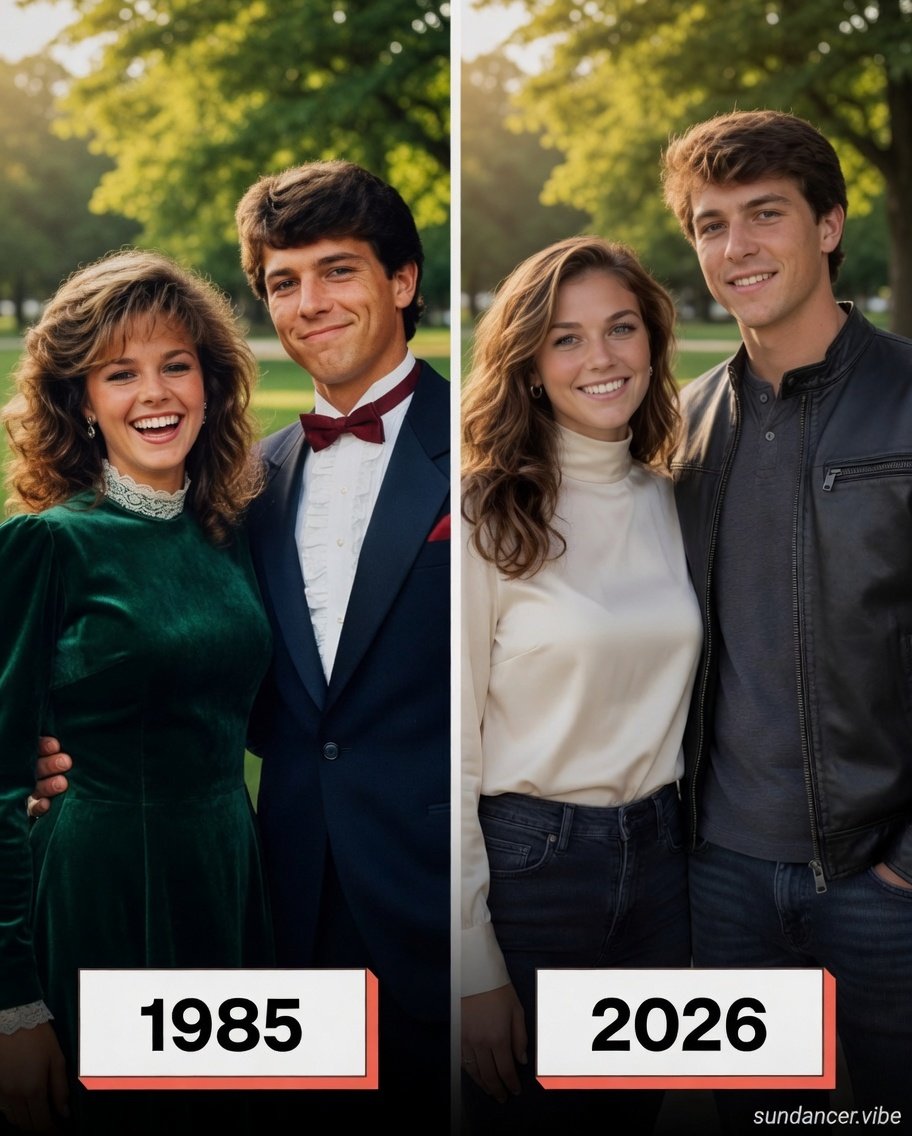
The first time I saw my daughter’s fiancé, the world didn’t just pause—it rewound. One second I was standing in my kitchen, holding a serving spoon over a pot of mashed potatoes, and the next I was seventeen again, staring at a boy under flickering gymnasium lights in 1985. The spoon slipped from my hand and clattered against the tile, but I barely heard it. All I could see was his face. Not similar. Not “reminds me of.” No—identical. The same sharp jawline, the same careful, observant eyes, the same way his mouth seemed caught between a smile and something unsaid. My daughter, Lila, stood beside him, glowing in that way people do when they are deeply, completely in love. “Mom?” she asked gently, her voice tugging me back into the present. “Are you okay?” I forced a laugh, bending to pick up the spoon. “I’m fine,” I said, though my hands trembled. “Dinner just got a little too excited to meet your guest.” But even as I said it, I couldn’t look away from him. Julian. That was his name. He stepped forward politely, offering flowers, but his eyes lingered on me—not in confusion, but in recognition. And that was when the first crack formed inside me, because recognition meant this wasn’t just coincidence. It meant something had followed me all these years and finally caught up.
I had lived a long life since 1985. Marriage. Loss. Motherhood. Survival. I had learned how to carry grief quietly, how to tuck it into corners of my mind so it wouldn’t spill into everyday moments. Leo had been part of that hidden grief. My first love. The boy who promised me forever and then vanished without a trace the night of prom. No goodbye, no explanation, no closure. Just absence. For years, I told myself stories to make it easier: that he got scared, that he changed his mind, that young love rarely survives reality. Eventually, I met Matthew—steady, kind, nothing like the wildfire Leo had been. Matthew gave me Lila, gave me a different kind of love, one built on patience instead of intensity. When he died, I told myself I had already survived losing someone once. I would survive again. But Leo had never really left me. Not completely. He lingered in unanswered questions, in the way I avoided certain songs, in the drawer where I kept a prom photo I couldn’t quite throw away. And now, somehow, he was standing in my kitchen—reborn in the face of the man my daughter wanted to marry.
Dinner should have been simple. Questions, laughter, getting to know each other. Instead, it felt like walking through a memory that refused to stay in the past. Julian was polite, thoughtful, careful with every word. Too careful. I noticed everything. The way he held his fork. The way he watched people before speaking. The way his eyes flickered toward me when he thought I wasn’t looking. Lila tried to keep the conversation light, telling stories about how they met, how he proposed near a lake at sunset, how he made her feel safe. I wanted to focus on her happiness. I really did. But every small detail pulled me backward. When he switched his fork to his left hand, my breath caught. Leo had been left-handed. When Julian mentioned he had grown up moving from town to town, something tightened in my chest. Leo had once talked about leaving, about starting over somewhere new. I told myself it was coincidence. It had to be. The world doesn’t circle back like that. People don’t reappear through their children. And yet, as the evening went on, denial became harder to hold onto.
The moment everything shifted came quietly. Julian reached up and loosened his collar, exhaling slightly. “Sorry,” he said. “It’s warm in here.” He shrugged off his jacket, rolling up his sleeves. I wasn’t prepared. I wasn’t ready for what I saw next. On his forearm, inked into his skin, was a small anchor wrapped in rope. Simple. Clean. Familiar. My fork slipped from my fingers and hit the plate with a sharp clang that echoed through the room. Lila jumped. “Mom!” she exclaimed, but I couldn’t look at her. I couldn’t look at anything except that tattoo. The anchor. The rope. And the letter woven into it—E. My initial. My chest tightened so fast it felt like the air had been pulled from the room. “Where did you get that?” I asked, my voice barely recognizable. Julian didn’t panic. He didn’t even look surprised. He just glanced down at his arm and then back at me, like he had been waiting for this moment. “My father had one just like it,” he said quietly. “I got it for him.” The room went silent. Lila looked between us, confusion turning into fear. “What’s going on?” she asked. But I already knew. Or at least, I knew enough to understand that the past I had buried wasn’t gone—it had been waiting.
What followed didn’t happen all at once. Truth rarely does. It comes in pieces, in fragments that don’t make sense until they suddenly do. Julian reached into his shirt and pulled out a chain. At the end of it was a silver locket. My locket. The one I had worn the night of prom. The one I had lost. I felt my knees weaken. “Where did you get that?” I whispered. Julian’s composure cracked just slightly. “I’ve been trying to find you,” he said. “For years.” Lila stared at him, her voice trembling. “Find her? Why?” He hesitated, then said the words that changed everything. “Because my father told me to.” My heart stopped. “Your father?” I repeated. He nodded. “Leo.” The name hung in the air like something alive. Lila stepped back, shaking her head. “No. That’s not… that doesn’t make sense.” I moved toward her quickly, taking her hands. “It’s okay,” I said, even though nothing felt okay. “Leo was someone I knew long before you were born.” But my voice shook, because I didn’t know what this meant yet. I didn’t know how deep it went.
Julian explained slowly, carefully, as if each word mattered. His father had died six months earlier. Before he passed, he gave Julian a letter and one instruction: find Emily. Find me. He had spent years searching, following fragments of information, trying to locate someone who had changed her name and her life. When he met Lila, it had been coincidence. Real, genuine coincidence. He hadn’t known who I was. Not at first. But then he saw the prom photo in a scrapbook. The one I never should have kept. The one that connected everything. “I recognized him immediately,” Julian said. “I recognized my father.” Lila’s voice broke. “You knew? For three months, you knew?” He nodded, shame written across his face. “I didn’t know how to tell you. I was afraid of losing you.” I closed my eyes. Fear. It always comes back to fear. “So you chose silence instead,” I said quietly. He didn’t argue. He just said, “Yes.” That honesty, at least, was something.
The letter from Leo was the final piece. My hands shook as I opened it, the paper worn, the handwriting achingly familiar. He hadn’t left me. He had come to my house after prom, just like he promised. My mother had met him at the door. She told him I had changed my mind, that I was embarrassed by him, that I didn’t want a future with someone like him. She gave him my locket as proof. I felt something inside me break open as I read. Years of quiet acceptance shattered in seconds. He had written to me. Dozens of letters. Maybe more. I never saw a single one. My mother had intercepted them. Controlled the story. Controlled me. By the time I finished reading, I wasn’t just grieving Leo—I was grieving the life we never had, the truth I was never given, the years stolen by someone who thought she knew better. I didn’t cry right away. I just sat there, holding the letter, feeling like the ground beneath me had shifted into something unfamiliar.
Confronting my mother the next day was inevitable. Necessary. She didn’t deny it. Not really. She framed it as protection, as guidance, as doing what was “best” for me. But it wasn’t protection. It was control. And for the first time in my life, I saw it clearly. Lila stood beside me, her hand gripping mine tightly. Julian stood a step behind, silent, carrying the weight of a truth that wasn’t his fault but had become his responsibility. When we left that house, something had changed. Not just in me, but in all of us. Lila postponed the wedding—not out of doubt, but out of clarity. Love wasn’t enough on its own. Not when it started with secrets. Not when the past demanded to be acknowledged before the future could begin.
Weeks later, we stood at Leo’s grave. The air was quiet, still. I placed the locket down gently, my fingers lingering on the cool metal. “I know now,” I whispered. It wasn’t closure. Not really. You don’t get closure for something like that. But it was truth. And sometimes, truth is the closest thing you get. When we walked away, Lila slipped her arm through mine. Julian followed beside us, not reaching for her hand this time, but close enough to show he hadn’t let go. Life doesn’t neatly resolve itself after revelations like these. It continues—messy, complicated, unfinished. But as we reached the car, I realized something I hadn’t expected. For the first time in decades, the past didn’t feel like a question anymore. It felt like an answer. And maybe, just maybe, that was enough to finally let me breathe.