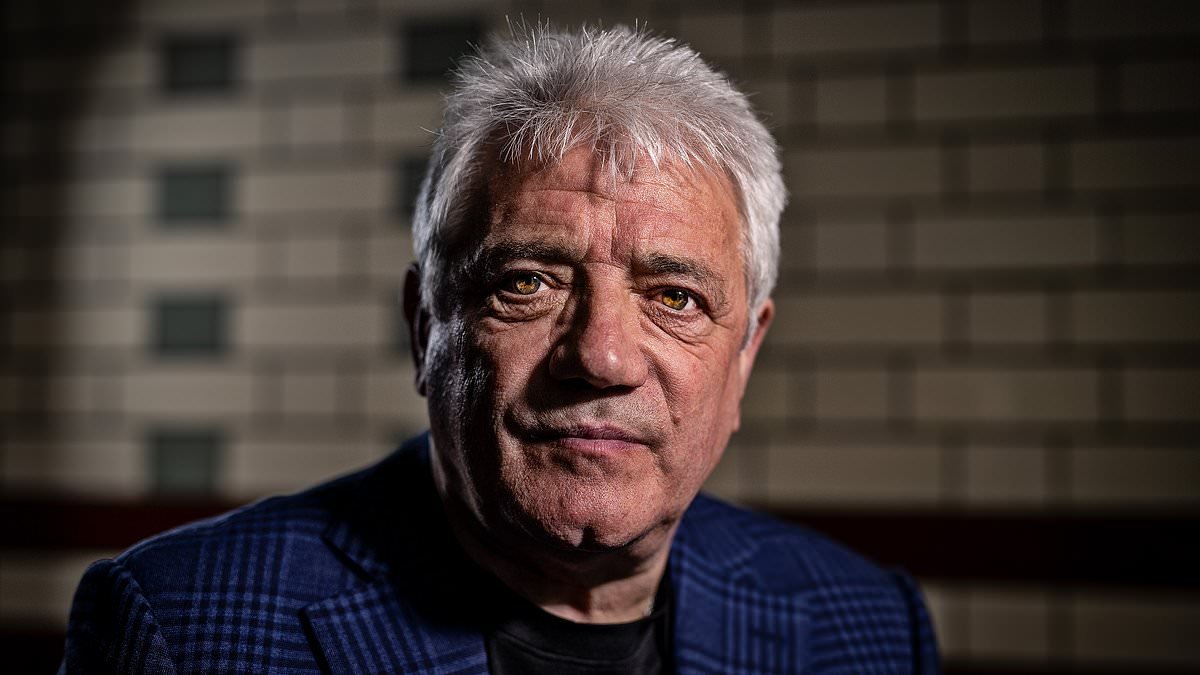
The doctor told Kevin Keegan he had a tremendous strike rate at tackling the cancer that, last Christmas, left him floored, confined to bed and his family tearful.
Here is Keegan, 75, entertaining on stage in Newcastle – more a congregation than an audience – speaking publicly for the first time about his cancer diagnosis. He softens his concerning news with humour and the lexicon of his goal scoring trade.
‘I said: “Fantastic! What is your strike rate?” He said: “33 per cent”. Oh. I thought he might say 80, maybe 90! Anyway, I am still here at the moment…’
Keegan, remarkably, is delivering a romp through his career with the aplomb of a stand-up comic. Jokes, old stories, that bike crash on Superstars, the Brut advert with Henry Cooper, the perms, road safety adverts, and sending himself up about the number of companies who sponsored him and then went bust.
Peter Beardsley arrives to surprise his old strike partner and manager. Even Sir Ian Botham, who also played for Scunthorpe United, is in the audience. Keegan is in such lively form it is hard to believe it is only five months since he began treatment for stomach cancer, discovered ‘luckily’ after a car accident after which he needed a body scan.
There is something special about the presence of Keegan in a room in Newcastle. It’s almost religious. Messianic. A football leadership version of Tony Blair selling a vision.
Kevin Keegan, right, cut an energetic figure in his first public appearance since his cancer diagnosis was made public
There is something special about the presence of Kevin Keegan. It’s almost religious. Messianic
Remember his head tennis duet with Tony Blair in 1995? ‘We got to 22, turns out he was really good at it,’ Keegan told the audience
Keegan, remarkably, is delivering a romp through his career with the aplomb of a stand-up comic
Remember their head tennis duet in 1995? ‘We got to 22, turns out he was really good at it,’ Keegan told the audience. He’s still inspirational, giving hope with his positivity. To Newcastle fans, especially, he’s the living embodiment of rebirth and reinvention of their club.
Not once, but twice. As a player, and manager. Saved the club from relegation to the third tier, promotions, Premier League runners up. Some 6,000 fans watched training every day because there was a public footpath through the pitches: ‘No need for Spygate in those days,’ he laughed. ‘Sir John Hall, the chairman, made the most of it and put in some burger vans!’
If he could change anything, he says, it would be not getting wound up by Sir Alex Ferguson. Love it.
Cancer? Facing mortality? Not Keegan, surely. But here he is explaining his own, traumatic few months.
People sometimes say to him: ‘Did you use to be Kevin Keegan?’ Study the grey-haired man on the stage being serenaded, and it’s still the Kevin Keegan. Darting, diminutive striker rejected for being too small as a kid. The electric smile, cheeky, funny and human. A people person. The words flowing so naturally, spreading warmth.
But there are words coming no one wants to hear: ‘They said we have a top doctor with this new way of fighting what you have got. Which is stage four cancer. He was a Liverpool supporter so I went to meet him. I knew I wouldn’t be walking alone, if you know what I mean.’
Keegan revealed in January that he was ill. In April, after a ‘really tough time’ he was feeling well enough to commit to this appearance at the Tyne Theatre, near the Gallowgate End that he used to salute.
This is a man who has achieved almost everything possible in football. England striker with 63 caps, 31 as skipper, scoring 21 goals and playing at the 1982 World Cup. A Liverpool legend with three league titles, an FA Cup win, a European Cup and two UEFA Cups. He won the Bundesliga with Hamburg, and the Ballon d’Or, one of only four Englishmen to do so.
This is a man who has achieved almost everything possible in football. A Liverpool legend with three league titles, an FA Cup win, a European Cup and two UEFA Cups
Keegan with the 1977 European Cup and a black eye after beating Borussia Monchengladbach in the final in Rome. It was Liverpool’s first of six times winning the competition
He won the Bundesliga with Hamburg, and the Ballon d’Or, one of only four Englishmen to do so
As a manager, there was the Newcastle revival and the Great Entertainers, just in time to be part of the Premier League’s burgeoning riches. He turned Manchester City’s fortunes managing 176 games, and his 18 months with England ended after defeat by Germany in the final game at Wembley in 2000.
Flawed at times? Yes, by his own admission. Too emotional when the chips were down? Maybe, but which fan would criticise a heart being worn on a sleeve.
His was a career rich in medals and played out at the top. Financial riches, yes, but nothing like the fortune that a middle of the road Premier League star would command these days. As the Harry Kane of his day, Keegan could have expected to retreat into his world of loyal family, wife Jean and two daughters.
But always an entrepreneur he finds the zest for life to entertain a few hundred die-hards a Sunday night in May. He’s not done yet.
Perhaps the wider footballing public outside of Newcastle and Liverpool, and new generations of fans, can appreciate his mercurial, historically significant career, the trophies, near misses and fragile moments. Sir Kevin?
Reminiscing, he is asked to wonder how a striker force of Keegan, Beardsley and Chris Waddle would fare these days?
A quip, again: ‘I’m not sure… probably struggle a bit. I’m not very fit at the moment.’
He doesn’t want a statue at St James’ Park, alongside Sir Bobby Robson’s and Alan Shearer’s. ‘You will have to wait until I die,’ he says. ‘My statue is the way people receive me.’
He doesn’t want a statue at St James’s Park, alongside Sir Bobby Robson’s and Alan Shearer’s
He will return to St James’ Park for the first time since an ill-fated spell as boss in 2008, next season, to wave to the crowd before kick off
However he will return to St James’ Park for the first time since an ill-fated spell as boss in 2008, next season, to wave to the crowd before kick-off, as long as Eddie Howe – who he backs fully – says it won’t be a distraction. That will raise the roof.
‘I want to say goodbye. I didn’t get the chance when I left the club last time…’ Keegan tells the audience.
He means goodbye from his second managerial stint, but it was poignant given the circumstances.
As Keegan continues his treatment, there could not have been any better therapy than a room full of mutual love and adulation.