I thought the hardest part of bringing my newborn home would be the pain, exhaustion, and panic of being a first-time mom. I was wrong. The real shock came when my husband looked at our daughter, then at his car, and made it clear which one mattered more to him.
I gave birth to my daughter on a Friday morning. By that evening, my husband left us outside the hospital because he didn’t want her in his car.
I was bundled in layers under sweatpants that pressed in all the wrong places. My baby was strapped into her infant carrier, one trembling hand hooked through the handle, while the diaper bag dug into my shoulder. Logan walked beside me, carrying nothing—not the diaper bag, not the discharge papers, not even the blanket the hospital had sent home.
When we reached the pickup lane, he stopped abruptly. At first, I thought he’d forgotten where he parked. Then he looked at the carrier and said, “I’m not putting the baby in my car.”
I stared at him. “What?” I thought he had to be joking.
He pointed through the back window. “The seats.”
“Logan, open the door.”
He did, but stood there gazing at the back seat like it was a museum exhibit. “My leather is brand new. If she spits up in there, that smell is never coming out.”
I laughed once—out of disbelief, not humor. “I just gave birth.”
He shrugged. “That doesn’t change the seats.”
The irony was that he had that car because of me. After my dad died, I sold his lake house. Part of the money went into savings, part to bills, and part to Logan—after months of him insisting we needed a reliable luxury car before the baby arrived. He spent more time researching leather cleaner than helping me build the crib.
Still, I asked slowly, “You want me to do what, exactly?”
“Call a cab.”
I couldn’t believe it. “You want me to take our newborn home in a taxi because you’re worried about the car?”
He crossed his arms. “My seats cost more than your whole wardrobe. I’m not wrecking them on day one.”
I said, “I can barely walk.”
He got in, slammed the door, and drove away.

I stood there in shock—bleeding into a hospital pad, holding our daughter—watching my husband disappear because he cared more about upholstery than his wife and child.
A nurse came out, took one look at me, and asked gently, “Honey, where is your transportation?” That broke me. I cried so hard I could barely answer. She brought me back inside, sat me down, and asked if she could call someone—my mother, a friend, a social worker. I shook my head, humiliated and exhausted. All I wanted was to go home.
She stayed anyway. She called a taxi, helped me carry the diaper bag, secured the infant seat in the back, and checked the straps twice because my hands were shaking too badly. The driver asked, “You okay, ma’am?” I whispered, “No,” and cried again.
The ride felt endless. Every bump hurt. My daughter cried halfway through, and I leaned as far as I could to touch her tiny hand. I thought, This is her first ride home, and this is what it is.
When we finally pulled into the driveway, Logan’s grandmother saw me from the porch. She lived in the downstairs suite of the house she still technically owned. Logan and I paid part of the bills, but it was her house. Her rules.
She rushed down the steps, looked at my face, the baby carrier, and the empty driveway. “Where’s Logan?”
I tried to smile. “It’s fine.”
She narrowed her eyes. “Try again.”
And I broke. I told her everything—Logan refusing to let the baby in the car, telling me to call a cab, driving off, the nurse helping me, the taxi ride. She listened silently, then said, “Don’t apologize for his failure.”
Later, Logan walked in smiling, twirling his keys. His grandmother stepped out holding a cardboard box. Logan froze. “What’s that?”
“A lesson,” she said, setting the box on the coffee table. Inside were the title paperwork, financing agreement, and bill of sale for his car. Logan went pale. “Oh no. Grandma, don’t.”
She ignored him and looked at me. “This is the part where your husband learns that the car he worships does not legally belong to him.”
Logan snapped, “It was going to be transferred.”
She explained: he couldn’t qualify for financing on his own, didn’t have enough for registration, insurance, and taxes. She co-signed, covered the shortfall, and kept the title in her name until he proved he could act like a grown man.
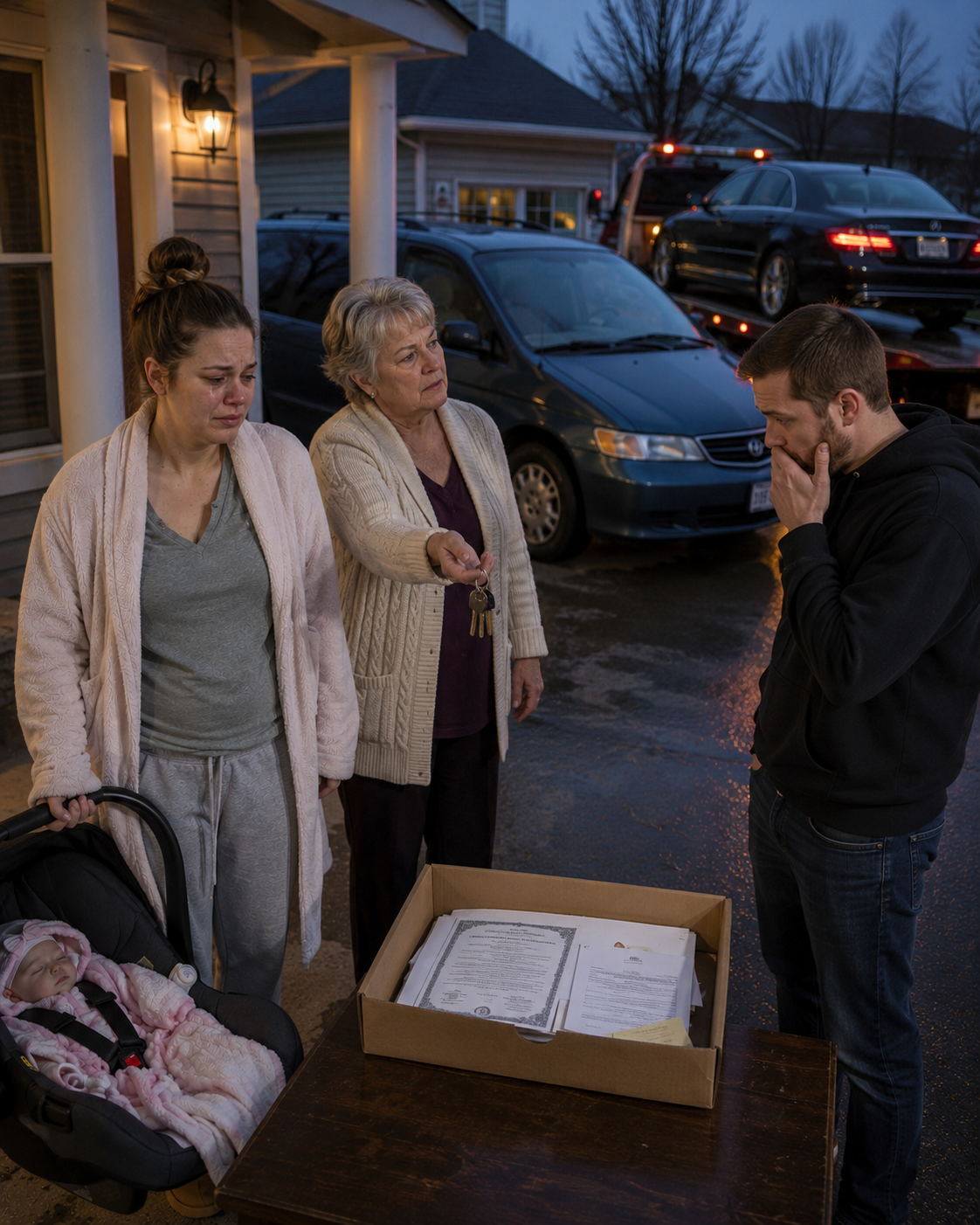
Then she pulled out another set of keys—old, scratched ones. “Look outside.” Parked behind Logan’s car was his grandfather’s faded blue minivan, dented, with cloth seats and a stubborn sliding door. At that moment, a flatbed truck pulled up to take Logan’s car away.
Logan panicked. “You sold my car while I was in the house?”
“Yes,” she said calmly.
“You can’t do that.”
“I already did.”
She explained that the money I had put into the car from my father’s inheritance was being returned to me. Logan sputtered, “This is insane. Over one mistake?”
I stood up, despite the pain. “One mistake? You stranded me less than twelve hours after I gave birth. You stranded your daughter too. Because you were worried she might spit up on leather. Don’t call that one mistake like you forgot milk on the way home.”
His grandmother handed him the van keys. “Here are your options. You want to keep living in this house, you drive the van. You take the baby to every appointment. You install the car seat. You clean the messes. You deal with spit-up and crumbs and stains. You learn responsibility. And if you don’t? Pack your things and go be precious somewhere else.”
Logan took the keys. He looked at me, scared now, because he realized this wasn’t about the car—it was about who he had shown himself to be when I needed him most.
Later that night, he asked quietly, “Can I hold her?” I handed her over, because she deserved to be held. But inside, I knew the truth: the worst part wasn’t that he chose the car. It was that he believed he could choose the car and still come home to us like nothing had happened.
His grandmother gave him a punishment. Life gave me a lesson: when someone shows you what they love most, believe them. He thought he was protecting a car. What he really did was show me the exact cost of staying with him.
Note: This story is a work of fiction inspired by real events. Names, characters, and details have been altered. Any resemblance is coincidental. The author and publisher disclaim accuracy, liability, and responsibility for interpretations or reliance. All images are for illustration purposes only.