The current Ebola outbreak is spreading faster than it can be contained, the World Health Organisation’s chief has warned, fuelling fears of a deepening global health crisis.
There have been more than 1,000 cases and 220 deaths from the deadly virus in the Democratic Republic of Congo (DRC) in Central Africa in recent weeks.
It was thought Europe had also been hit by the virus when two suspected cases involving humanitarian aid workers – a man and a woman who had recently returned from Uganda – were identified in northern Italy. However, both later tested negative.
Still, fears remain that the virus could spread further, with airports in the US increasing screenings for potentially infected passengers after an American doctor tested positive for Ebola earlier this month following a period of working in the region.
Scientists from the University of Oxford are racing to create a vaccine for the current strain of the virus, named Bundibugyo, which kills up to 50 per cent of those infected.
But the WHO’s director-general Dr Tedros Adhanom Ghebreyesus has warned that the response is not keeping pace with the speed of the outbreak.
Addressing the African Union to discuss the spread, he said: ‘We are urgently scaling up operations, but at the moment the epidemic is outpacing us.’
The present epidemic is one of the fastest spreading since the 2014 outbreak which was linked to more than 28,000 cases and 11,000 deaths across West Africa. It has already been declared a global public health emergency.
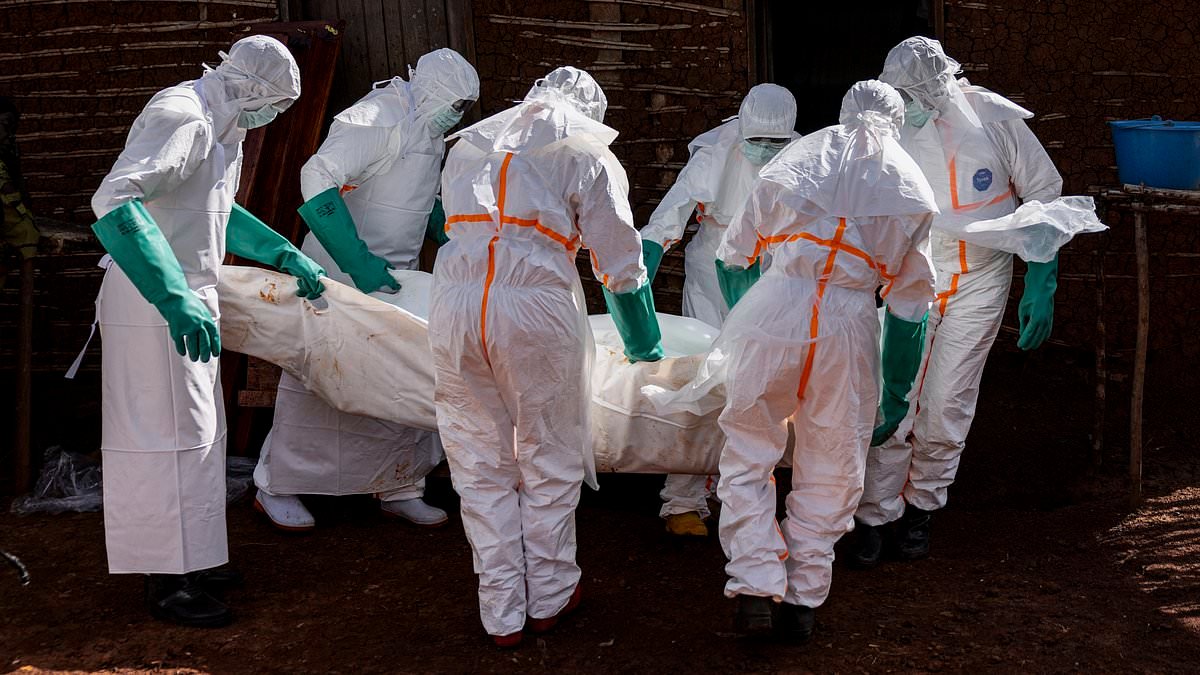
Health workers wearing protective equipment carry the body of a suspected Ebola victim on May 24 in Mongbwalu, Ituri Province, Democratic Republic of Congo
Red Cross workers prepare to carry a coffin with the body of an Ebola victim on May 26 at the Nyamurongo cemetery in Bunia town, Ituri province, Democratic Republic of Congo
Among the 220 people killed in the latest outbreak are three Red Cross volunteers, who are believed to have contracted the virus while handling infected bodies.
Mongbwalu General Referral Hospital in the DRC has also come under attack from people wanting to bury the bodies of friends and family members who have died from Ebola, according to the hospital’s medical director, Dr Richard Lokodu.
However, burials are highly contagious and will be handled by medical teams in the area.
Some factions in the region are rebelling in the belief that Ebola is a hoax, and confronting Red Cross volunteers.
Meanwhile others in local communities have taken to villages with megaphones to encourage residents to follow official health guidance.
All flights to and from Bunia – the eastern DRC city where most cases and deaths have occurred – have been grounded, but experts believe the virus may have already spread to other nearby nations, such as South Sudan.
Dr Ghebreyesus warned other nations that they need to take immediate action to prevent further spread in his recent address to the African Union.
In previous Ebola outbreaks, the virus has killed more than half of those infected, many of whom died due to internal bleeding and organ failure.
A local raises awareness of Ebola in the camp where internally displaced people reside in Bunia, Congo on May 26
Health workers are sprayed down with disinfectant on May 24 in Mongbwalu, Ituri Province, Democratic Republic of Congo
Experts are now warning that, because there is no vaccine to protect against the current variant driving the outbreak, it will almost certainly continue to spread and kill.
Oxford University scientists have warned that the vaccine they are creating will take two-to-three months before it can be tested on humans, meaning it is unlikely patients in Africa will get the drug within the next six months.
A successful vaccine would likely protect patients from severe illness and death as well as limit the spread of the virus, but there is no guarantee it will be effective.
Symptoms for the Bundibugyo strain remain the same across all Ebola variants, starting with a flu-like fever, headache, muscle pain, vomiting and diarrhoea before progressing to internal bleeding, organ failure and, in many cases, death.
Patients can carry the virus for up to 21 days before symptoms begin, which is when experts believe they become infectious.
In the case of the Italian workers who developed symptoms, the woman, from Lurate Caccivio, had a very high fever and mild neurological issues.
Meanwhile the man, from Bulgarograsso, displayed milder symptoms of a temperature of around 38C and gastrointestinal problems.
The American who contracted the virus, Dr Peter Stafford, was transported to Germany for treatment.
Health workers carry out hand sanitising, handwashing and temperature screening for people at the Kanyaruchinya checkpoint near Goma Democratic Republic of the Congo, on May 25
Workers from the Uganda Red Cross Society don protective suits as they prepare to evacuate the body of a suspected Ebola victim in Kampala on May 26
The UK has announced up to £20million to help contain the outbreak of Ebola in the eastern region of the DRC.
British health officials have also activated a Returning Workers Scheme – where healthcare workers returning from Ebola outbreak regions are monitored for signs of the disease once back in the UK.
However, experts have warned that the UK is unprepared for the Ebola outbreak, and argue that the population may be at risk.
Dr Derek Sloan, an expert in infectious diseases at St Andrew’s University, said the recent outbreak shows we must remain ‘vigilant’ and ‘preserve funding’.
‘This outbreak, along with the recent Hantavirus cases on a cruise ship and meningitis infections in the UK shows how important it is that we stay vigilant and use effective public health tools to protect our populations,’ Dr Sloan, also a spokesman for UK-Med and Healthy World, Secure Britain, said.
‘Infectious disease outbreaks such as these in our interconnected world cannot be dismissed as someone else’s problem.
‘These examples show how important it is to maintain this expertise and underline the need to preserve funding for global health and international aid.’