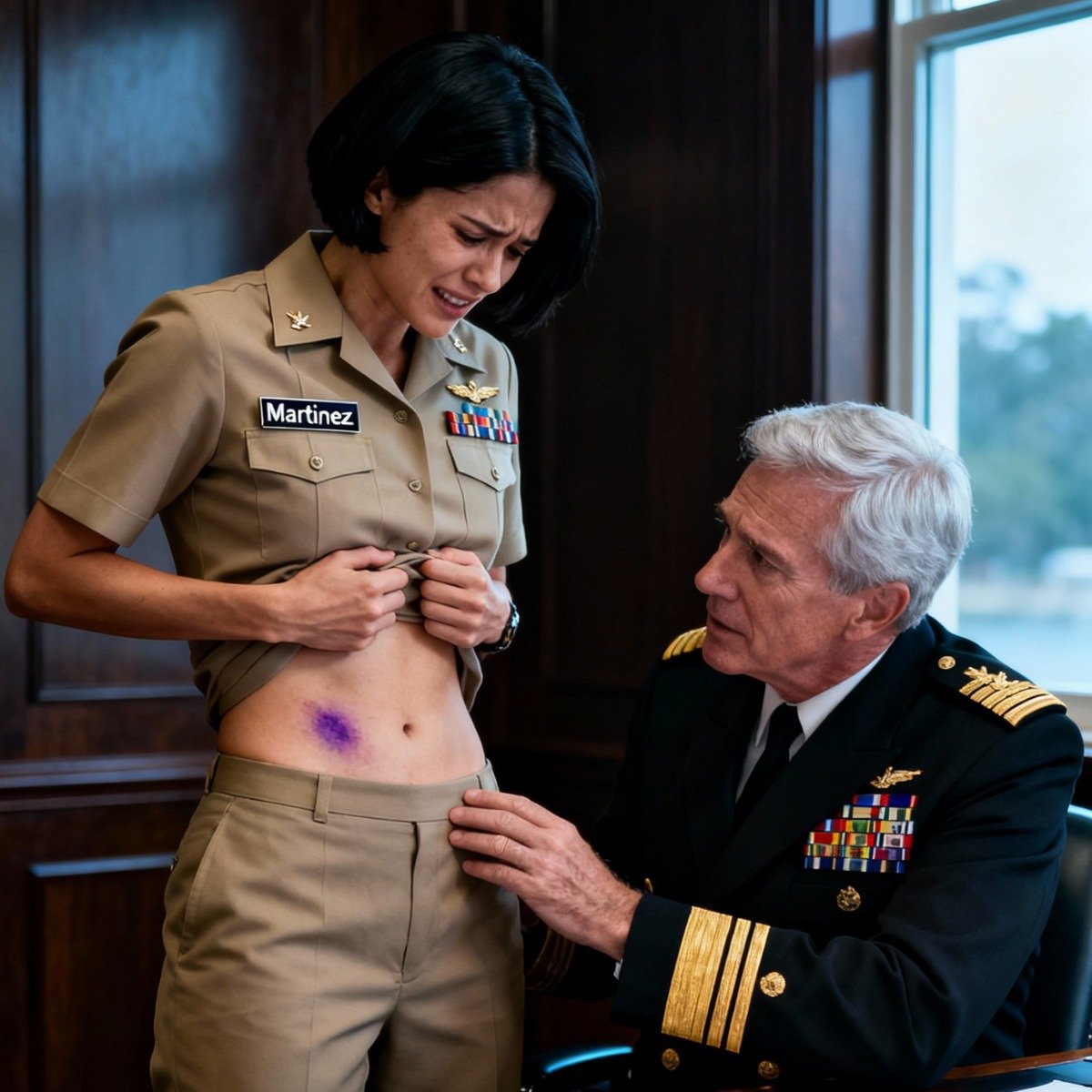
Silence in the admiral’s office was a tangible thing, thick enough to feel. On one side of the vast desk, Admiral Hayes represented the unwavering spine of the Navy. On the other, Lieutenant Elena Cruz stood at attention, her flawless uniform belying the storm within. Hayes had summoned her to discuss her future—a prestigious, perilous assignment from a shadowy branch of intelligence. Her record was exceptional, a narrative of courage and capability. But as he finished outlining the opportunity, Cruz did something extraordinary. She declined to answer. Instead, she stated that a prior, unrecorded chapter of her service had to be understood first.
The admiral expected a report of enemy action, a tale of survival against external threats. What he received was a confession of betrayal from within. Cruz’s voice remained controlled, a stark contrast to the horror of her words. She spoke of being apprehended by her own side after a mission, of a black-site facility, and of a chilling new duty: to serve as a test subject. The program’s objective was to forge the ultimate operative, one whose breaking point was so thoroughly explored that it could never be reached by an adversary. Patriotism, she was told, required this sacrifice.
Then, in an act that dismantled the formal distance between them, she revealed the physical proof. The scars she showed were not the clean lines of battlefield surgery. They were a chaotic map of inflicted suffering, wounds layered upon wounds. They told a story of calculated brutality, of ribs deliberately stressed, of tissue damaged and healed only to be damaged again. Each mark was data point in a clandestine experiment, a metric in a classified file far removed from her official service record. She had been broken, not to save her life, but to prove she was unbreakable.
Admiral Hayes felt the room contract. The classified folder before him, which moments ago represented trust and due process, now felt like an accomplice to the crime. The proposed assignment was not a step forward; it was a loop back into the darkness. The “they” Cruz referred to were not a foreign intelligence service, but a covert cell within the vast apparatus he was part of. His duty was suddenly split. One path led to following orders, promoting a valued officer, and ignoring the scars. The other path led to confronting a profound moral rot at the heart of the institution he loved. The lieutenant’s silence now awaited his judgment. Would he be a commander, or would he become another part of the “they”?