WHAT HE LEFT BEHIND
My name is Martha, and for the last two years, I’ve been learning how to live with less.
Not because I suddenly discovered minimalism or decided that a simpler life was somehow more meaningful.
I learned because I had no other choice.
By the time my divorce was finalized, I understood that the life I had spent more than twenty years building rested on financial decisions I had barely understood.
I had trusted my husband, Daniel, to handle the money.
The accounts.
The mortgage.
The paperwork.
I handled Lily, our daughter, the house, the schedules, school activities, appointments, meals, and all the invisible pieces that kept a family functioning.
For twenty-one years, that division of responsibility had seemed reasonable.
Until it wasn’t.
When the marriage ended, I discovered that trust and protection were not the same thing.
Daniel had prepared for the divorce long before I even realized our marriage was ending.
He had the better attorney.
He understood where the money was.
He knew which documents mattered.
I did not.
By the time everything was settled, my eight-year-old daughter and I had about eight hundred dollars, a car with two years remaining on the loan, and nowhere permanent to live.
Daniel kept the house.
Continuing the legal fight would have cost more than I could afford, and my attorney finally told me something I already suspected.
Even if I kept fighting, I might spend more than I could ever recover.
So I stopped.
Not because it felt fair.
Because sometimes survival requires knowing when fairness has become too expensive.
I found a small duplex in late October.
The landlord, Grace, was a practical woman who had owned the property for years. Instead of looking only at my credit score, she listened when I explained what had happened.
I told her I had recently divorced.
I told her most of our financial history had been under Daniel’s name.
I told her I worked in the administrative office of the local school district and that, as long as nothing unexpected happened, my income was enough to cover the rent.
Grace rented the duplex to me.
I have never forgotten that kindness.
The place wasn’t large.
Two bedrooms.
One bathroom.
A narrow kitchen.
A modest living room.
And a covered porch stretching across the front.
That porch became my favorite part.
On warm Friday evenings, Lily and I would carry our dinner outside and sit together watching cars pass beneath the old elm trees lining the street.
Our new life was smaller.
But it belonged to us.
There was something unexpectedly peaceful about that.
Two years passed.
Lily was ten now.
She had adjusted better than I feared she would.
She had friends at school, a teacher she adored, and a bedroom she had decorated in several carefully selected shades of purple.
She rarely asked about Daniel.
When she did, I gave her the truth a ten-year-old could carry.
Her father loved her.
Adults sometimes made decisions that hurt people.
And somehow, our new life would still become a good one.
I hoped that last part was true.
One Thursday evening near the end of summer, a storm rolled into town.
It had been unbearably humid all afternoon.
By dinner, the sky had turned that strange yellow-green color that warns you something serious is coming.
The wind rose.
Tree branches twisted.
Then the rain began.
Lily was spending the weekend with Daniel, so the duplex felt unusually empty.
I was going from room to room closing windows when I noticed someone across the street.
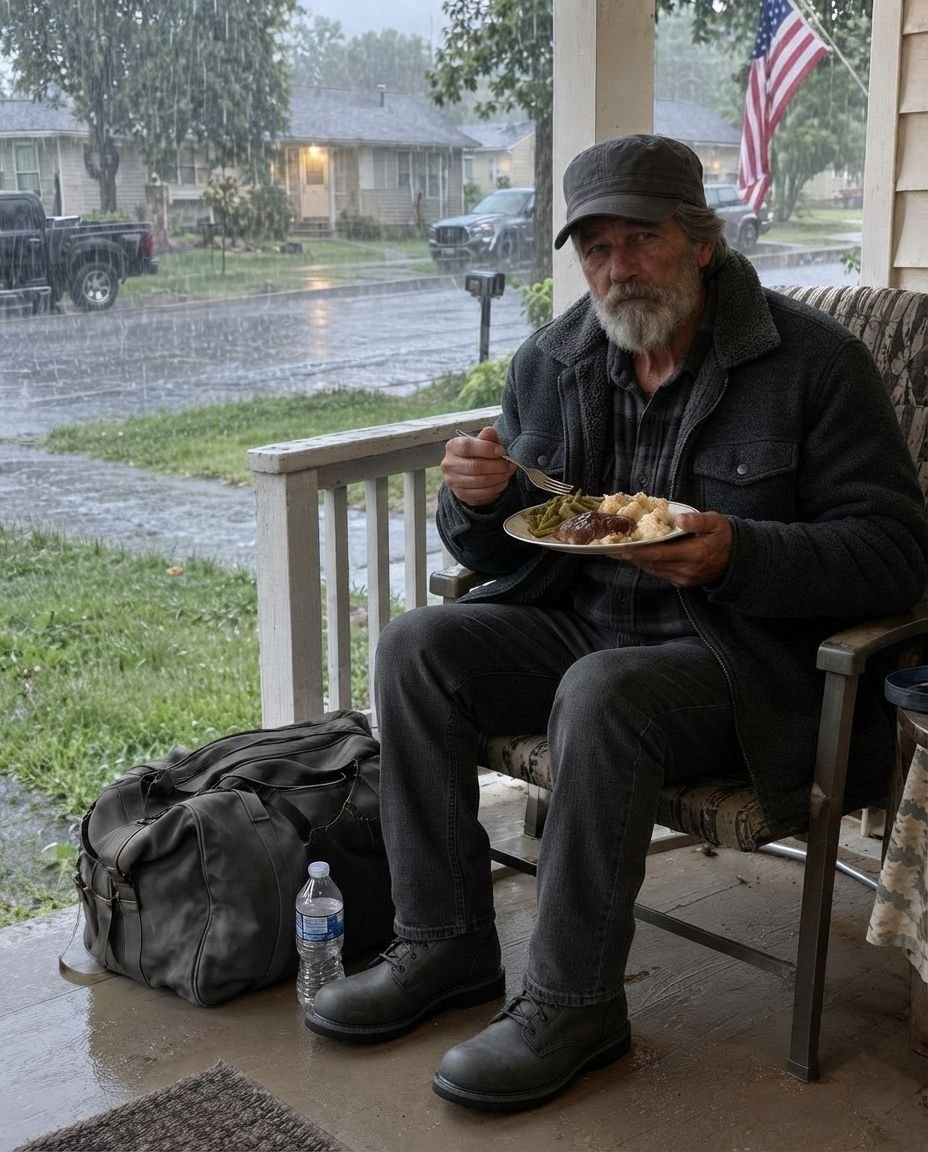
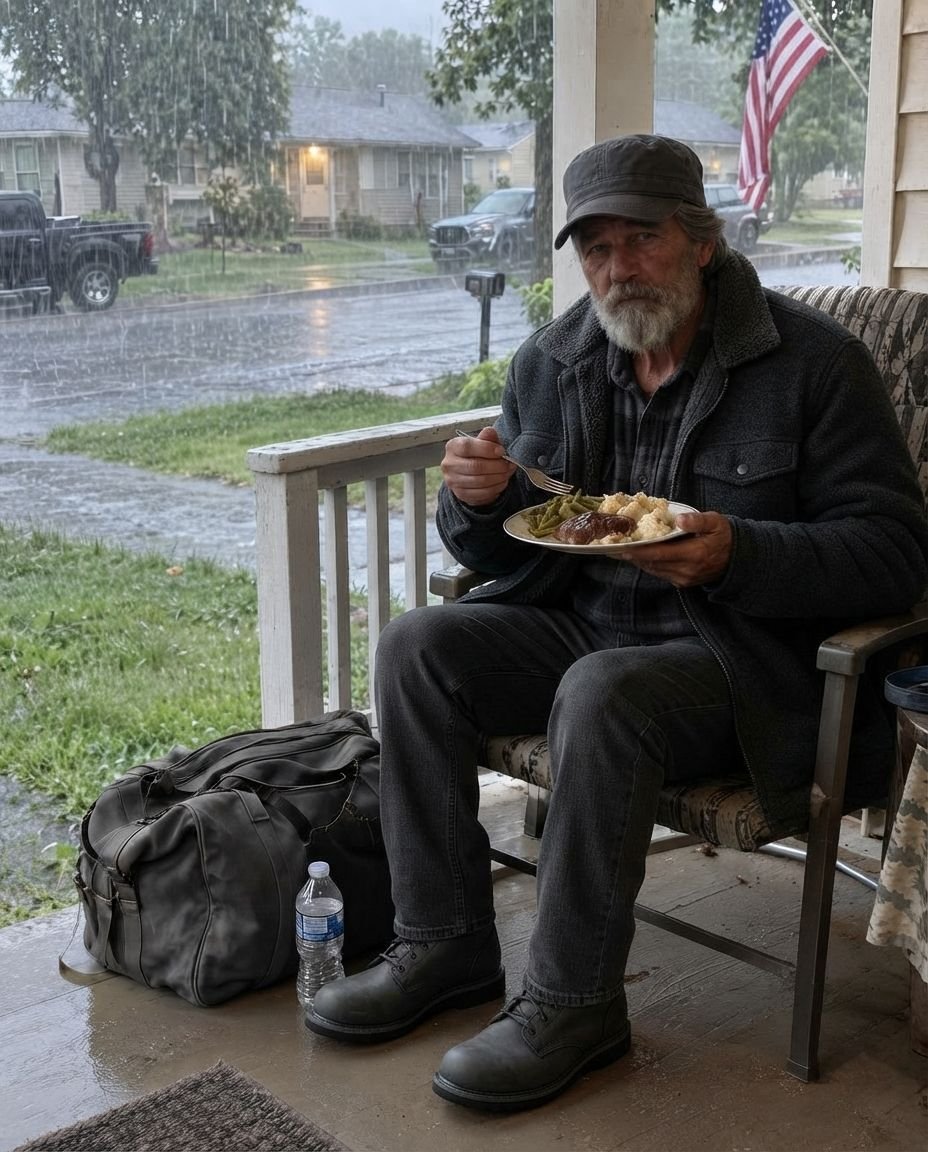
An elderly man stood beneath one of the elm trees.
Even from my window, I could tell he was probably in his seventies.
His shoulders were slightly bent, and he stood with the careful stillness of someone trying not to be noticed.
He was completely soaked.
The rain had already been falling hard for nearly twenty minutes.
He held an old backpack tightly against his chest.
Something about the way he protected that backpack told me it contained nearly everything important to him.
I opened the front door.
“Sir?”
He looked up.
For a moment, he seemed uncertain whether I was actually speaking to him.
“You can come inside,” I called. “I have a couch.”
He shook his head.
I offered again.
He refused again.
He wasn’t rude.
Quite the opposite.
There was something painfully polite about him, as though years of difficulty had taught him to apologize simply for existing in someone else’s space.
Then he looked toward my porch.
“Would you mind if I stayed there until the rain lets up?”
The porch was covered.
At least he would be dry.
“Of course.”
I brought him two cushions, a towel, and the warmest blanket I owned.
It was a quilt my mother had made years earlier, one of the few things from my old life that had unquestionably belonged to me after the divorce.
Then I went back inside and warmed some chicken soup I had cooked that afternoon.
Cooking had become one of the things I did when loneliness felt too loud.
When I carried the bowl outside, he stared at it for several seconds before accepting it.
Then he looked at me.
“You’ve probably got enough problems without taking care of an old man.”
He wasn’t wrong.
Rent was due soon.
The car payment was coming.
Lily needed school clothes.
Rumors about budget cuts had started circulating at work, and I had no idea whether my position was secure.
Still, I smiled.
“Tonight,” I said, “I have enough for both of us.”
And I meant it.
Later, I went inside.
I read for a while before bed while rain drummed against the porch roof.
I kept thinking about the stranger outside.
A bowl of soup.
A dry porch.
A blanket.
None of it was much.
But it was something I could give.
That night, strangely enough, I slept better than I had in weeks.
The next morning, I made coffee and poured an extra cup.
I opened the front door expecting to find him sitting outside.
The porch was empty.
My mother’s quilt rested neatly folded on the doormat.
Not casually folded.
Precisely folded.
The corners were carefully aligned.
The fabric had been smoothed flat.
I bent down to pick it up.
That was when I noticed an envelope beneath the mat.
On the front, someone had written one word.
Martha.
Inside was a single sheet of paper.
Wrapped inside that paper was an old brass key.
A small cardboard tag was tied to it with twine.
There was an address written on the tag.
A town about forty minutes away.
Underneath it were five words.
**Small box. Bottom shelf.**
I sat down on the porch steps and unfolded the letter.
The man’s name was Albert.
He explained that he had spent the previous eight months moving between shelters, porches, and places outdoors after his daughter-in-law changed the locks on the house where he had been staying.
His son had not stopped her.
Albert wrote that he wasn’t telling me because he wanted sympathy.
He simply wanted me to understand that he had not always been a man carrying his life inside an old backpack.
For forty years, he had owned a small hardware store.
Nothing glamorous.
Just the kind of neighborhood store where customers were known by name and broken things were repaired whenever possible.
Then his wife, Estelle, became ill.
Albert sold the business to help cover expenses that insurance would not.
He wrote that he had never regretted it.
They had been married forty-three years.
Estelle died two years earlier.
His relationship with his son had become complicated afterward.
His daughter-in-law never particularly liked him.
Eventually, she changed the locks.
Albert chose not to fight because he did not want to force his son to choose between his father and his wife.
His son never asked him to come back.
So Albert kept moving.
Then he explained the key.
Before Estelle died, they rented a storage unit.
Albert continued paying for it afterward because he could never bring himself to sort through the things inside.
Even while sleeping in shelters and outdoors, he continued paying that monthly bill.
He simply wasn’t ready to let Estelle’s belongings go.
But while sitting beneath my porch listening to the storm, something changed.
He became ready.
There was nothing in the storage unit he believed he needed anymore.
But there was something he thought I might need.
A leather notebook.
Estelle had kept it for decades.
She called it her recipe book, although according to Albert, recipes were only part of what she had written inside.
The notebook contained everything she knew about surviving difficult times.
How to stretch money.
How to cook when the pantry was nearly empty.
How to keep going when everything felt uncertain.
How to make something useful from almost nothing.
Albert wrote that if I had a daughter, maybe she would want the notebook someday too.
The storage unit was already paid through the end of the year.
Everything inside could be kept, donated, discarded, or given away.
Then came the line that stopped me.
He wrote that I had shown him kindness without knowing anything about him.
And kindness offered without knowing whether someone can repay it, he believed, was the purest kind.
He ended the letter with five words.
**I hope your worries get smaller.**
Albert.
I sat on the porch for a long time.
The storm had passed.
Sunlight clung to drops of water on the elm leaves.
Neighbors walked dogs.
Cars drove past.
Everything looked completely ordinary.
Yet I was holding a key left behind by a seventy-four-year-old man who had spent eight months carrying his life in a backpack.
That morning, I drove to the address.
The town was small, the sort of place modern highways had largely passed by.
The storage facility stood near the edge of town behind a chain-link fence.
Rows of orange doors stretched across the property.
I found Albert’s unit.
The key fit perfectly.
When I rolled open the door, morning sunlight spilled into a space about eight feet by ten feet.
There wasn’t treasure inside.
There were wooden chairs.
Boxes of books.
Old kitchen items.
A sewing machine inside a wooden case.
Household objects from a life that had once occupied more space.
Then I saw several boxes labeled in handwriting different from Albert’s.
Smaller.
Faster.
More compact.
I knew immediately.
Estelle.
On the bottom shelf sat a small wooden box.
I opened it.
Inside was the notebook.
Burgundy leather.
Soft from years of use.
Thick with handwritten pages.
I opened the cover.
The first page read:
*If you are reading this, I hope you needed it.*
Estelle explained that writing things down had always seemed more useful for other people than for herself because she had already learned those lessons.
Someone else might still be learning them.
Then she added an invitation.
Write in the margins.
The book becomes better when more voices are added.
I sat in one of the wooden chairs and began reading.
Albert had been right.
There were recipes.
Chicken soup.
Bread.
Stews.
Meals designed to turn inexpensive ingredients into enough food for a family.
Her instructions weren’t precise in the modern cookbook sense.
A handful.
Cook until it smells right.
Stop when you know it’s done.
One note beside a soup recipe made me smile.
Soup, Estelle had written, is what you make when you have almost nothing, because soup never pretends to be anything other than what it is.
But the notebook contained much more than food.
There were pages about money.
Not motivational slogans.
Not cheerful advice about abundance.
Practical knowledge.
What to do when rent was short.
How to choose between two necessary expenses when you could afford only one.
How to explain financial difficulty to children without making them responsible for adult fear.
How to continue when you genuinely did not know what came next.
One sentence said:
**When you don’t know how to keep going, keep going anyway. The movement teaches you what comes next.**
Another said:
**What belongs to you belongs to you because of the work you invested in it, not because someone gave you permission to keep it. Someone may take the object, but they cannot take the work. And with the work, you can build again.**
I read that sentence three times.
I thought about Daniel.
The house.
The eight hundred dollars.
The suitcases.
Driving away with Lily asleep in the backseat.
The two years since.
I thought about rent.
School clothes.
My uncertain job.
Then I thought about the soup I had cooked the afternoon before.
Something I made because I didn’t know what else to do with my loneliness.
Maybe that was what Estelle meant.
Making something from almost nothing.
I took the notebook home.
For several days, I wondered whether I should search for Albert.
I knew only his first name.
I contacted the shelter in town and described him.
The woman at the desk explained that she couldn’t disclose information about current or former residents.
I understood.
But she agreed to pass along a message if he appeared.
My message was simple.
**The soup was the best thing I’d made in a long time too. Thank you for Estelle’s book.**
I didn’t know if Albert would ever hear it.
Lily returned from Daniel’s house on Sunday.
That evening, we ate soup together.
After dinner, I showed her Estelle’s notebook.
I told her everything.
The storm.
Albert.
The porch.
The folded quilt.
The envelope.
The key.
The storage unit.
She listened without interrupting.
When I finished, Lily looked at the notebook.
“She wrote everything down?”
“Everything she thought mattered.”
“So it wouldn’t disappear?”
“Yes.”
She carefully read Estelle’s introduction.
Then she looked at me.
“She says to write in the margins.”
“I know.”
“Are we going to?”
I smiled.
“Eventually. First, I think we should listen to her.”
Lily nodded.
Then her expression changed.
“Do you think Albert is okay?”
“I hope so.”
She thought about him for several seconds.
“He kept paying for the storage unit even though he didn’t have a house.”
“Yes.”
“Because he couldn’t let her things go.”
“Not yet.”
“But then he could.”
“Yes.”
Lily looked at the notebook again.
Then she said something that surprised me.
“We should do something.”
“What kind of something?”
“Something good. Because Albert did something good for us. Then we do something good for somebody else. Like a chain.”
“What do you have in mind?”
“The shelter.”
I waited.
“We could make soup,” she said. “We’re good at soup.”
The next morning, we called.
A woman named Ruth managed food donations.
She explained exactly what they needed and how much they could accept.
What mattered most, she told me, was consistency.
One large donation was nice.
Someone reliably returning was better.
So that Thursday, Lily and I pulled out the largest pot I owned.
We followed Estelle’s chicken soup recipe.
A handful of this.
A little of that.
Cook until it smells right.
Lily decided when it smelled right.
Friday morning, we delivered it before school.
Ruth met us behind the shelter.
She inspected the pot.
“Good amount,” she said.
Then she looked at Lily.
“You can come back anytime.”
Lily smiled.
“We will.”
On the drive to school, she stared out the window quietly.
Then she said,
“Mom?”
“Yes?”
“Albert didn’t have to give us anything.”
“No.”
“He could’ve eaten the soup, slept on the porch, and left.”
“He could have.”
“Then why didn’t he?”
I considered the question.
“I think he’d been carrying something for a long time and finally became ready to put it down. And maybe the person he wanted to give it to appeared at the right moment.”
“The storm brought him to our porch.”
“Maybe.”
“And you made soup because you didn’t know what else to do.”
“Yes.”
She frowned thoughtfully.
“That’s a lot of things that had to happen.”
“It is.”
After another moment, she smiled.
“I think Estelle would like that we made soup.”
When we returned home that afternoon, the notebook was lying open on the kitchen table.
A bread recipe.
I picked up a pen.
For the first time, I wrote in one of Estelle’s margins.
**A ten-year-old made this and knew exactly when it smelled right. Estelle was correct. Somehow, you know.**
Then beneath that, I added:
**A man named Albert gave us this book. We’re trying to deserve it.**
Nothing about my practical situation had magically changed.
Rent was still approaching.
School clothes still needed to be purchased.
My job was still uncertain.
But something inside the landscape had shifted.
I had Estelle’s notebook.
I had Lily standing beside a pot deciding when soup smelled right.
I had Ruth opening the shelter’s kitchen door.
I had a storage unit paid through December filled with things I could decide how to use.
And somewhere, I hoped, Albert had found another dry porch.
Maybe even another bowl of soup.
For the first time in a long while, I realized I didn’t have nothing.
I had thought I was barely holding on.
But barely holding on is still holding on.
And sometimes the word *barely* contains more strength than we realize.
Six weeks later, my phone rang while I was working.
It was Ruth.
She told me a man named Albert had arrived at the shelter the week before.
He had asked whether anyone had left a message for him.
Ruth gave him mine.
Albert asked for a pen.
Then he wrote something for her to pass back to me.
Ruth read it over the phone.
He said he was happy we enjoyed the soup.
He hoped Estelle’s notebook was useful.
According to him, Estelle had always believed that every recipe was simply the beginning of a conversation.
Then came the part that mattered most.
Albert was staying at the shelter for a while.
They had beds.
There was honest work available.
And he was helping in the kitchen.
Ruth apparently believed he made excellent stock.
At the end of the note, he repeated:
**I hope your worries have gotten smaller.**
I didn’t cry.
I had cried when I found his first letter.
I had cried while sitting inside the storage unit reading Estelle’s notebook.
But this time, I simply stood in the hallway outside my office feeling something settle into place.
Albert was making stock.
He had a kitchen.
He had somewhere to be.
I texted Lily during her lunch break.
**Albert is at the shelter. He’s helping in the kitchen.**
Her answer arrived almost immediately.
**I TOLD YOU HE WOULD BE OKAY.**
Then came three soup emojis.
Our attempts at Estelle’s bread required more patience.
The first loaf was too dense.
Estelle had anticipated this possibility.
One handwritten note warned:
*If the bread doesn’t rise, blame either the yeast or your patience.*
The yeast was new.
So apparently, our patience was the problem.
The second loaf improved.
The third loaf came out golden brown.
Lily stared at it through the oven door.
“That’s the color,” she announced.
We ate it warm with butter.
I added another note to the notebook.
**Third attempt. Lily was right about the color. This is the bread.**
In September, I returned to the storage unit with my friend Diane and a rented truck.
We gave the wooden table and chairs to a family moving into their first apartment.
They fit perfectly in the small kitchen.
I kept the sewing machine.
I don’t know how to sew.
At least not yet.
But Estelle had written an entire section about mending.
Some things, she explained, should be repaired because replacing them costs too much.
Other things should be repaired simply because they are worth saving.
The important part is learning how to tell the difference.
I suspect she wasn’t only talking about fabric.
Lily and I sorted the books during two weekends in October.
Some we kept.
Many went to the shelter.
Then I opened the boxes containing Estelle’s personal belongings.
She had saved old recipes clipped from newspapers.
Photographs.
Small objects that probably meant very little to strangers and everything to the people who had once held them.
There was also a bundle of letters tied with twine.
I didn’t open them.
Some things remain private even when ownership becomes complicated.
I carefully packed the photographs and letters and sent them to Albert through the shelter.
One week later, a postcard arrived.
On the front was a snowy mountain landscape.
On the back, Albert had written:
The photographs arrived.
Thank you.
He had forgotten, he said, that he still possessed a photograph of Estelle’s face.
He placed his favorite one on the windowsill beside his bed.
I pinned the postcard to the board in our kitchen.
Beside it, I added one of Estelle’s sentences.
**What they take is the object. The work remains yours.**
Slowly, my own worries did begin changing.
Not disappearing.
Changing.
Lily’s school clothes worked out.
A late-summer sale arrived at exactly the right time.
She got the green jacket she desperately wanted, along with new jeans and the boots she had researched with the seriousness of someone preparing a major investment proposal.
My job survived the budget cuts.
There was no dramatic announcement.
One week, everyone simply stopped speaking in worried whispers.
The atmosphere returned to normal.
I still paid attention.
I had learned the danger of not paying attention.
But for now, I was safe.
Then something happened that would have seemed insignificant to almost anyone else.
I opened a savings account.
Only my name appeared on it.
The amount inside was small.
Very small.
But it came from my paycheck.
My work.
My decisions.
No husband.
No shared authorization.
No one else who could quietly rearrange my financial life while I trusted them.
When the woman at the bank handed me the paperwork, I signed it.
She asked if I had questions.
I said no.
Then I walked outside, sat in my car, and stared at the documents for several minutes.
I thought about Estelle.
**The things that are yours are yours because of the work you put into them.**
Yes.
Exactly.
Lily began visiting the shelter on Fridays whenever school and schedules allowed.
She wanted Ruth to teach her kitchen work.
More specifically, she wanted to learn Albert’s stock recipe.
Ruth described his technique as slow and very particular about temperature.
That sounded exactly like him.
Albert remained at the shelter.
Ruth respected his privacy and never shared much, but occasionally she gave us small updates.
He was doing well.
He seemed less tired.
He had taught several other residents how to make proper stock.
I often thought about the night he stood beneath the elm tree.
The storm.
My porch.
The soup.
My mother’s quilt.
His letter beneath the doormat.
His wish that my worries would grow smaller.
They haven’t completely.
Rent still arrives every month.
Cars still need repairs.
School expenses appear.
Jobs can change.
Life remains uncertain.
But perhaps my worries did not need to become smaller.
Perhaps I needed to become stronger.
There is a difference between reducing the weight and strengthening the person carrying it.
Estelle understood that.
Her notebook sits on my nightstand now.
Most evenings, I read a page before sleeping.
Sometimes I write in the margins.
Sometimes Lily gets there first.
Her handwriting looks exactly like what it is—the handwriting of a ten-year-old learning how to make stock, wait for bread to rise, and recognize when something is finished.
The first page still says:
**If you are reading this, I hope you needed it.**
I did.
I still do.
I suspect I will for many years.
Outside our duplex, the elm trees are bare now.
Winter has arrived.
But sometime next spring, green leaves will return.
No one has promised me that personally.
Still, I believe it.
I count on it.
And maybe that is where I am now.
Not certain.
Not fearless.
Not wealthy.
Not completely healed.
Just willing to count on the green returning.
Considering where I started, that is not a small thing.
I think Estelle would understand.
Albert would too.
And somehow, I think they would both be pleased.
So am I.
Not loudly.
Not dramatically.
But quietly.
And these days, quietly is enough.