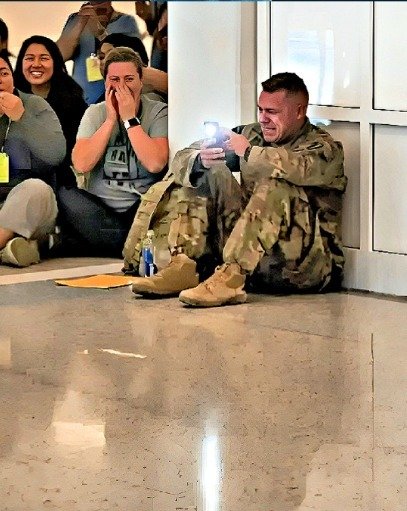
The most powerful stories of service are often the quietest. On a delayed flight filled with impatient passengers, a lesson in true sacrifice unfolded without fanfare. A soldier, his uniform neat but his expression weary, prepared for a journey home that was already too late. As the plane ascended, he made the most important call of his life, connecting to a hospital room where his wife was in labor. There, in his airline seat, he became a father.
He watched the birth on his phone, a small square of light holding his expanding world. The emotions that crossed his face—love, wonder, aching sorrow—told a story more eloquent than any speech. He was witnessing a miracle through a screen, a bittersweet testament to the reality of his commitment. The first cries of his child, transmitted through a speaker, were a sound of pure joy that underscored everything he was physically missing.
Around him, the cabin gradually stilled. One by one, passengers noticed his tears, his rapt attention, the hushed, loving words he spoke into the phone. The collective focus shifted from the inconvenience of delay to a shared, human moment of profound significance. In that space, the soldier’s personal sacrifice became a communal experience. He was no longer just another passenger; he was a symbol of the countless service members who trade first hugs for duty.
The response was organic and moving. As he ended the call, a soft clap broke the silence. It was contagious. Soon, the entire section was applauding—a sincere, heartfelt standing ovation offered not to a hero in the abstract, but to a specific man, a new father, in the midst of a deeply personal sacrifice. The applause was a language of gratitude, a way for strangers to say, “We see you. We honor what you’re giving up.”
This moment on a plane is a powerful call to awareness. “Thank you for your service” is a necessary sentiment, but it must be coupled with a deeper understanding of what that service entails: missed birthdays, empty chairs at graduations, and births witnessed from afar. Real support means advocating for military families, providing resources for reintegration, and never letting the daily comforts of civilian life make us forget the personal prices paid to secure them. True honor lies in consistent, meaningful acknowledgment of these unseen sacrifices.