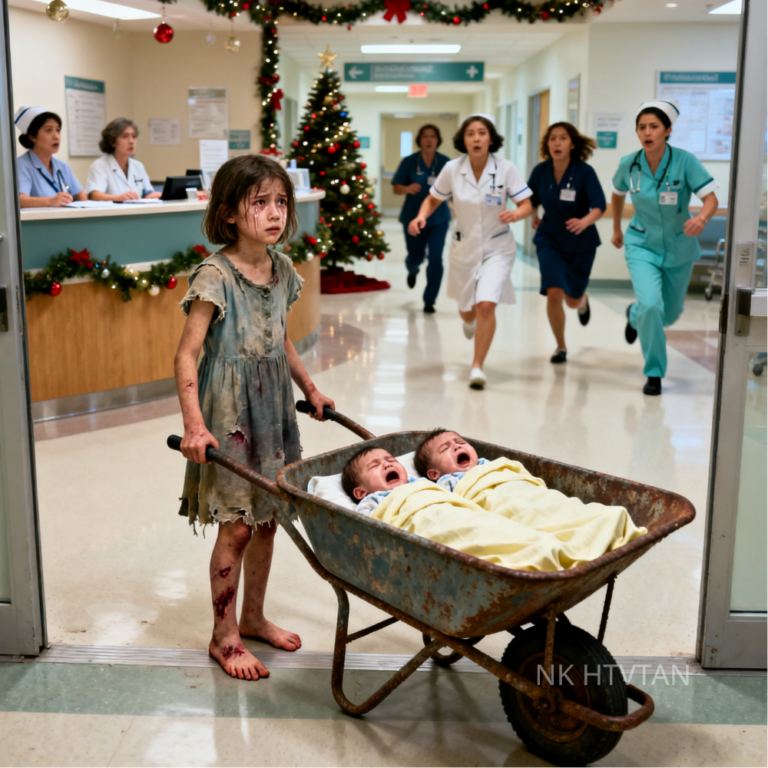
It was the quiet determination in her eyes that first struck the nurses. Lily, seven years old and barefoot, had pushed a rusty wheelbarrow containing her newborn twin brothers for over five miles to reach the hospital. Her small body was a map of her journey: bleeding feet, blistered hands, a face gaunt with exhaustion. When she whispered that her mother had been “asleep” for three days, the medical team understood the unspoken horror. The infants in the wheelbarrow were hypothermic and severely dehydrated, their lives balanced on a knife’s edge. This was not a simple case of neglect, but a catastrophic domestic collapse witnessed and shouldered by a child.
While doctors worked frantically on the babies, Lily sat rigid in a waiting room chair, her gaze locked on the doors to the emergency area. She did not cry or fidget. She simply waited, holding onto the hope that her impossible effort had not been in vain. Her courage was a stark, silent reproach to the world that had allowed her family to become so invisible and vulnerable. She had made a choice no child should ever face: to leave her incapacitated mother to seek help for her siblings, following a maternal instruction that became her sacred command.
The police investigation at the family’s isolated home revealed the depth of the crisis. They found Lily’s mother, Carme, in a critical state from an untreated postpartum hemorrhage. The environment was one of profound poverty, but also of poignant love. A discovered notebook revealed a mother’s heartbreaking descent, documenting her weakness, her reliance on her seven-year-old, and her growing certainty that she would not survive. The final entries were a mix of apology, instruction, and a testament to her faith in Lily. She had not “been asleep”; she had been dying, silently, while her daughter tried to care for everyone.
The hospital became a place of dual miracles. The twins, against the odds, responded to treatment. Their mother, receiving the emergency care she desperately needed, also stabilized. The moment of reunion was charged with a profound emotional gravity. Carme’s tears were of gratitude and grief for the burden placed on her small daughter. Lily’s tears, finally released, were the floodwaters of fear and stress breaking through a dam of incredible bravery. In that embrace, the weight shifted from the child’s shoulders back to the community around them.
Lily’s story resonated because it laid bare the extreme consequences of isolation and lack of support. The community’s subsequent response—providing housing, stability, and ongoing care—became a corrective to that failure. The wheelbarrow, that simple tool of her ordeal, was transformed into a symbol. It no longer represents just the weight she carried, but the astonishing strength of the human spirit, even in its smallest form. Lily’s journey teaches that heroism is not about the absence of fear, but about moving forward when every step hurts, because love demands nothing less.