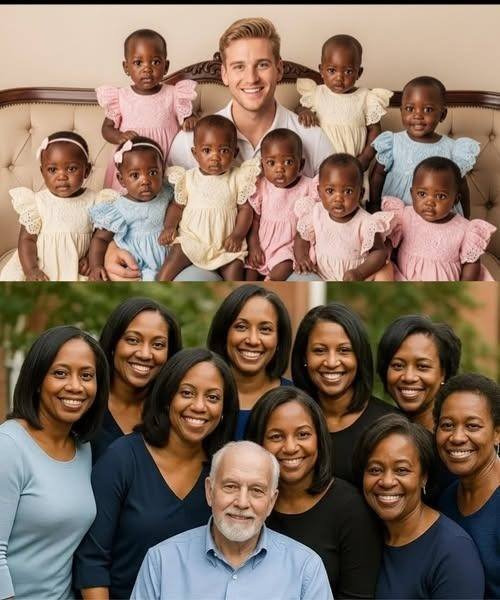
Parenting is often described as a leap of faith, but for Richard Miller, it was a conscious dive into the deep end. In the wake of his wife Anne’s tragic passing in 1979, the concept of family felt like a closed chapter. That changed when he met nine sisters at a local orphanage, all facing the heartbreaking prospect of being split apart. In a decision that defied all conventional wisdom, Richard, a grieving widower, chose to adopt them all. His journey redefines what it means to be a father, illustrating that the heart’s capacity to love is not limited by circumstance, biology, or public opinion.
The practicalities were daunting. Overnight, Richard became a single father to nine children, navigating a steep learning curve that involved everything from managing finances to mastering the intricacies of different hair textures. He approached fatherhood with a humble, hands-on determination, believing that presence was his most important offering. The image of him braiding hair by the kitchen light after a long shift became a symbol of his commitment—a small, tender act that spoke of a much larger devotion. His parenting philosophy was built on consistency, unconditional support, and the simple, powerful act of showing up, day after day.
Challenges arose not just within the home, but from outside it. Richard and his daughters faced prejudice and curious stares, their family structure an anomaly in their community. Yet, within the walls of their home, he fostered a sanctuary of acceptance and identity. He celebrated each daughter’s individuality, from Sarah’s radiant humor to Leah’s compassionate soul, teaching them that their worth was inherent and their bond unshakeable. He provided the safety net that allowed them to grow into their own persons, proving that a parent’s greatest gift is the space to become who you are meant to be.
The result of this extraordinary upbringing is a powerful testament to his success. His daughters have flourished, carrying the lessons of resilience, love, and integrity into their own careers and families. They are a close-knit unit, their sisterhood fortified by the shared experience of being chosen and cherished. Richard’s story moves beyond the fairy-tale ending to show the real, grimy, glorious work of building a family: the sacrifices, the small victories, and the transformative power of putting a child’s needs before your own fears.
For any parent feeling overwhelmed, Richard’s legacy offers a different kind of blueprint. It suggests that you don’t need to have all the answers, just a willing heart. It argues that family is a verb—an action built through nightly lullabies, patient lessons, and steadfast belief. His life reminds us that the most impactful families are often the ones we make, not just the ones we are born into, and that love, in the end, is the only truly necessary tool.