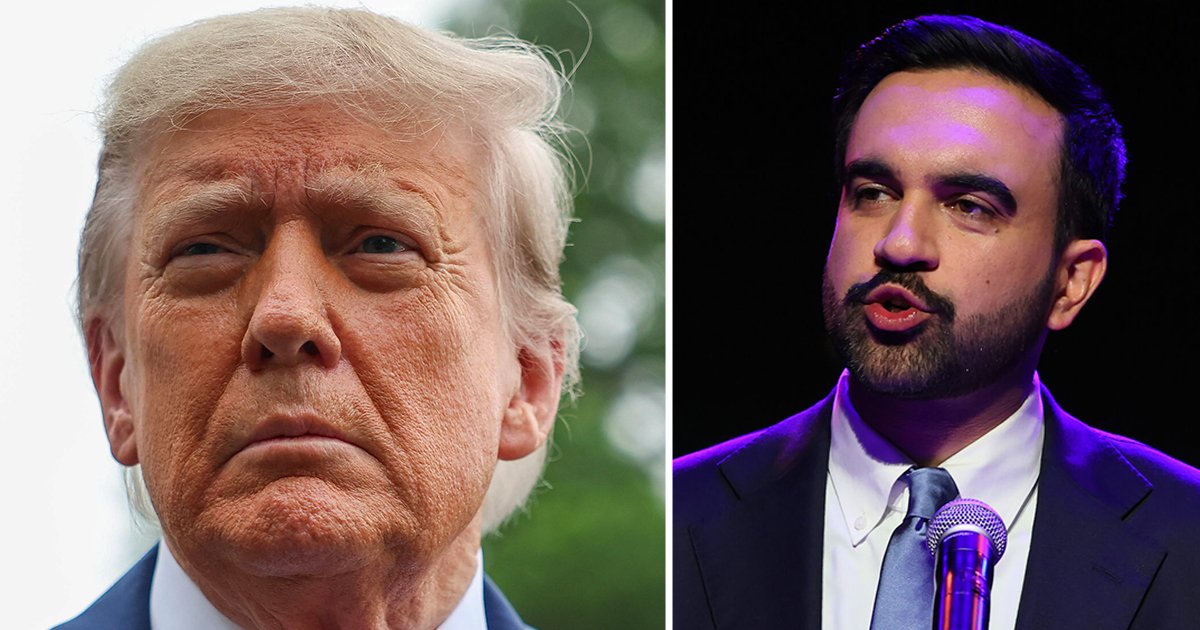
The political world is captivated by the opening salvos of a new and intensely personal feud. The catalyst was Zohran Mamdani’s election night victory speech, where the newly elected mayor of New York City shifted from celebration to confrontation. In a moment charged with symbolism, Mamdani declared that his city, a bastion of immigrant heritage, was now poised to lead the charge against Donald Trump. The most memorable line was a direct address to the former president, who Mamdani assumed was watching. He issued a four-word challenge that instantly went viral: “turn the volume up,” a clear signal that he was not afraid of a public fight.
Donald Trump, never one to avoid a conflict, has now responded in kind. His reaction, delivered in a media appearance, was to frame Mamdani’s confidence as a liability. Trump criticized the speech as being filled with anger and labeled its tone as “very dangerous.” He coupled this with a paternalistic warning, suggesting that the mayor-elect’s success depended on showing respect to Washington. This response effectively positioned Trump as the established authority figure and Mamdani as an upstart who needed to learn his place, setting a clear power dynamic for their future interactions.
This clash did not emerge from a vacuum. Trump had spent weeks leading up to the election attacking Mamdani’s political ideology, consistently using the incendiary term “communist” to describe his democratic socialist platform. Mamdani’s decision to answer these attacks head-on in his victory speech demonstrates a calculated political strategy. He is embracing the role of a progressive warrior, using Trump as a foil to galvanize his base and define his political identity from his very first moments as mayor-elect.
Beyond the war of words lies a more concrete threat. Trump explicitly referenced his previous promise to withhold federal funds from New York City if Mamdani were elected. This economic warning adds a layer of real-world consequence to their rhetorical battle. It suggests that the residents of New York could feel the impact of this political rivalry in the form of reduced support for city programs and infrastructure, raising the stakes from a mere debate to a struggle over vital resources.
The former president’s focus was not exclusively on New York. During his same public remarks, he also targeted California Governor Gavin Newsom with a fresh and derogatory nickname, illustrating that his approach to political opponents remains consistently personal and confrontational. For Mamdani, Trump’s sharp retort confirms that his message was received. The volume has indeed been turned up, and the nation will be watching closely to see how this high-profile political duel unfolds between the bold new mayor and the seasoned former president.