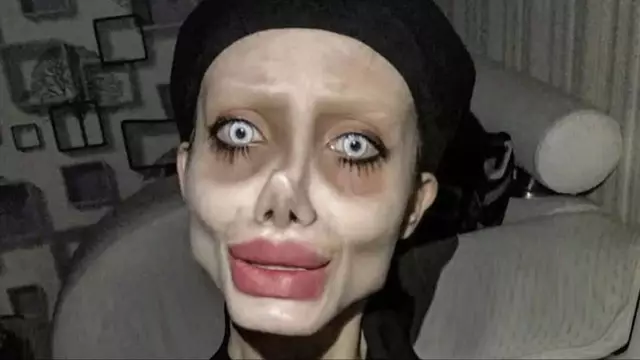
In the world of social media, perception is often far removed from reality. Few stories illustrate this better than that of Sahar Tabar, the Iranian woman who captivated and horrified the internet as “Zombie Angelina Jolie.” Her online gallery featured a face that seemed barely human—sunken eyes, a skeletal jaw, and a ghostly grey pallor. This digital character, she said, was a creative experiment, a form of art that she used for self-expression. But what began as an online amusement soon spiraled into a legal nightmare, leading to her imprisonment and an eventual unveiling of her true self.

The extreme nature of her photos led many to believe she had undergone extensive and dangerous cosmetic surgery. Reports circulated that she had over 50 procedures, a claim that added to the shocking legend of her online persona. However, these reports were later debunked. The truth was that her transformation was achieved through a combination of more minor procedures, such as a nose job and lip fillers, and, most significantly, the powerful use of photo editing software. The viral images were a digital illusion, crafted to generate a reaction.

This illusion had serious consequences. The Iranian government viewed her online presence as a threat, leading to her arrest on charges of blasphemy and corrupting the youth. She was made an example of in a crackdown on influencers, receiving a 10-year prison sentence that seemed to outweigh the nature of her offense. After serving 14 months, she was released, and her first major public appearance was on state television. The audience saw a completely different person: a young woman with a normal, unassuming appearance, a far cry from the monstrous figure she had portrayed online.
During her interview, Tabar reflected on her actions with a sense of remorse. She admitted that her drive for fame, a desire she held since childhood, led her to exploit the easy accessibility of cyberspace. She confessed that using makeup and Photoshop to grow her Instagram following was a simpler path to recognition than traditional routes like acting. Her mother’s pleas for her to stop went unheeded, a decision she now seems to regret. The revelation of her real face was not just a personal moment but a public dismantling of a carefully constructed myth.

The saga of Sahar Tabar is a powerful lesson in the age of social media. It demonstrates the immense power of digital tools to create deceptive identities and the potential perils of seeking fame through shock value. Her journey from viral curiosity to prisoner and back to an ordinary individual reminds us that behind every sensational online profile is a real person, one who can be deeply affected by the persona they project to the world. Her true face, finally revealed, tells a story more compelling than any digital fiction.