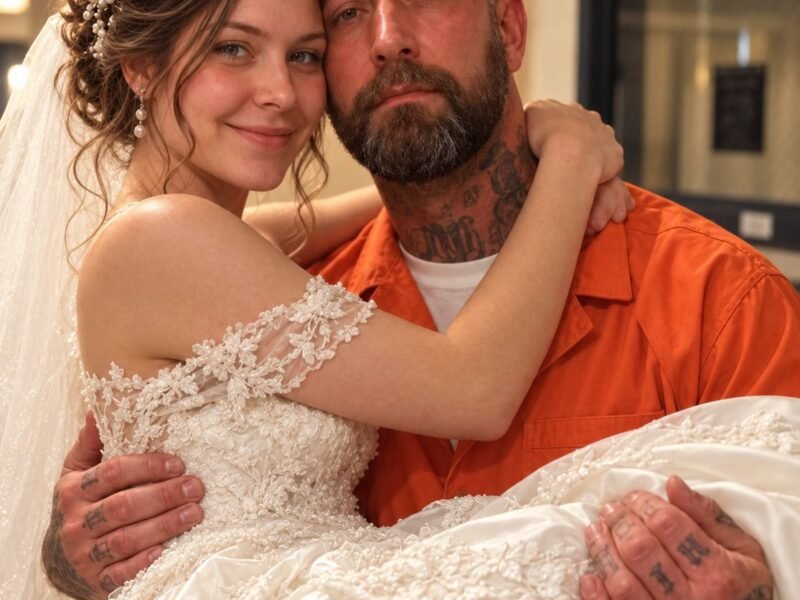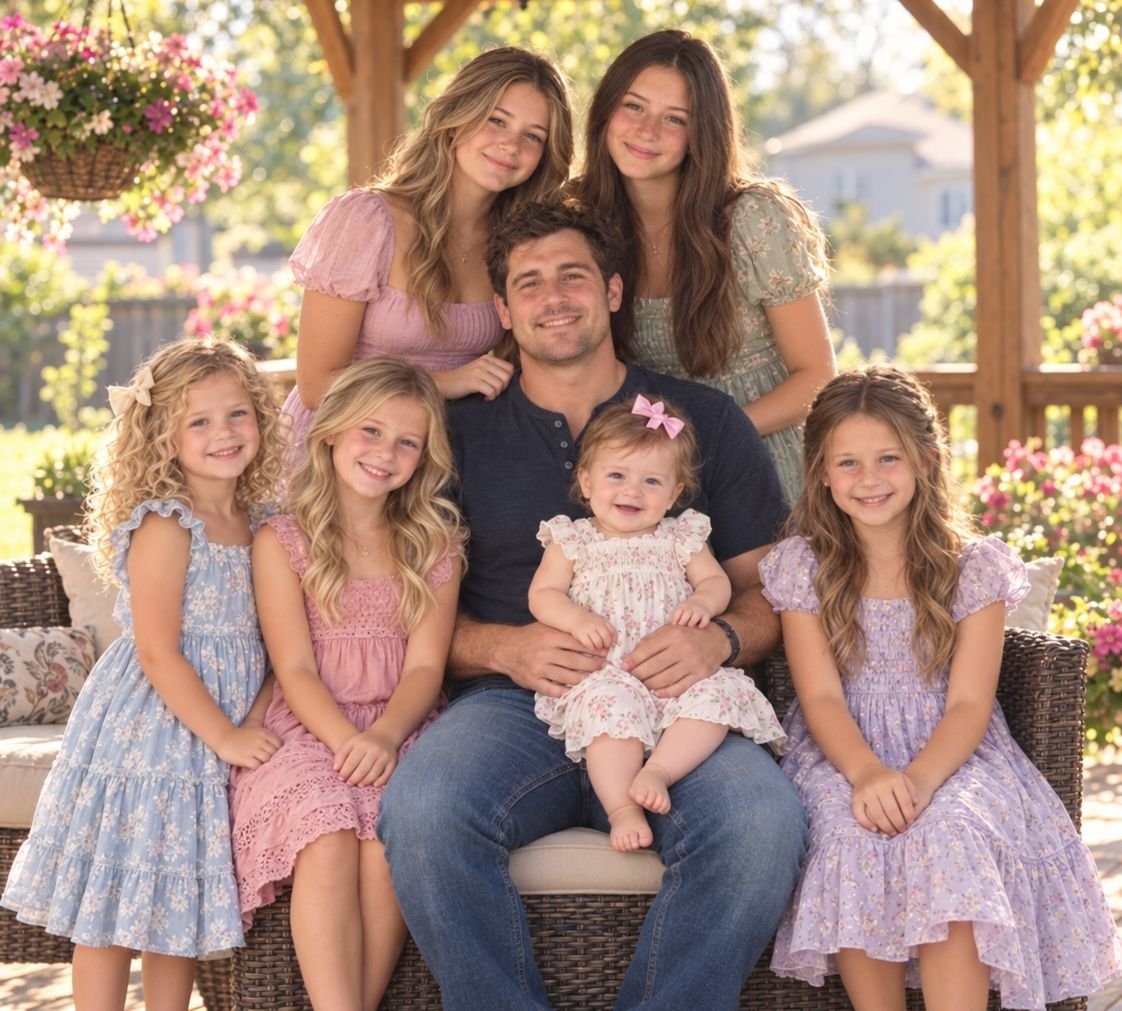
She left with three suitcases and a man who’d bought her a Mercedes. I was left with a baby on my hip, five more girls at the kitchen table, and a stack of bills I couldn’t pay. For fifteen years, she never sent a card, a dollar, or a single word. Then she showed up at my daughter’s wedding in sequins, hugged the bride for the cameras, and told everyone within earshot that I was the reason she’d gone. She had no idea what was waiting for her under that silver bow.
Part 1: The Text Message
“I’ll be at our daughter’s wedding. What would my NEW family think if I missed something this important? So yes, I’ll be there!”
I was standing at the kitchen counter with my first cup of coffee when that message lit up my phone. I read it twice. Then I set the mug down very carefully, because my hand had started to shake.
It was from Vanessa. My ex-wife.
I hadn’t heard her voice in fifteen years. I hadn’t seen her handwriting, her name on an envelope, or her number on a caller ID. As far as my daughters and I were concerned, she had become a ghost the moment she walked out our front door. And now, three weeks before our oldest girl’s wedding, the ghost had decided to RSVP.
My name is Owen Mercer. I’m fifty-one years old. I run the dispatch floor at a freight logistics company outside Columbus, Ohio, and I am the father of six daughters.
I raised all six of them by myself.
I still remember the exact night she left. It was a Thursday in late March, and it was raining.
We lived in a cramped three-bedroom apartment on the east side back then. The girls slept two and three to a room, and the baby, Wren, slept in a crib squeezed into the corner of ours. I came home from a twelve-hour shift and found Vanessa in the bedroom with three new leather suitcases open on the bed, folding clothes I’d never seen before. Silk blouses. A cream-colored coat with a designer label stitched inside the collar.
Wren was crying in her crib. Vanessa hadn’t picked her up.
I lifted the baby onto my shoulder and asked my wife what she was doing.
She didn’t even stop folding.
“You can’t give me the life I want, Owen,” she said. “Grant can. He bought me a brand-new Mercedes last month. He flew me to the Caribbean while you thought I was at a conference in Cleveland. Do you understand what kind of life that man can give me? The life I actually deserve?” She zipped the first suitcase shut and finally looked at me. “And you? You can’t give me anything.”
Grant Whitmore was her boss, the regional vice president at the insurance firm where she worked. I learned that night that she’d been sleeping with him for almost a year.
I asked her what she wanted me to tell the girls.
She shrugged. “Tell them whatever you want. You’re good at bedtime stories.”
Then she rolled her suitcases past the kitchen, where our five older daughters were sitting at the table in their pajamas, watching her with huge, frightened eyes. Hannah was eleven. Rose was nine. Ivy was seven. The twins, June and Juliet, were four.
Vanessa didn’t stop to hug a single one of them.
The front door slammed. A car engine started in the parking lot. And that was it.
What came after was silence.
No calls on birthdays. No Christmas cards. No visits. The divorce went through by mail; she didn’t even show up to the hearing. The court ordered her to pay child support for all six girls, and she never sent one dollar. Every time I tried to enforce it, her lawyers, Grant’s lawyers, really, buried me in paperwork. Her income was hidden in “consulting fees.” Her car was in his company’s name. I couldn’t afford to keep fighting, and I had six mouths to feed. Eventually, I stopped trying.
So I did what fathers do when there’s nobody else. I figured it out.
I worked double shifts and came home bone-tired. I learned to French braid by watching videos at two in the morning. I learned that there are at least ten different shades of pink, and that every one of them matters enormously to a seven-year-old. I kept six school calendars taped to the fridge and color-coded them with markers. I learned to cook five dinners from one chicken. I sat in the bleachers at every soccer game and in the folding chairs at every dance recital, usually still in my work boots.
I never missed a fever. Not one.
When Wren got pneumonia at three years old and our insurance had lapsed, I sold my grandfather’s gold watch and the engagement ring Vanessa had left behind on the dresser to cover the hospital bill. I didn’t tell the girls. Hannah figured it out anyway. She was fourteen by then, and she noticed the empty spot on my wrist.
She never said a word about it. But that was the year she decided she was going to become a lawyer.
Now Hannah was twenty-six. She’d graduated law school the year before, passed the bar on her first try, and taken a job at a family law firm downtown. And in three weeks, she was marrying Caleb Brooks, a kind, steady young man who taught high school chemistry and who had once driven four hours in a snowstorm because one of her sisters had a flat tire.
I didn’t know how to tell her about the text. I almost didn’t. But we’d never kept secrets in our house, so that evening I sat her down on the back porch and handed her my phone.
I expected tears. Maybe anger. Maybe she’d ask me to block the number and pretend it never happened.
Instead, she read the message, and something cool and very still came over her face.
Then she smiled.
“Tell her she can come, Dad,” Hannah said quietly.
“Hannah, you don’t have to…”
“I know I don’t have to.” She handed the phone back to me. Her eyes had a calm glint in them that I’d only ever seen when she was preparing for a trial. “Tell her she’s welcome. Tell her I’m so glad she reached out.” She paused. “I’ll even prepare a special welcome for her.”

I didn’t want Vanessa anywhere near my family. Every protective instinct I had was screaming at me to say no.
But it was Hannah’s wedding. Hannah’s day. And if this was what my daughter needed to finally close the door her mother had left hanging open for fifteen years, I wasn’t going to stand in her way.
So I typed four words and pressed send.
She says you’re welcome.
The wedding was held on a bright Saturday in September at a country club outside the city, with white chairs lined up on a green lawn and a reception hall full of tall windows and string lights. One hundred and fifty guests. Caleb’s whole family had driven in from Indiana. Hannah’s coworkers were there, along with half of our old neighborhood, and all five of her sisters, standing beside her in dusty blue.
Vanessa arrived forty minutes late.
She made sure everyone noticed. She stepped out of a black town car in a skin-tight silver sequined dress, completely wrong for a garden wedding, with oversized sunglasses pushed up into her hair and a designer handbag looped over her wrist like a trophy. Grant Whitmore followed a step behind her, gray at the temples now, in a suit that probably cost more than my first car.
She didn’t look at me. She walked straight past the guests on the lawn and into the bridal suite, where Hannah was having her veil pinned.
“My beautiful girl!” Vanessa cried, throwing her arms around her. She spoke loudly, clearly enough for every bridesmaid and both photographers to hear. “We’re finally together again! Oh, sweetheart, you have to understand. Leaving wasn’t my choice. It was all your father’s fault. He was poor, he was lazy, and he couldn’t give me the life I needed. A woman like me didn’t have any choice.”
Rose went rigid. June took a step forward, and Juliet grabbed her arm.
Hannah didn’t pull away.
She smiled serenely over her mother’s shoulder and said, “Of course I understand, Mom. And I have something for you. I prepared a very special gift just for your arrival.”
Vanessa leaned back, glowing with pride, and glanced around the room to make sure the photographers had caught it. “Oh, honey. You shouldn’t have!”
“Oh,” Hannah said softly, “I really should have.”
Right before dinner was served, Hannah took her mother’s hand and led her to the center of the reception hall, directly in front of the head table.
The DJ lowered the music. Conversations faded. One hundred and fifty faces turned toward the bride.
Two venue staff members wheeled out an enormous wooden crate on a flat dolly. It was nearly waist-high, wrapped in a huge shimmering silver bow, and they set it down at Vanessa’s feet like a centerpiece.
Hannah lifted a microphone from the DJ’s table. Her voice rang out across the speakers.
“Everyone, I want you to meet my mother, Vanessa. She hasn’t been to a family event in fifteen years, so this is a very special occasion.” She turned to her mother with a warm smile. “Go ahead, Mom. Open it.”
Vanessa beamed. She smoothed her sequined dress, posed for a quick photo, untied the bow with a flourish, and lifted the hinged wooden lid.
The moment she looked inside, the blood drained out of her face.
The guests in the front row leaned forward. Somebody gasped. Then the whole room went silent.
Vanessa stumbled backward so hard that she slammed into a dinner table, sending a wine glass shattering across the floor.
And then she screamed at the top of her lungs.
“Oh my God… no! Take it away! How DARE you?!”