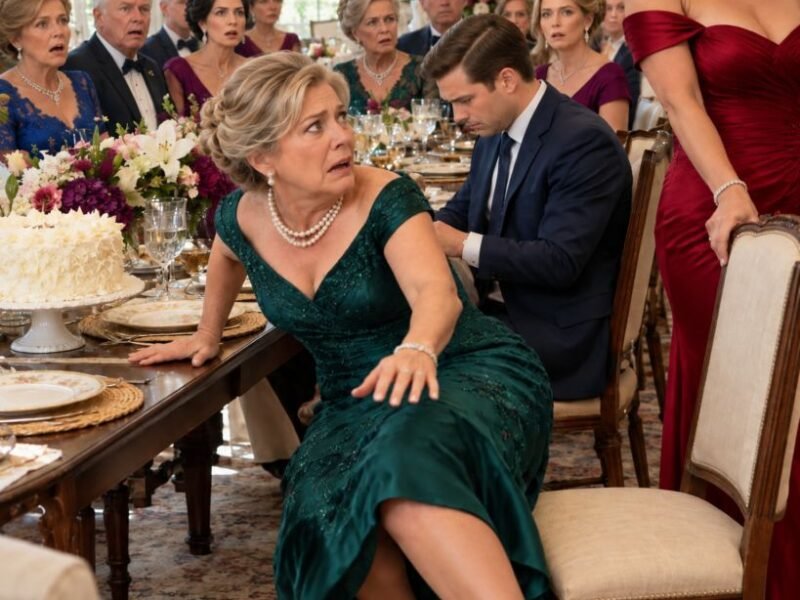
Five minutes after our plane lifted from the runway, the woman who had told my eighty-six-year-old grandmother that people her age should not be traveling looked down at her phone—and went crimson.
Her screen was filling with comments.
Give the grandmother her seat.
Did she really just say that?
Someone in row 18, please help her.
The woman read each message with growing horror. Then she looked at my grandmother, at the raised armrest between them, and finally at the phone again.
She had no idea that her entire argument had been broadcast live to thousands of people.
But I’m getting ahead of myself.
Part One: The Ocean on a Postcard
My grandmother Rose had never seen the ocean in person. She had only seen it in movies, photographs, and the postcards friends brought her from vacations.
Whenever someone asked whether she had ever been to the coast, she gave the same little shrug.
“One day,” she would say.
But one day became another until she was eighty-six.
Rose had worked for thirty-nine years at the Henderson Public Library, raised three children, cared for my grandfather through his final illness, and spent more than a decade helping me become the person I am now. She saved the prettiest piece of chicken for somebody else and spent every spare dollar on family.
So I decided to give her the ocean.
I started saving in January. I worked weekdays at a dental office and picked up Saturday shifts at a bakery, putting a little money each week into an envelope marked Florida.
By spring, I had enough for two plane tickets, a modest hotel near St. Augustine, and three days of meals if we were careful.
I printed the confirmation and tucked it inside a birthday card.
When Grandma opened it, she stared at the confirmation as if she had forgotten how to read.
“Jacksonville,” she whispered. “Florida.”
“We’ll drive to St. Augustine and stay near the beach.”
Tears slipped down her cheeks.
“You mean I’m actually going to see the ocean?”
“You are.”
She stood so quickly that I had to catch her elbow.
“I’m going to see the ocean,” she repeated, laughing and crying. “After all these years.”
That night, she pulled out a small notebook and wrote a list titled Things to Do in Florida.
- See the ocean.
- Put my feet in the water.
- Eat a key lime pie.
- Buy Anna something she doesn’t need.
I crossed out number four.
She wrote it again.
Part Two: Seat 18B
Grandma wore a blue cardigan and sensible white sneakers. She carried a paperback mystery novel, two peanut-butter sandwiches, and a little black purse. She had packed lightly because she wanted room for “something beautiful from the ocean.”
Our happiness lasted until we looked at our boarding passes.
Grandma’s seat was 18B.
Mine was 26C.
The least expensive tickets had separated us. I asked the gate agent if we could switch, but the flight was completely full.
“You can ask another passenger,” she told me. “The crew may be able to help once everyone is seated.”
I didn’t like leaving Grandma alone, but she squeezed my hand.
“I can manage for a little while,” she said. “I’m not made of glass.”
“I know. I just don’t want you to have to struggle.”
“Save your worrying for the ocean. It may be more dangerous than I think.”
When we boarded, I walked Grandma to row 18.
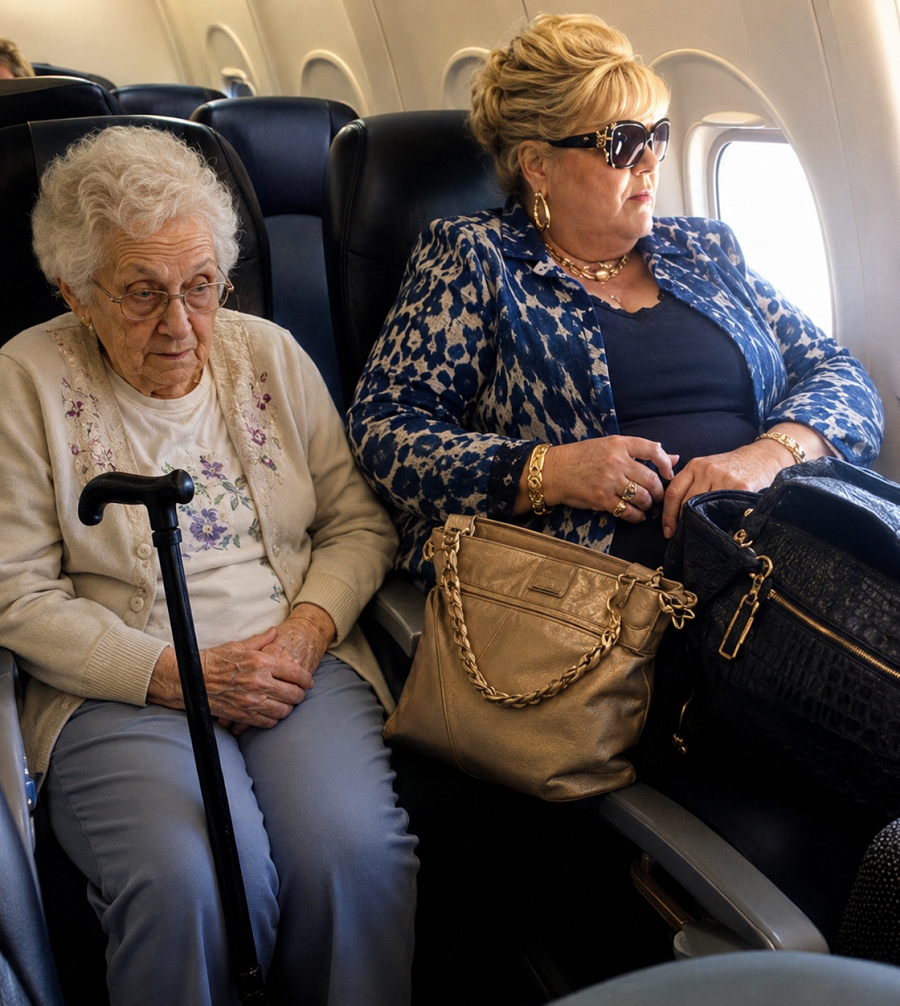
The woman in seat 18A had already made herself very comfortable. She wore a fitted black jacket and gold earrings, and her blond hair was pulled into a smooth ponytail. Her coat was draped over Grandma’s seat, her tote bag blocked the foot space, and the armrest was raised. Her hip covered almost half of 18B.
Grandma stopped beside the row, holding her cane in one hand.
“Excuse me,” I said politely. “That’s my grandmother’s seat.”
The woman barely looked up from her phone.
“I’m comfortable like this.”
She moved her coat but left the armrest raised and kept her tote near Grandma’s feet.
Grandma tried to turn sideways, but the arthritis in her knees made the movement painful. Her shoulder brushed the woman’s arm.
The woman pulled away sharply. “Could you please not crowd me?”
I looked at the two seats.
“She’s barely sitting down.”
The woman finally turned and looked Grandma up and down.
“Then maybe people her age shouldn’t even be traveling.”
The words hung in the narrow aisle, and heat rushed into my face.
“What did you just say?”
Grandma’s fingers closed around mine.
“Please, honey,” she whispered. “Don’t let one rude person ruin our first vacation.”
A flight attendant named Nora approached.
“Is everything all right?”
I explained. Nora looked at the coat, bag, and raised armrest.
“Ma’am, I need you to lower the armrest and keep your personal items in your assigned space. Your fellow passenger needs her seat.”
The woman’s mouth tightened.
“I paid for my ticket.”
“So did the passenger beside you.”
“It’s not my problem if she needs extra space.”
Nora’s voice became firmer.
“No one is asking you to give up your seat. We’re asking you to remain within it.”
The woman lowered the armrest with an irritated snap, shoved her tote beneath the seat in front of her, and pulled her coat onto her lap.
Grandma eased herself into 18B.
There was still little room, but Grandma could sit without twisting her legs.
I tucked her purse beneath the seat and adjusted the strap of her cardigan.
“Are you comfortable?” I asked.
“Comfortable enough.”
That was Grandma’s way of saying she wasn’t.
Nora promised to check on her and keep looking for a possible seat change.
I kissed Grandma’s forehead and walked toward the back of the plane.
Every step away from her felt wrong.

Part Three: The Little Red Word
I found my seat beside a college student and an older man who was already asleep. From where I sat, I could see the top of Grandma’s silver hair between the rows.
The woman in 18A kept angling her phone toward herself. Then I noticed a tiny red word near the top of the screen.
LIVE.
I recognized it because Grandma had once asked me to show her how livestreams worked. She loved watching people make quilts and restore old furniture, but she never trusted livestreams.
“People are too willing to talk when they think nobody can hear them,” she always said.
As the last passengers boarded, Grandma noticed it, too.
She glanced over at the woman’s phone, then back at me.
I mouthed, She’s live. Grandma raised her eyebrows, and I nodded.
The woman tapped through screens and fixed her hair in the camera, apparently unaware. Grandma gave me a knowing smile.
“Should we tell her?” I whispered after the safety demonstration.
“Not yet,” Grandma said.
“And if she doesn’t?”
Grandma settled her hands over the top of her cane.
“Then perhaps the world will explain it more clearly than we could.”
The plane rolled down the runway.
Grandma closed her eyes as the wheels left the ground. She had never flown before either, and I hated being twenty rows away for that moment.
Five minutes after takeoff, the seatbelt sign remained on. The cabin was quiet except for the low roar of the engines.
Then Grandma turned slightly toward the woman in 18A.
“Ma’am,” she said. “Excuse me.”
The woman didn’t respond.
Grandma tried again.
“Ma’am, please, look down.”
The woman pulled one earbud out.
“How dare you?” she snapped. “Leave me alone!”
A few passengers looked up, but Grandma didn’t raise her voice.
“You really need to look.”
Then she turned around, caught my eye, and winked.
The woman frowned and looked down at her phone.
For a second, she appeared confused.
Then her entire face changed.
The little red word was still there.
LIVE — 3,184 viewers.
Comments raced up the screen faster than she could read them.
Are you sitting in someone else’s seat?
Please move over for the older lady.
Did she really say people her age shouldn’t travel?
I’m in row 19. We can hear you.
The woman’s eyes widened.
She tapped the screen frantically.
“No,” she whispered. “No, no, no.”
Another notification appeared.
Your live video has been saved.
She made a small sound of panic. The college student across the aisle leaned forward.
“Ma’am, you’ve been live since we were at the gate.”
The woman’s cheeks turned bright red.
When the sign went off, I walked toward Grandma. Nora arrived at the same time.
“Let’s take a breath,” the flight attendant said. “Please end the broadcast.”
The woman’s fingers shook as she pressed the button. “I didn’t know.”
“I believe you,” Nora replied. “But people heard what happened.”
The woman stared at the dark screen, her face red with shame.
She looked at Grandma.
“You knew?”
“I saw the little red word,” Grandma said.
“Why didn’t you tell me?”
Grandma glanced at the armrest between them.
“I tried.”
“When you told me to look down?”
“Yes.”
“I thought you were complaining about the seat again.”
“I was trying to help you.”
That answer seemed to hurt the woman more than any angry response could have.
Part Four: A Seat, an Apology, and a Choice
Nora checked Grandma’s knees. The woman lowered the armrest, moved her purse, and gave Grandma the whole seat.
“You can use all of your space,” she said.
Grandma studied her. “Thank you.”
The woman swallowed. “I’m sorry. I was rude and selfish, and what I said was cruel.”
I stood in the aisle with my arms crossed. “You should be.”
Grandma gave me a gentle look, but she didn’t tell me to stop.
“I know saying it doesn’t undo it,” the woman continued.
“No, it doesn’t,” Grandma said. “But I can hear that you mean it.”
The woman’s eyes filled. “I can’t believe everyone heard me.”
Grandma reached for the small blue handkerchief in her purse and offered it to her.
“You’re giving me a tissue?”
“A handkerchief,” Grandma corrected. “My mother embroidered the flowers.”
The woman accepted it. Even after being insulted, Grandma was still carrying something for someone else.
“I don’t deserve this,” the woman whispered.
“Kindness isn’t a prize people earn,” Grandma replied. “Sometimes it’s how they learn what they should have offered in the first place.”
The man in 18C had been listening. He leaned toward me.
“If you want to sit with your grandmother, I can switch seats with you.”
I looked at him.
“Really?”
“Of course. My knees are better than hers.”
Nora approved the change, and the college student helped move my bag. Minutes later, I was beside Grandma.
Grandma’s face brightened when I sat down.
“There,” she said. “Now our vacation can begin.”
The woman by the window gave us more space than she needed. She stared at her phone.
“People are still commenting,” she said, turning the screen toward us.
“They’re saying I should apologize publicly.”
“You apologized before you knew what I thought,” I said.
She looked at Grandma.
“I apologized because she looked at me like I was better than what I had done.”
Grandma shook her head.
“I didn’t look at you that way.”
“You should have.”
“No,” Grandma said. “That would have made it easier for you to stay angry at me. It’s harder to be angry at someone who gives you a chance to do better.”
The woman folded the handkerchief in her lap.
“My name is Leah,” she said.
“I’m Rose. This is Anna.”
“I’m sorry, Anna.”
I wanted to say that I didn’t accept her apology. I wanted her to feel the same discomfort she had caused Grandma.
But Grandma placed her hand over mine.
“She heard you,” she said. “You can let her answer in her own time.”
“That’s fair,” Leah said.
Part Five: The Story Behind the Cruel Words
For the next half hour, none of us spoke much. Grandma looked out at the clouds while Leah kept her phone face down.
Eventually, she said, “I wasn’t recording a video to be rude.”
I turned toward her. “You were recording something?”
“I make travel content for my company. Mostly short videos about hotels and weekend trips. I thought I was filming a preview, but I must have started a live broadcast by accident.”
“You didn’t notice three thousand people watching?”
“The comments were hidden behind another screen. I was too busy trying to get comfortable.”
Grandma glanced at her.
“You certainly succeeded at that.”
Leah’s mouth twitched, then the smile disappeared.
“I was already angry before I got on the plane.”
She looked down at the handkerchief. “I’m flying to Florida to see my mother. She lives in assisted living outside St. Augustine. She fell a few months ago and has been asking me to visit.”
“Is she all right?” Grandma asked.
“She’s recovering. Physically, anyway.”
“My mother and I have never been easy with each other,” Leah said. “She thinks I work too much, and I feel as if every call becomes a list of things she needs. I know she’s lonely, but it can be tiring.”
“That can be tiring,” Grandma said.
Leah looked surprised that Grandma had not scolded her.
“I’ve also used that tiredness as an excuse to be careless. This morning she asked whether I would take her to the beach.”
Her fingers tightened around the handkerchief. “I told her I didn’t know if she could manage it. I said we might not have time.”
“And then you told my grandmother that old people shouldn’t travel,” I said.
Leah closed her eyes.
“Yes.”
“I think I was talking to myself,” Leah continued. “I was frustrated with my mother for getting older, then I saw your grandmother taking longer to sit down and decided she was in my way.”
“She wasn’t in your way,” I said.
“I know. She was in her assigned seat.”
Grandma rested her hand on the notebook in her lap.
“Getting older changes the speed of your knees,” she said. “It does not change the size of your heart, your curiosity, or your right to go somewhere beautiful.”
Leah’s eyes filled. “My mother wanted to see the ocean when she was young. She never did because she was busy raising me.”
Grandma looked at me.
“That sounds familiar.”
I smiled.
Leah looked out the window. “I planned to visit for two hours and leave. I thought if I stayed longer, she would ask me to do something else.”
“She probably will,” Grandma said.
Leah laughed softly through her tears. “You’re not making this easier.”
“I’m not trying to. I’m trying to make it honest.”
Leah picked up her phone, stared at the frozen screen, then turned it off.
“When we land, I’m going to take her to the beach.”
“That sounds like a good idea,” Grandma said.
“Even if she takes too long.”
“Especially then.”

Part Six: The First Wave
By the time we landed in Jacksonville, the tension had changed into something quieter. Leah asked before helping Grandma lift her bag.
“Would you like help?”
Grandma studied her.
“Yes, please.”
The difference mattered. Leah didn’t grab the bag or assume; she asked, and Grandma answered.
At the gate, Nora stopped us. “How are your knees feeling?”
“Better now that my granddaughter is beside me.”
Nora turned to Leah, who held up her phone. “I’m going to be much more careful with this thing.”
“That would be wise,” Nora said.
Before we separated, Leah asked where we were staying. Her mother’s community was only twenty minutes away.
“If you need directions, call me,” she said. “I also know a diner nearby with excellent pie.”
“We were planning to find key lime pie,” Grandma said.
“Then I know exactly where you should go.”
Grandma wrote Leah’s number beneath the list in her notebook.
That evening, we walked to the beach.
The sun was low, and the air smelled of salt and warm sand. Grandma moved slowly with her cane but refused to let me carry her.
“I’ve carried myself this far,” she said. “I can carry myself the rest of the way.”
When we reached the boardwalk, she stopped. The ocean stretched beyond us, wider than any photograph could hold, and the horizon looked like a place where the earth had forgotten to end.
Grandma pressed one hand against her chest.
“Oh,” she whispered.
I took her arm. “Are you okay?”
She nodded, tears shining in her eyes.
“It’s moving.”
“The ocean?”
“Everything.”
We went down to the edge of the water. Grandma removed her sneakers and rolled up her pants. I held her hand as the first wave touched her feet.
She gasped.
“It’s cold!”
Then she laughed.
She laughed so freely that people nearby turned to look. A little girl building a sandcastle smiled at her.
Grandma stood with her feet in the water, her silver hair moving in the wind.
“I waited too long,” she said.
“You’re here now.”
“That’s the important part.”
The next morning, Leah sent me a message.
My mother says she is ready for the beach. Would it be all right if we met you there?
I showed Grandma. She smiled. “Tell her to bring a sweater.”
An hour later, Leah arrived pushing her mother, Alice, in a beach wheelchair. Alice looked nervous until she saw Grandma Rose.
“This is Rose,” Leah said.
Alice’s face softened.
“The ocean girl.”
Grandma laughed.
“That’s me.”
The two women talked as if they had known each other for years. Alice admitted she had always wanted to see the ocean but had spent her younger years working and raising Leah.
Leah stood behind the wheelchair, listening. Finally, she said, “I’m sorry I waited so long to bring you.”
Alice reached back and took her daughter’s hand.
“You came.”
“I should have come sooner.”
“Probably.”
Leah laughed, and so did Grandma.
Leah wheeled Alice to the edge, where a thin sheet of water washed over the tires.
Alice closed her eyes.
“It sounds exactly like I imagined,” she said.
Grandma looked at Leah. “Now you have two people to take to the ocean next time.”
Leah nodded.
“I’ll make room.”
Part Seven: What Leah Did With the Shame
Leah could have deleted the saved video and blamed the crowded plane or her stress. Instead, she made a choice.
That afternoon, she recorded another video, checking the screen three times before pressing anything. She sat in a plain hotel room and did not show Grandma or Alice without permission.
“Yesterday, I said something cruel to an older passenger on a plane,” she began. “I told her that people her age shouldn’t be traveling. I was wrong. She was in her assigned seat, and I was taking part of it because I felt entitled to more space.”
She explained that the first video had been broadcast live by accident. “The embarrassment was not the lesson,” she said. “The lesson was that I had said those words before I realized anyone could hear them.”
She talked about her mother and how easily impatience could disguise itself as practicality.
“Older people are not obstacles between us and the life we want,” she said. “They are people who still have places to go, things to see, and stories we may be lucky enough to hear.”
The video received thousands of comments.
Some people criticized Leah. Others shared stories about parents and grandparents they had helped travel. A ninety-two-year-old woman wrote that she flew to Arizona every winter to visit her sister.
“I’m not done living,” the woman wrote. “Neither is your grandmother.”
Leah replied, You’re right. I’m sorry I forgot.
She sent the original live video to me and asked whether Grandma wanted to see it.
“Absolutely not,” Grandma said, then reconsidered. “Actually, show me the comments.”
She read them for nearly an hour. She laughed at the supportive ones and shook her head at the people who wanted Leah punished forever.
“No one needs to be destroyed over one bad moment,” she said. “They need to understand it and stop repeating it.”
Leah continued visiting her mother. She took Alice to the beach again at sunset and sent Grandma a photograph.
In the picture, Alice was sitting beside the water with her shoes off. Leah knelt beside her, holding a paper cup of lemonade.
On the back of the photograph, Leah wrote:
You were right. The ocean is better when you make room for someone else.
A month later, Leah began Still Traveling, an online project sharing accessible-travel advice and stories from older people who were still seeing the world.
Grandma Rose became her first official interview.
Leah asked permission before recording every answer.
“What would you say to someone who thinks older people should stay home?” Leah asked.
Grandma looked directly into the camera.
“I would say they should come with us,” she replied. “We know where the best pie is.”
Part Eight: The Room We Make
It has been a year since that flight.
Grandma still talks about the ocean as if it were an old friend she finally got to meet.
She keeps a jar of sand on her bookshelf and a photograph of herself standing in the waves. In the picture, her cardigan is blowing sideways, her cane is planted firmly in the sand, and her smile is so wide that it makes her look twenty years younger.
She also keeps the little notebook.
The original list now has several additions:
- Watch the sunrise.
- Visit Alice again.
- Try lobster, even though it looks difficult.
- Take Anna somewhere she has never been.
Number eight remains a concern.
“You’ve already taken me to the ocean,” I remind her.
“That doesn’t mean I’m finished.”
Leah and her mother visited us last fall. Alice brought Grandma a shell painted pale yellow. Grandma gave Alice one from the blue bowl she had kept for decades.
They sat at my kitchen table, trading memories and arguing cheerfully about which beach had the softer sand.
Leah and I talked about the plane only once.
“I’m still embarrassed when I remember that livestream,” she said.
“You should be embarrassed by what you said,” I replied. “But you don’t have to be embarrassed forever by who you became afterward.”
She looked toward Grandma, who was showing Alice her notebook.
“She didn’t have to forgive me.”
“No,” I said. “She chose to.”
Leah nodded.
“I think that was the part I expected least.”
Grandma overheard us.
“People often expect punishment because punishment is easier to understand than mercy,” she said.
Leah smiled.
Grandma closed her notebook and looked at me.
“You know, Anna, everyone keeps calling what happened on the plane karma.”
“It was pretty close.”
“No.” She shook her head. “Karma would have been the woman losing her luggage or spilling coffee on her white shoes.”
“She did turn red in front of three thousand people.”
“That was consequences.”
“Then what was it?”
Grandma glanced at the yellow shell in Alice’s hand.
“It was a correction. She forgot that I was a person, and the world reminded her.”
That was Grandma Rose’s gift. She could tell the truth without using it as a weapon.
So if you ever see an older person moving slowly through an airport, boarding a plane, or taking extra time to settle into a seat, remember this:
They are not taking up space that belongs to someone younger.
They are using the space they paid for, earned, and have every right to occupy.
They may be traveling to a wedding, a funeral, a family reunion, or the first ocean they have ever seen.
And sometimes, all it takes to change the entire journey is one person willing to make room.
Note: This story is a work of fiction inspired by real events. Names, characters, and details have been altered. Any resemblance is coincidental. The author and publisher disclaim accuracy, liability, and responsibility for interpretations or reliance. All images are for illustration purposes only.