Part 1 — The Peaceful Life I Thought I Had Bought
At fifty-five, I thought I had finally earned a quiet life.
For most of my adult years, I had been the kind of woman who said, “It’s fine,” even when something clearly wasn’t.
Someone cut in front of me? Fine.
A relative made a rude comment? Fine.
A neighbor borrowed something and forgot to return it? Fine.
I told myself I was choosing peace. Looking back, I think I had simply become too practiced at swallowing my irritation.
So when I sold my old house and poured nearly all my savings into a small home in a peaceful suburban neighborhood, I made myself a promise.
This chapter would be different.
No drama.
No unnecessary arguments.
Just a white porch, a modest backyard, two maple trees, and enough room to sit outside with my coffee every morning.
On my first day there, I carried a mug onto the front step and watched the neighborhood wake up.
A man next door was watering his lawn. After staring at me for several seconds, he finally lifted one hand.
“You’re the new owner?”
“That depends,” I replied. “Are you about to complain about something?”
He lowered the hose.
“Not yet. I’m George.”
“Nora.”
He glanced at my lawn.
“You’re cutting that grass too short.”
I stared at him.
“Good morning to you too, George.”
“I’m trying to save your lawn.”
“My lawn hasn’t asked for help.”
He burst out laughing.
That was George.
A little nosy. Occasionally annoying. Completely harmless.
Most of the neighbors turned out to be the same—friendly people who cared slightly too much about lawns, recycling schedules, and who had planted what near the sidewalk.
Then there was Helen.
Helen lived two houses down in the largest home on our side of the street. Her husband was a dentist, and from what I could tell, Helen had made supervising everyone else’s lives her personal occupation.
Our first real conversation happened while I was arranging flowerpots on my porch.
“That one should go on the other side,” she said.
I turned.
She was standing at the bottom of my steps, pointing at one of my blue pots.
“Hello to you too.”
“Move it left,” she continued. “Your windows look uneven.”
I looked at the flowerpot.
Then at Helen.
“I like it there.”
She laughed as though I were an inexperienced child.
“You’ll understand once you’ve lived here longer.”
At the time, I thought she was simply opinionated.
I should have paid more attention.
A week later, her two boys charged straight through the flower bed I had spent an entire afternoon planting.
“Careful!” I called.
Helen stood at the end of her driveway scrolling through her phone.
She barely looked up.
“They’re kids, Nora.”
“I know. That’s why I asked them to stop instead of calling the police.”
She laughed.
I laughed too.
It was easier that way.
That became the pattern.
Helen pushed.
I smiled.
Helen crossed a line.
I moved the line.
Once, I found her standing inside my open garage holding my pruning shears.
I stopped in the doorway.
“Looking for something?”
She raised the shears.
“These. Mine are dull.”
“You could have asked.”
Helen smiled.
“Would you have said no?”
Probably not.
“That isn’t the point.”
“I’ll bring them back.”
Three days passed before I finally went over and asked for them.
Again, I told myself it wasn’t worth creating tension.
Again, Helen learned that I would tolerate a little more.
I just didn’t realize yet how much she had been learning about all of us.
Part 2 — The Crooked Frame
Helen’s behavior wasn’t limited to me.
At a neighborhood barbecue, I watched Susan politely ask Helen to keep her children out of her flower beds.
Helen immediately smiled.
“Of course. I’m so sorry.”
An hour later, Helen and Susan were sitting together drinking lemonade as though nothing had happened.
I remember nudging George.
“See? That’s what adults do. You say what bothers you, then you move on.”
George made a doubtful sound.
“What?”
“Nothing.”
“You’re terrible at saying nothing.”
He nodded toward Helen.
She was standing beside the food table, holding a small wooden picture frame.
My wooden picture frame.
“What’s this?” she asked.
Something in me tightened.
“Careful.”
Helen looked surprised by my tone.
I walked over, took the frame gently from her hands, and set it back where it had been.
“My husband made that.”
Her expression softened a little.
“Your late husband?”
I nodded.
The frame wasn’t perfect.
One corner sat slightly higher than the other, and there was a shallow groove near the bottom where my husband’s tool had slipped while he was making it.
A store would never have sold something like that.
That was exactly why I treasured it.
I could still remember him sitting at the kitchen table, squinting at the wood and insisting he could fix the uneven corner.
He never did.
After he died, that little imperfection became one of my favorite things about it.
Helen tilted her head.
“You know, you could put the photograph into something nicer.”
I laughed.
I genuinely thought she was joking.
She wasn’t.
I ran my thumb over the crooked edge.
“That’s the point. He made it.”
Helen lifted both hands.
“Fine. Keep your crooked frame.”
The next morning, it was gone.
I searched everywhere.
I opened boxes I had already unpacked. I emptied drawers. I checked behind furniture and under the mantel. I even searched the garage, wondering whether I had absentmindedly carried it outside.
Nothing.
For days, I kept looking.
Eventually, I did what I had always done when something upset me.
I convinced myself it wasn’t worth dwelling on.
Maybe I had misplaced it.
Maybe I would find it someday.
Maybe letting go was easier.
Two weeks later, I discovered that letting things go had consequences.

Part 3 — The Garbage Bags
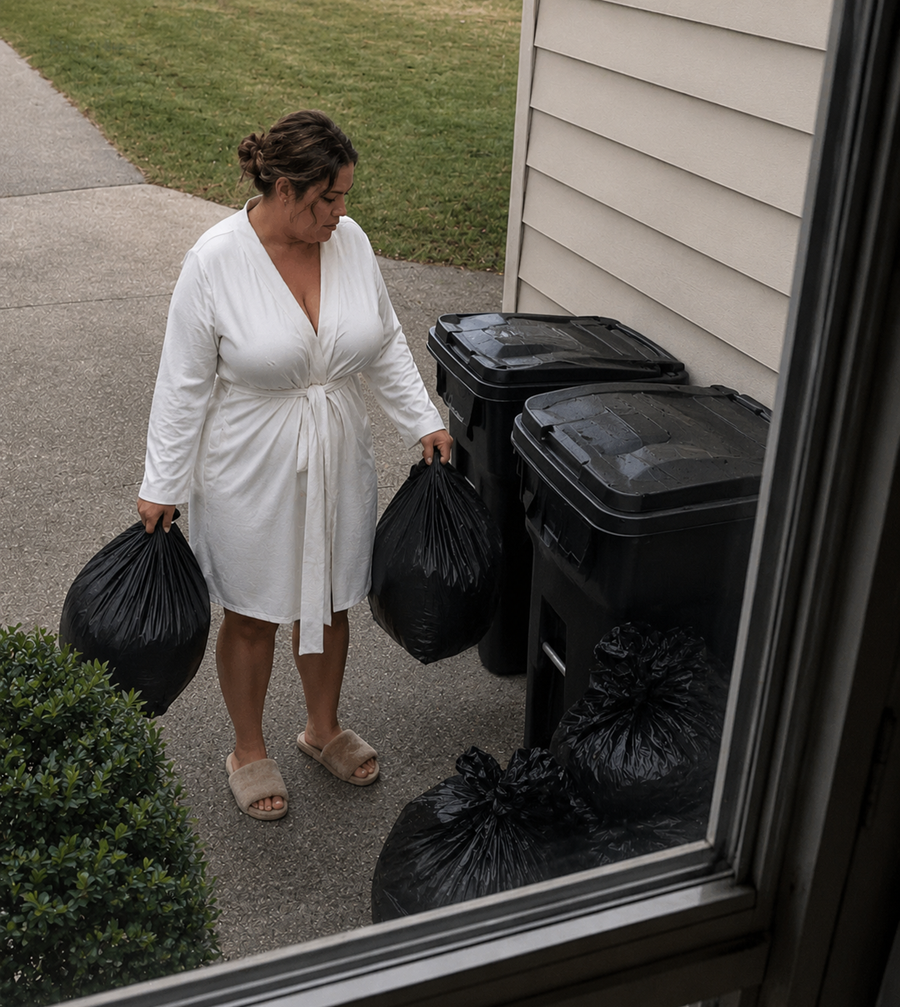
One morning, I carried my trash outside and found two black garbage bags sitting beside my bin.
They weren’t mine.
George was collecting his newspaper across the street.
“Those yours?” he called.
“No.”
He looked at the bags.
Then at me.
“Interesting.”
I ignored him.
The next morning, there were four.
By the end of the week, there were seven.
Seven enormous black bags sat beside my garbage bins as if someone had quietly moved half a household onto my curb.
Friday morning, I stood on the porch holding my coffee and staring at them.
Across the street, George appeared again.
“Don’t say it,” I warned.
He stopped.
“Say what?”
“Whatever your face is saying.”
“My face is impressed that one woman can produce this much garbage.”
“My face thinks you should go back inside.”
He laughed.
I didn’t.
Two bags could have been a mistake.
Four could have been confusion.
Seven meant somebody had decided my property was convenient.
So on the next pickup morning, I got up before six.
I made coffee, switched off the living room lamp, and sat beside the window.
Twenty minutes later, a figure appeared.
Leggings.
Slippers.
Two enormous black garbage bags.
Helen.
She walked casually down the sidewalk, dropped the bags beside my bins, brushed her hands together, and started heading home.
She wasn’t sneaking.
She wasn’t embarrassed.
She apparently believed this arrangement was perfectly reasonable.
“Helen!”
She turned and waved cheerfully.
“Morning, Nora.”
I stepped outside in my robe.
“Are those bags yours?”
“Yes.”
“And the others?”
“Most of them. The kids create an unbelievable amount of garbage.”
I stared at her.
“Why is your unbelievable amount of garbage sitting in front of my house?”
She looked almost surprised that I had asked.
“I canceled our pickup.”
“You canceled garbage pickup?”
“It’s ridiculously expensive.”
“But you still produce garbage.”
Helen gave me the same patient expression someone might use with a confused child.
“You already have a truck coming.”
“Because I pay for it.”
“Exactly. Why should both of us pay?”
For several seconds, I had absolutely no response.
Not because she made sense.
Because I had never heard entitlement explained so confidently.
“Helen, that isn’t how garbage service works.”
“Oh, please.”
She held up one perfectly manicured hand.
“I’d rather spend that money on another manicure than something I don’t really need.”
I looked at her pale-pink nails.
Then at the mountain of garbage beside my lawn.
“You clearly need garbage pickup.”
“No.” She smiled. “You need garbage pickup. I just need you.”
Something changed in me.
All at once, I saw the past few weeks differently.
The flowerpot.
My garage.
My pruning shears.
Her children trampling my flowers.
Every time I had said, “It’s fine,” Helen hadn’t heard kindness.
She had heard permission.
“Take the bags back.”
Her smile disappeared.
“I’m not carrying nine garbage bags home.”
“Then call the garbage company.”
She rolled her eyes and turned away.
The old version of me would have followed her.
I would have explained.
Reasoned.
Apologized for sounding annoyed.
And somehow, by the end of the conversation, I probably would have been the one feeling guilty.
But I was tired of being that woman.
Then an idea came to me.
“Helen.”
She turned impatiently.
“What?”
I smiled.
“Fine. Leave them.”
Her face brightened immediately.
“I knew you’d come around.”
“One condition.”
She waited.
“Anything you leave on my property becomes mine.”
Helen stared at me.
Then she laughed.
“You want my garbage?”
“I want us to understand each other.”
She waved dismissively toward the pile.
“Absolutely. Keep whatever treasures you find.”
“Perfect.”
She walked home looking pleased with herself.
At that moment, neither of us knew how important the word treasures was about to become.
Part 4 — What Was Inside the Bags
That afternoon, the garbage truck came.
My bins were emptied, but several of Helen’s bags remained beside the curb.
One had torn open.
A nearly new blanket was sticking through the plastic.
I frowned.
Why would anyone throw that away?
I put on gardening gloves and opened the bag.
Under the blanket were several books.
Then a vase.
A small lamp.
A wooden box.
None of it looked like garbage.
I opened another bag.
That was when I found the pruning shears.
I froze.
Faded yellow tape was wrapped around one handle.
My yellow tape.
Years earlier, I had put it there because the rubber grip became slippery when wet.
There was no possibility I was mistaken.
They were mine.
“No way…”
I hurried into the garage and opened the drawer where I kept my gardening tools.
The space where the shears belonged was empty.
Helen had borrowed them months earlier.
I remembered asking for them back.
I even remembered seeing them again afterward.
Yet somehow, they had ended up in her garage—and now in her garbage.
I was still trying to understand how when I heard children behind me.
Helen’s boys had stopped near the driveway.
The younger one pointed.
“Hey, that’s our garage stuff.”
His older brother elbowed him.
“Shut up.”
I turned around slowly.
“What garage stuff?”
“Nothing,” the older boy said quickly.
But the younger one kept staring at the things spread across my driveway.
“Mom keeps that stuff in boxes in our garage.”
The older boy grabbed his arm.
“Come on.”
Something about his sudden nervousness made me pay attention.
“Where does your mother get these things?”
The younger boy shrugged.
“Different places.”
“What kind of places?”
“People’s houses.”
His brother’s face changed.
“You’re not supposed to tell!”
The younger child looked confused.
“Why?”
“Because Mom said so!”
I tried to keep my voice calm.
“Does she buy the things?”
“No. She just brings stuff home sometimes.”
“And then throws it away?”
“When she gets bored with it.”
He pointed toward the garbage.
“She cleans the garage and gets rid of stuff.”
His brother pulled harder on his sleeve.
But before they left, the younger boy added one more sentence.
“Mom says people usually don’t notice their stuff until it’s gone.”
Every trace of amusement disappeared from me.
The boys hurried home.
I remained standing beside the bags with my pruning shears in my hand.
Slowly, I looked over everything again.
A silver cake server.
A child’s book with a name written inside the cover.
A wooden jewelry box with initials scratched underneath.
A blue ceramic bowl carefully wrapped in old newspaper.
Five minutes earlier, I had seen discarded household clutter.
Now I saw evidence of dozens of unanswered questions.
My first instinct was to knock on every door on the street.
But what would I say?
Helen’s child says your neighbor might have been taking things from your houses?
She could deny everything.
She could claim the boys were confused.
I needed something stronger.
I needed the truth to reveal itself.
Then I remembered Helen’s words.
Keep whatever treasures you find.
I looked at the items again.
And suddenly, I knew exactly what I was going to do.
I wouldn’t carry Helen’s garbage around the neighborhood looking for its owners.
I would bring the neighborhood to the garbage.

Part 5 — The Charity Giveaway
Saturday morning, I set up three folding tables on my front lawn.
I washed the dishes.
Folded the blankets.
Stacked the books neatly.
Wiped dust from the lamp and wooden boxes.
Then I made a large sign and taped it to the first table:
NEIGHBORHOOD CHARITY GIVEAWAY — EVERYTHING FREE
George arrived before I had even finished arranging the last table.
He read the sign.
“Charity?”
“Everything gets a new home.”
“And Helen?”
“She told me to keep her treasures.”
George studied my face.
“What exactly are you planning?”
“Nothing terrible.”
He raised an eyebrow.
“Go invite the neighbors.”
That was the important part.
There happened to be a weekend market nearby, so strangers often walked through our area on Saturdays.
I knew Helen would assume the people gathering around my yard were simply visitors.
But I had quietly invited every household on our street.
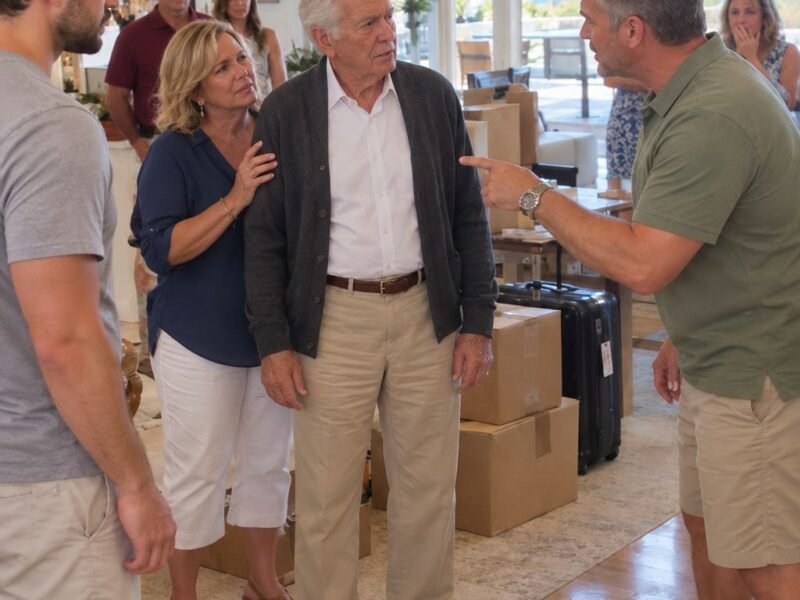
By ten o’clock, my front lawn was full.
People browsed.
Talked.
Picked things up.
Then Helen appeared.
The moment she saw the tables, her eyes widened.
“What are you doing with my things?”
“Giving them away.”
“You have no right!”
I looked at her calmly.
“You left them on my property. Remember our agreement?”
Helen glanced around.
There were enough unfamiliar faces nearby that she apparently assumed most of the people were strangers.
Then someone thanked me for putting together the giveaway.
Helen’s entire demeanor changed.
Her shoulders straightened.
She smiled.
“Actually,” she announced loudly, “all these things are mine. I was planning to donate them anyway.”
I almost laughed.
Of course.
Even now, she wanted the praise.
A woman nearby smiled.
“That’s very generous of you.”
Helen lifted her chin proudly.
“I’d rather help people than throw perfectly good things away. Please, take whatever you want.”
“How charitable,” I murmured.
Helen didn’t notice my tone.
Then Carol picked up the silver cake server.
She turned it over.
Her face changed.
“Helen?”
Helen looked toward her.
Carol held up the server.
“Why is my wedding date engraved on your cake server?”
Silence.
Helen’s smile vanished.
“I lent this to you last year,” Carol continued. “You told me you returned it.”
Helen swallowed.
“I must have forgotten.”
“You didn’t forget. I asked you twice.”
Before Helen could respond, George suddenly reached for a small red toy truck.
“What the hell?”
He turned it over, examining one of the wheels.
“This was my son’s.”
Helen shook her head quickly.
“George, there are thousands of toy trucks like that.”
“Not like this one.”
He pointed to a tiny brass screw.
“My son and I repaired that wheel together when he was eight. I kept this truck in my den for twenty-five years.”
The atmosphere changed instantly.
People stopped browsing.
Now they were searching.
Megan grabbed the wooden jewelry box.
“These are my initials.”
She looked up sharply.
“My daughter made this for me.”
Another woman opened two children’s books.
“These belong to Emma! Her name is right here!”
Voices rose around the tables.
“I’ve been looking for this for months.”
“You said you returned mine!”
“That belonged to my mother!”
Helen raised both hands.
“Everybody calm down!”
Nobody did.
Part 6 — The Thing I Never Expected to Find
Then Susan reached the table.
She picked up the blue ceramic bowl.
The moment she turned it over, she went pale.
On the bottom were two handwritten words:
For Susie.
Susan’s fingers tightened around it.
“My mother made this.”
Helen stepped backward.
Susan looked at her.
“I searched my entire house for this.”
Her voice was shaking now.
“You told me you had never seen it.”
“I don’t remember every bowl I’ve ever—”
“You held it at my barbecue!”
Carol stepped closer.
“How many things did you take?”
Helen’s face hardened.
“I didn’t take anything!”
George raised the toy truck.
“Then explain how this ended up in your garbage.”
Helen spun toward me.
“You set me up!”
I folded my arms.
“I organized the charity giveaway you just took credit for.”
Her mouth opened.
Nothing came out.
“You were perfectly happy to tell everyone these were your belongings when you thought strangers were taking them,” I continued. “You just didn’t realize I had invited the people who actually owned them.”
For once, Helen had no clever reply.
Then something dark beneath one of the folded blankets caught my attention.
Wood.
I pulled it free.
And stopped breathing.
My husband’s picture frame.
The crooked one.
The frame I had searched for until I had finally convinced myself that I must have misplaced it.
For a moment, the voices around me faded.
I ran my thumb over the uneven corner.
Then over the tiny groove where his tool had slipped.
It was unmistakable.
I looked at Helen.
“You took this too.”
Her face went still.
“I don’t remember—”
“I do.”
My voice sounded calmer than I felt.
“You held it at the barbecue. You told me it didn’t match my living room.”
And suddenly, another pattern became clear.
Susan’s bowl had disappeared after she complained about Helen’s children running through her flowers.
George’s truck vanished after he refused to support one of Helen’s neighborhood complaints.
Carol had confronted Helen about blocking her driveway.
And my frame?
It disappeared almost immediately after I told Helen’s children to stay out of my flower bed.
I looked at her.
“You didn’t take these things because you needed them.”
Helen shook her head.
“That’s ridiculous.”
“You took something important whenever one of us told you no.”
The yard went quiet.
Susan held her bowl against her chest.
“You knew my mother made this.”
George’s voice became low.
“And you knew exactly what that truck meant to me.”
Helen looked around.
For perhaps the first time since I had met her, she seemed to understand that charm wasn’t going to rescue her.
She looked from face to face, searching for someone to laugh.
Someone to make an excuse.
Someone to say it wasn’t worth fighting over.
Nobody did.
Especially me.

Part 7 — Some Things Are Worth Taking Back
I picked up one of the remaining black garbage bags and dropped it at Helen’s feet.
“Take these home.”
“Nora—”
“All of them.”
Her cheeks reddened.
I continued.
“And from now on, you stay out of my garage.”
She stared at me.
“You stay off my porch unless you’re invited.”
“Nora, this is ridiculous—”
“You stay away from my belongings. Your children use the sidewalk instead of my flower beds. And your garbage stays at your house.”
Her face became even redder.
“You can’t tell me what to do.”
I looked directly at her.
“On my property?”
I paused.
“Yes, I can.”
For once, I didn’t smile afterward.
I didn’t soften my words.
I didn’t add, “But it’s okay.”
Because it wasn’t okay.
And it hadn’t been okay for a long time.
One by one, the neighbors collected the belongings they recognized.
Susan carried her mother’s bowl home as carefully as if she were carrying glass made of memories.
George held the little red truck in both hands before slipping it gently into his jacket pocket.
Carol kept running her thumb over the wedding date engraved beneath her cake server.
And I carried my husband’s frame back inside.
The following week, a brand-new garbage bin appeared in front of Helen’s house.
George noticed it before I did.
He stood across the street with his newspaper and pointed.
“Looks like she found room in the budget.”
I smiled.
“Maybe she skipped a manicure.”
He laughed.
Later that afternoon, I returned my husband’s crooked frame to the mantel.
I stood there for a long time looking at it.
For years, I had believed keeping the peace meant ignoring small offenses.
Not making scenes.
Not holding grudges.
Not saying something when saying nothing felt easier.
But there is a difference between choosing peace and allowing someone to disrespect you.
Every time I had said, “It’s fine,” when it wasn’t, I had taught Helen that my boundaries could be moved.
Until finally there were none left.
That little wooden frame reminded me of something I should have understood much earlier.
Not everything needs to become an argument.
Not every annoyance deserves a battle.
But some things matter.
Your home matters.
Your memories matter.
Your boundaries matter.
And sometimes, protecting your peace doesn’t mean letting something go.
Sometimes it means looking someone in the eye and saying:
No. This belongs to me. You don’t get to take it.
At fifty-five, I thought I had bought myself a peaceful home.
What I actually found was something even more valuable.
The courage to finally defend it.
Note: This story is a work of fiction inspired by real events. Names, characters, and details have been altered. Any resemblance is coincidental. The author and publisher disclaim accuracy, liability, and responsibility for interpretations or reliance. All images are for illustration purposes only.