Part One: The Smell of Lilies
I realized I was being cremated alive when I smelled lilies through the darkness.
At first, I thought I was trapped inside a nightmare.
I couldn’t open my eyes.
Couldn’t move my fingers.
Couldn’t even force my tongue to form a sound.
But I could hear everything.
The prayers.
The muffled crying.
The soft shuffle of expensive shoes across the marble floor.
Funeral guests whispered about my “sudden heart attack” as though I were already a memory.
That was when the truth struck me.
I wasn’t in a hospital bed.
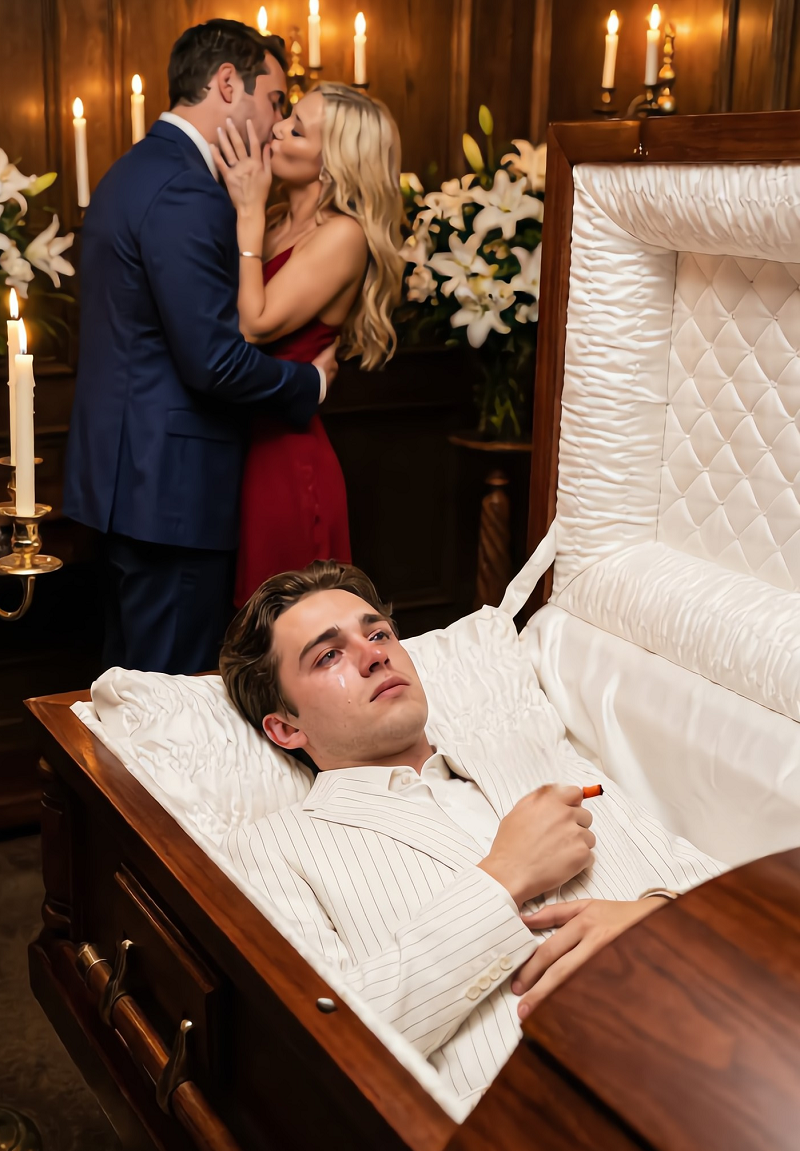
I was inside my own coffin.
I was forty-five years old, the CEO of Blackridge Bourbon, a family company worth hundreds of millions of dollars—and I was fully conscious while people mourned me as if I were dead.
I tried to scream.
Nothing happened.
My body remained perfectly still.
A woman nearby sobbed loudly.
“My poor husband,” Victoria said. “He worked too hard. I begged him to slow down.”
My wife.
Even through the padded walls of the coffin, I recognized the practiced tremble in her voice.
People rushed to comfort her.
Someone told her she had been a devoted wife.
Someone else said I had been lucky to have her.
If I could have laughed, I would have.
Then I remembered the tea.
Victoria had brought it to me the night before while I lay weak and dizzy in bed.
“Drink this,” she had whispered gently. “Dr. Vance says it’ll help your heart.”
Dr. Harrison Vance.
My private cardiologist.
My oldest friend.
The man I had trusted with my life.
I remembered taking three sips.
I remembered the room tilting.
I remembered Victoria watching me over the rim of the cup.
Not worried.
Waiting.
Then darkness.
Now, surrounded by lilies and satin, I understood.
My death had not been sudden.
It had been planned.
Part Two: The Grieving Widow
The funeral service was held in the private chapel attached to Blackridge Manor, my family’s estate outside Louisville, Kentucky.
I knew the chapel well. My mother’s memorial had been held there years earlier.
The vaulted ceiling turned every whisper into an echo.
A minister spoke about my generosity, my loyalty, and my commitment to preserving the company my grandfather had built.
Then Victoria approached the coffin.
Her perfume drifted through the narrow seam near my face.
She placed one hand on the lid.
“My darling Ethan,” she said, her voice breaking beautifully. “I don’t know how I’ll live without you.”
Applause would have been inappropriate, but she deserved it.
It was the performance of her life.
She leaned closer.
Her lips must have been inches from my ear.
Then, so softly that no one else could hear, she whispered, “Goodbye, Ethan.”
There was no grief in her voice now.
Only relief.
My heart began pounding.
Surely someone would notice.
Surely the funeral director would see my chest moving.
But the medication had trapped me inside my own body. My heartbeat felt violent to me, yet from the outside, I must have appeared completely still.
Footsteps approached.
A man murmured, “You should step away now, Mrs. Cole. The service is over.”
It was Harrison.
Victoria gave another convincing sob.
Guests began leaving.
One by one, their voices faded.
The chapel doors closed.
Silence settled over the room.
Then Victoria stopped crying.
“Is everyone gone?” she asked.
“Yes,” Harrison replied.
His voice was calm.
Clinical.
The same voice he had used for years while reviewing my medical reports.
A lock clicked.
Then I heard something worse than their words.
I heard them kiss.
Not a quick, frightened kiss.
A slow one.
Familiar.
When they finally separated, Victoria exhaled happily.
“It’s done,” she said.
“Not yet,” Harrison replied. “It’s done when the cremation is complete.”
My entire body screamed to move.
Harrison continued, “There can’t be an examination later. No second opinion. No questions.”
Victoria tapped her nails against the coffin.
“What if the drug wears off too soon?”
“It shouldn’t.”
“That isn’t an answer.”
Harrison sighed. “Even if he regains awareness, he won’t regain movement for several hours.”
“And the furnace?”
“It’s already heated.”
The words seemed to drain every bit of air from the coffin.
Victoria’s voice became quieter.
“Once he’s gone, the trust transfers to me?”
“Most of it.”
“And the voting shares?”
“Yours to control until the board meets.”
I understood then.
This wasn’t only about an affair.
It was about Blackridge Bourbon.
My company.
My name.
My family’s legacy.
Harrison had not merely betrayed me as a friend.
He and Victoria had decided to erase me and divide everything I had built.

Part Three: The Brother I Pushed Away
As the coffin was moved, wheels rattled beneath me.
Every bump sent a helpless jolt through my mind.
I tried to focus on anything that might keep panic from overwhelming me.
That was when I thought of my younger brother, Owen.
Owen should have been at the funeral.
But I hadn’t heard his voice.
We had once been inseparable.
As boys, we spent summers racing through the old barrel houses, hiding behind rows of oak casks while our father pretended not to find us.
When our parents died, I took control of the company.
Owen wanted a simpler life. He became a mechanical engineer and moved to Cincinnati.
Victoria never liked him.
She said he resented my success.
She said he was always asking questions about the company because he wanted money.
She said I needed to set boundaries.
Gradually, I stopped returning his calls.
Our last conversation had ended badly.
“You don’t sound like yourself anymore,” Owen had told me.
“I’m tired of your judgment.”
“I’m not judging you. I’m worried.”
“Then stop.”
That had been six months ago.
Now I would have given everything I owned just to hear his voice.
The coffin stopped moving.
A vehicle door slammed.
I heard Victoria speaking to someone outside.
“My husband was very private. He wanted a direct cremation after the family service.”
That was a lie.
My family had been buried for generations in the cemetery behind Blackridge Manor.
I had never wanted to be cremated.
Victoria knew that.
But fire destroyed evidence.
And fire could silence a man who was not yet dead.
The vehicle began moving.
Each turn made my body shift slightly against the satin lining.
I fought to move one finger.
Nothing.
I tried to blink.
Nothing.
I tried to control my breathing.
The breaths came so shallowly that I could barely feel them.
Somewhere beyond the coffin walls, traffic passed.
People were driving to work.
Buying coffee.
Complaining about the weather.
And I was traveling toward a furnace while my wife sat beside me pretending to mourn.
Part Four: The Final Goodbye
The ride ended sooner than I expected.
Doors opened.
The coffin rolled down a ramp.
The air changed. I could no longer smell the chapel’s flowers or polished wood.
Instead, I smelled metal, dust, and heat.
A crematorium employee spoke in a respectful tone.
“Mrs. Cole, would you like one final private moment before we proceed?”
“Yes,” Victoria said. “Dr. Vance is family. I’d like him to stay.”
The employee hesitated.
“Of course.”
A door closed.
Once again, I was alone with the two people who had tried to kill me.
Victoria released a breath.
“I hated that service.”
“You were convincing,” Harrison said.
“I had to be. Half the company board was watching me.”
“They believe you.”
“They’d better.”
The coffin lid creaked slightly as Victoria rested her hand on it.
“Do you think he knew?” she asked.
“Knew what?”
“About us.”
“No.”
“What about the financial transfers?”
Harrison paused.
“He had started asking questions.”
My thoughts raced.
Two weeks earlier, my chief financial officer had told me that money was moving through a consulting account I didn’t recognize.
When I asked Victoria about it, she claimed it was related to a charity project.
Harrison had advised me to take time away from work because stress was affecting my heart.
They had been buying time.
Preparing.
Victoria lowered her voice.
“I still can’t believe you kept the recorder.”
“I destroyed it.”
“You said you threw it away.”
“After I smashed it.”
“What about the memory card?”
“I removed it.”
“Where is it?”
Another pause.
“In my office.”
“You should have destroyed that too.”
“I will after this.”
My heart seemed to stop.
A recorder.
They had recorded something.
Perhaps my medical readings.
Perhaps forged instructions.
Perhaps their conversations.
Whatever it was, they believed it could hurt them.
Victoria asked, “And the empty vial?”
“I put it in the garbage bag with the broken recorder. The trash was collected from the mansion early this morning.”
She gave a nervous laugh.
“Then there’s nothing left.”
Harrison’s reply was cold.
“In a few minutes, there won’t be.”
Part Five: The Furnace
The crematorium employee returned.
“We’re ready, Mrs. Cole.”
Victoria began crying instantly.
“Please take care of him.”
“We will.”
The coffin moved again.
This time, the sound was different.
Not wheels over carpet.
Metal rollers.
A mechanical hum.
Heat pressed through the wood around me.
The furnace was close.
Too close.
I thought of all the things I had never said.
I thought of the employees who had trusted me.
I thought of my father teaching me to identify bourbon by scent.
I thought of Owen standing beside me at our mother’s grave, both of us promising that nothing would ever divide us.
Then I thought of the final conversation I had with him.
I had hung up while he was still speaking.
Regret hurt more than fear.
The machinery stopped.
A button beeped.
The furnace roared to life.
The sound filled the room like a storm.
Someone began reading a checklist.
Victoria sniffled behind me.
Harrison said nothing.
I gathered every bit of strength left inside me.
Move.
I ordered my hand.
Move.
A spark of sensation appeared in my right thumb.
I pushed harder.
The thumb twitched.
Barely.
No one noticed.
I tried again.
My fingernail scraped the satin.
It produced the faintest sound.
Victoria stopped crying.
“Did you hear that?”
“Hear what?” the employee asked.
“Nothing,” Harrison answered quickly. “She’s overwhelmed.”
The machinery started again.
The coffin moved forward.
The heat intensified.
I scraped my thumb against the lining once more.
The sound was too soft.
The furnace door began opening.
Then a crash thundered through the room.
A door slammed against the wall.
Footsteps raced across the floor.
A man shouted, “STOP!”
The machinery halted.
Everyone began talking at once.
“What are you doing here?”
“Sir, you can’t—”
“Turn it off!”
My heart surged.
I knew that voice.
Owen.
Victoria sounded shocked. “You weren’t invited.”
“I don’t care.”
Harrison stepped forward. “He’s grieving. Get him out of here.”
Owen roared over them all.
“TURN OFF THAT FURNACE—ETHAN IS ALIVE, AND I HAVE VICTORIA AND VANCE ON TAPE ADMITTING THEY DRUGGED HIM!”
Silence followed.
A deep, absolute silence.
Then Victoria whispered, “That’s impossible.”

Part Six: What Owen Found
The crematorium employee immediately shut down the system.
Harrison tried to take control.
“This man is unstable,” he said. “Ethan was examined and legally declared dead.”
“By you,” Owen replied. “The same doctor whose voice is on this recording.”
“You have no idea what you heard.”
“I heard you discuss the drug, the forged heart report, and the plan to destroy Ethan before an autopsy could expose you.”
Victoria’s breathing became uneven.
“That recording was destroyed.”
Owen’s voice sharpened.
“So you admit there was one?”
She said nothing.
I heard a small plastic object strike a metal table.
“The cleaning crew hadn’t collected the rear service bins,” Owen said. “I found the broken recorder in a bag outside the mansion. You removed the main memory card, Harrison, but you forgot that Ethan used recorders with an automatic backup chip.”
Harrison swore under his breath.
Owen continued, “I repaired enough of it to recover the last conversation recorded in Ethan’s study.”
Victoria tried to leave.
Owen blocked her.
“The police are outside.”
Harrison said, “This is absurd. A damaged recording proves nothing.”
“Then open the coffin.”
“No,” Victoria snapped.
Everyone froze.
The crematorium employee asked, “Why wouldn’t we open it?”
“Because…” Victoria stammered. “Because it would be disrespectful.”
Owen stepped toward the coffin.
“Ethan would rather be disrespected than burned alive.”
The lid was locked for transport.
Someone fumbled with the mechanism.
Seconds dragged by.
At last, the seal released.
Cooler air touched my face.
“Ethan?” Owen said.
I tried to move.
Nothing happened.
Harrison spoke immediately.
“You see? He’s dead.”
Owen leaned closer.
His hand touched my wrist.
“Come on, big brother.”
I gathered everything inside me.
My thumb moved.
Once.
Then again.
Owen sucked in a breath.
“He moved.”
“That could be a reflex,” Harrison said.
My eyelid trembled.
Then, with enormous effort, I opened my eyes a fraction.
The world appeared as a blur of white light and terrified faces.
Victoria stood near the doorway.
The color had vanished from her skin.
Harrison took one step backward.
Owen looked down at me, tears filling his eyes.
“I knew you wouldn’t leave without arguing with me one more time.”
Part Seven: The Man Who Declared Me Dead
Paramedics rushed in.
They removed me from the coffin and placed me on a stretcher.
I could hear Victoria protesting as police officers separated her from Harrison.
“This is a misunderstanding!”
Harrison claimed I had suffered a rare medical event.
He insisted he had acted in good faith.
Then Owen played the recording.
The audio was damaged, but the important words were clear.
Victoria’s voice: “How long will he appear dead?”
Harrison’s reply: “Long enough to sign the certificate and complete the cremation.”
Then came the sound of them laughing.
No explanation could erase that.
At the hospital, doctors discovered that my heart had never stopped.
The substance Harrison gave me had slowed my pulse and breathing to dangerous levels while leaving me aware.
Because Harrison was the attending physician, no independent examination had been requested.
He signed the death certificate himself.
Victoria then used the document to rush the cremation.
It was a carefully designed plan.
But it had depended on everyone trusting the grieving widow and the respected doctor.
For two days, I remained weak and unable to speak.
Owen stayed beside me.
He slept in a chair with his arms folded across his chest, just as he had when our mother was sick.
On the third morning, I managed one word.
“Sorry.”
Owen looked up.
“For what?”
I struggled to speak.
“Not… believing you.”
He leaned back and rubbed his eyes.
“Save your strength.”
“I pushed you away.”
“Yes, you did.”
His honesty almost made me smile.
Then he reached for my hand.
“But you’re still my brother.”
Part Eight: Victoria’s Real Plan
During the investigation, the full conspiracy emerged.
Victoria and Harrison had been having an affair for nearly two years.
Together, they created fake consulting companies and moved almost $18 million from Blackridge Bourbon.
When my finance team began noticing irregular payments, Victoria became afraid I would uncover the truth.
Harrison began altering my medical records.
He added reports of heart rhythm problems I had never experienced.
He prescribed medications I did not need.
Then he encouraged me to work from home, where Victoria could control who saw me.
Their plan was to make my death look inevitable.
Afterward, Victoria intended to take control of my voting shares and approve the sale of Blackridge to an international corporation.
Harrison expected to receive a portion of the money and disappear with her.
But the plan had another weakness.
My will.
Victoria believed she would inherit everything.
She did not know that three months earlier, after discovering the strange financial transfers, I had quietly revised my estate documents.
Control of the company would not pass directly to my wife.
It would transfer to a temporary trust overseen by Owen until the board completed an investigation.
My instincts had warned me that something was wrong.
I simply hadn’t understood how wrong.
When investigators told Victoria, she reportedly stared at the wall for several minutes.
She had tried to kill me for a fortune she never would have controlled.

Part Nine: The Trial
The case became national news.
Headlines called me “The Man Who Woke at His Own Cremation.”
Reporters crowded outside the hospital.
Documentary producers offered millions for interviews.
I refused them all.
This was not a story I wanted to become famous for surviving.
It was a warning about what happens when trust becomes blind.
Victoria tried to claim Harrison had manipulated her.
Harrison claimed Victoria had designed the plan.
The recording contradicted them both.
It captured their discussions, their financial scheme, and their decision to destroy the evidence.
The damaged recorder Owen found in the garbage became the center of the case.
A piece of broken plastic no one thought mattered ended their carefully built lies.
At trial, I sat across from Victoria for the first time since the crematorium.
She looked smaller than I remembered.
She no longer wore the elegant clothes or perfect makeup that had once made her seem untouchable.
For a moment, our eyes met.
I searched her face for regret.
What I saw was resentment.
She wasn’t sorry for what she had done.
She was sorry she had failed.
When I testified, the courtroom was silent.
I described waking inside the coffin.
I described hearing them kiss.
I described the furnace.
I did not raise my voice.
I did not need to.
The truth was terrible enough without decoration.
Victoria and Harrison were convicted on multiple charges, including attempted murder, conspiracy, fraud, and falsifying medical records.
They received long prison sentences.
As officers led Victoria away, she turned toward me.
“I did love you once,” she said.
I looked at her and answered quietly.
“No. You loved the life you thought I could give you.”
Then I walked out of the courtroom beside my brother.
Part Ten: Rebuilding Blackridge
Recovering my strength took almost a year.
At first, I needed help standing.
Then I learned to walk steadily again.
Each step felt like a declaration.
I was still here.
Owen temporarily took control of Blackridge while I recovered.
Unlike what Victoria had claimed, he never tried to keep the company.
He uncovered the stolen funds, rebuilt the accounting department, and protected hundreds of jobs.
When I returned to the headquarters for the first time, every employee was waiting in the main courtyard.
No reporters.
No cameras.
Just the people who had worked beside my family for decades.
They applauded as Owen helped me from the car.
I stood before them with a cane and looked at the brick warehouses, the copper stills, and the black oak sign bearing our family name.
“I spent years believing leadership meant trusting my own judgment above everyone else’s,” I told them. “I was wrong. Leadership means listening when people who care about you are brave enough to tell you something you don’t want to hear.”
I turned toward Owen.
“I almost lost my life because I stopped listening to my brother.”
Owen looked embarrassed by the attention.
“So I’m fixing that mistake,” I continued. “Effective immediately, Owen Cole is the co-chairman of Blackridge Bourbon.”
The courtyard erupted.
Owen leaned toward me.
“You could have warned me.”
“You might have said no.”
“I’m still considering it.”
“You came to my funeral uninvited. I assumed boundaries weren’t important to you.”
For the first time in months, we both laughed.
Epilogue: One Year Later
On the first anniversary of the day I nearly died, Owen and I returned to the chapel at Blackridge Manor.
The lilies were gone.
Sunlight poured through the stained-glass windows.
I stood near the place where my coffin had rested.
For months, I had avoided that room.
Sometimes, I still woke at night imagining the furnace roaring.
Sometimes, the smell of flowers made my chest tighten.
But fear grows stronger when it is never faced.
Owen stood beside me.
“You okay?” he asked.
“I think so.”
We walked outside to the family cemetery.
My parents’ graves rested beneath an old maple tree.
I placed my hand on my father’s headstone.
“I almost joined you early,” I said.
Owen shoved his hands into his jacket pockets.
“Dad would have complained about the cremation.”
“He would have complained about the coffin.”
“He would have complained about the flowers.”
“He hated lilies.”
We stood quietly for a while.
Then Owen pulled something from his pocket.
It was the broken recorder.
The police had returned it after the trial.
The plastic casing was cracked. One corner was melted from Harrison’s attempt to destroy it.
I stared at the small object that had saved my life.
“Why did you go through the trash?” I asked.
Owen shrugged.
“Victoria told me the funeral was private and I wasn’t welcome at the mansion. That made me suspicious.”
“That’s all?”
“No. You left me a voicemail the night before you died.”
I looked at him.
“I did?”
“You sounded weak. You said you thought something was wrong with the company. Then the message cut off.”
I remembered reaching for my phone after drinking the tea.
I had tried to call him.
“I thought the call never connected.”
“It did.”
Owen looked toward the trees.
“When I heard you were dead, I knew the timing was wrong. Victoria had the house cleaned immediately, so I checked what they were throwing away.”
“And you found the recorder.”
“I found a hundred useless things first.”
He handed it to me.
I closed my fingers around the cracked device.
For most of my life, I had believed powerful things were large.
Companies.
Fortunes.
Mansions.
Names engraved on buildings.
But the most powerful object I had ever held was a broken recorder pulled from a garbage bag by a brother I had pushed away.
I looked toward Blackridge Manor, where employees were preparing for the company’s annual family picnic.
Children chased one another across the lawn.
Music played near the old barrel house.
Life continued.
Not the life I had before.
Something better.
A life built without Victoria’s lies.
A company protected from the people who had tried to steal it.
A relationship with my brother restored by the narrowest possible miracle.
I handed the recorder back to Owen.
“Keep it.”
“Why?”
“So the next time I ignore your advice, you can put it on my desk.”
He smiled.
“I’ll frame it.”
We started walking toward the picnic.
Halfway there, Owen stopped.
“There’s something I’ve been meaning to ask.”
“What?”
“While you were trapped in the coffin, could you really hear everything?”
I nodded.
“Unfortunately.”
“So you heard my speech at the hospital about how much I admired you?”
“You didn’t make a speech.”
“Good.”
“But you cried.”
“I had allergies.”
“In February?”
“Rare winter allergies.”
I laughed as we continued down the hill.
Behind us, the chapel doors stood open.
For a long time, I had thought of that building as the place where my life nearly ended.
Now I understood it differently.
It was the place where deception was finally exposed.
The place where my brother refused to believe a convenient lie.
The place where a man everyone had given up on moved his thumb—and began his life again.
Victoria and Harrison had planned every detail.
The false diagnosis.
The drugged tea.
The death certificate.
The grieving performance.
The rushed cremation.
They thought wealth had made me isolated.
They thought betrayal had made me helpless.
They thought fire would destroy the truth.
They were wrong.
Because the one person they dismissed was the person who knew me best.
And when the furnace roared, my brother came through the door carrying the truth they had thrown away.
Disclaimer: This story is a work of fiction created for entertainment purposes. Any resemblance to real people, events, or places is purely coincidental.