There are some stories that are not simply remembered; they are felt. They stay with us because they reveal something powerful about the human spirit — the ability to endure pain, to fight through darkness, and to hold on to hope when every possible reason to hope seems gone. In the history of war, countless acts of courage have been recorded, but few journeys capture the raw determination of survival quite like the story of U.S. Navy Lieutenant Dieter Dengler. His name became forever connected with one of the most extraordinary escapes of the Vietnam War era, a story of suffering, resilience, and a refusal to surrender even when death seemed closer than rescue.
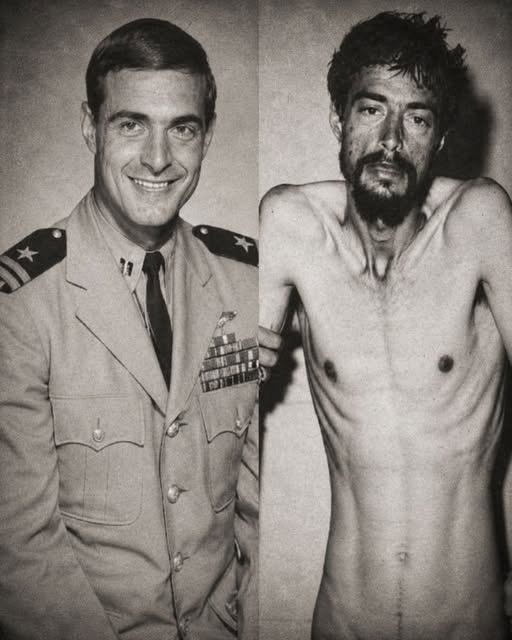
For 23 days, Dieter Dengler walked through one of the most unforgiving environments on Earth. He had no food supplies, no map, no protection, and no certainty that anyone would ever find him. The jungle of Laos surrounded him like an endless wall of green, filled with danger at every turn. His body was broken by months of captivity, his strength was fading, and every step became a battle against exhaustion. Yet somewhere deep inside him remained a belief that would not disappear: he was going to survive.
Many people know war stories because of battles, weapons, and armies. But Dieter Dengler’s story was different. His greatest battle was not fought against an enemy soldier. It was fought against hunger, fear, loneliness, disease, and the voice inside his own mind telling him that he could not continue. His battlefield was the jungle, and his weapon was something no enemy could take away from him — his determination.
Before he became a symbol of survival, Dieter Dengler was simply a young man with a dream. Born in Germany in 1938, he grew up during one of the darkest periods in modern history. As a child, he witnessed the destruction and suffering left behind by World War II. His early years were shaped by hardship, but they also gave him a powerful dream that would guide his entire life.
One day, as a young boy, he looked into the sky and saw an American aircraft flying overhead. To many people, it may have been just a machine passing through the clouds. But to Dieter, it represented something much bigger. It represented freedom. It represented possibility. It represented a world beyond the limitations of his childhood.
From that moment, he knew he wanted to fly.
That dream never left him.
Years later, after moving to the United States, Dengler worked hard to build a new life. He joined the U.S. Navy and eventually became a pilot, achieving the very thing he had imagined as a child. Flying was not just a profession for him; it was the fulfillment of a promise he had made to himself many years before.
But destiny can be unpredictable. The same skies that once represented freedom would eventually lead him into one of the most terrifying experiences imaginable.
During the Vietnam War, Lieutenant Dieter Dengler was assigned to fly missions over Southeast Asia. In 1966, while participating in a mission over Laos, his aircraft was shot down. The plane crashed into dense jungle territory, far from safety and surrounded by enemy forces.
In the moments after the crash, Dengler was no longer a Navy pilot flying above the clouds. He was a survivor trapped in hostile land.
He knew that being captured could mean torture or death. He knew the jungle offered little protection. But he survived the crash, and that alone was an act of incredible determination. Injured and alone, he began trying to navigate through unfamiliar territory, hoping against hope that rescue would come.
But rescue never arrived.
Instead, he was captured.
What followed were months of suffering that tested every limit of human endurance.
Dengler was taken prisoner by Pathet Lao forces and brought to a hidden prison camp deep in the jungle. The camp was not simply a place of physical confinement; it was a place designed to destroy the mind. Prisoners were deprived of food, exposed to disease, and forced to live with the constant fear that they might never leave.
The conditions were brutal.
Days blended into nights. Hunger became normal. Pain became familiar. Hope became something that had to be protected like a precious resource.
The human body can endure incredible suffering, but the mind often breaks first. When a person begins believing there is no future, survival becomes almost impossible. That was the greatest danger faced by prisoners like Dengler. The enemy was not only outside the prison walls. It was also the despair that slowly entered their thoughts.
But Dieter Dengler refused to allow captivity to define him.
Even while weakened and exhausted, he watched. He studied his surroundings. He looked for opportunities. He understood that freedom would not be given to him. If he wanted to live, he would have to fight for it.
The decision to escape was one of the most dangerous choices of his life.
Some prisoners believed that escaping into the jungle was impossible. The wilderness was enormous, and they had almost nothing to help them survive. But remaining in captivity meant waiting for a slow death.
Dengler chose the only chance he had.
Freedom.
The escape was filled with danger from the very beginning. Every sound could reveal their location. Every movement could attract enemy patrols. Once they disappeared into the jungle, they were no longer prisoners — but they were also not yet free.
They were simply men fighting to stay alive.
The jungle of Laos was unlike anything most people could imagine. It was beautiful from a distance, but terrifying up close. The thick vegetation blocked sunlight. The heat was overwhelming. Rain could arrive suddenly and soak everything they carried. Insects, illness, injuries, and starvation were constant threats.
For someone who had spent months being tortured and deprived of food, the jungle was almost an impossible challenge.
But Dengler kept moving.
He did not have the luxury of thinking about how far he had to go. He could not imagine the endless days ahead. He could only focus on what was directly in front of him.
One more step.
One more hour.
One more sunrise.
That was how he survived.
In the jungle, every small victory mattered. Finding water was a victory. Finding something edible was a victory. Having enough strength to stand up another morning was a victory.
The human spirit often reveals itself in the smallest moments. Not in dramatic speeches or heroic poses, but in quiet decisions made when nobody is watching. Dengler’s courage was found in those moments — when his body begged him to stop, but his mind told him to continue.
He survived on stream water and whatever plants he could find. He endured exhaustion that would have broken many stronger men. He fought against hunger that consumed his thoughts. He carried wounds, weakness, and fear, yet he continued moving through the endless wilderness.
The jungle tried to convince him that he was already defeated.
But Dieter Dengler had spent his entire life refusing to accept impossible things.
The little boy who once looked up at an airplane in the sky was still inside him. The young man who chased his dream across continents was still alive. The pilot who had faced danger in the air was now facing danger on the ground.
And he refused to surrender.
After more than three weeks alone in the wilderness, Dengler’s condition became desperate. His body was dangerously weak. He had lost a significant amount of weight. His chances of survival were shrinking with every passing day.
But then, something happened that changed everything.
High above the jungle, an American aircraft passed through the sky.
For many people, it would have been just another flight over a vast and dangerous landscape. But for Dieter Dengler, it was a possible miracle.
He knew this might be his only chance.
Using the last remaining strength he had, he tried to make himself visible. He created signals. He moved. He fought against exhaustion one final time, hoping someone above would notice.
And then, someone did.
The aircraft crew spotted signs of life below.
After 23 days of suffering, loneliness, and unimaginable hardship, the possibility of rescue became real.
But even then, the danger was not over.
A rescue mission into enemy territory was extremely risky. The men coming to save him were putting their own lives in danger. The jungle that had trapped Dengler for weeks remained dangerous, and reaching him required courage from those who refused to leave a fellow American behind.
When the rescue finally came, it marked the end of one of the most incredible survival journeys of the Vietnam War.
Dieter Dengler had walked through hell and survived.
But the greatest lesson from his story was not simply that one man lived through impossible circumstances.
It was that hope itself can become a form of survival.
Because long before the rescue aircraft appeared, long before someone finally saw his signals from above, Dieter Dengler had already defeated the greatest enemy he faced.
He had defeated the belief that he could not make it.
His story remains powerful decades later because it reminds us of something deeply human: sometimes survival begins long before the situation changes. Sometimes it begins with a single decision inside the heart — the decision to keep going.
Dieter Dengler was not the strongest man in the jungle. He was not protected by comfort, equipment, or certainty. He was simply a man who refused to give up.
And sometimes, that is the greatest strength a person can have.
His journey through the jungles of Laos became more than a story of war. It became a story about courage when courage seems impossible, about hope when hope seems foolish, and about the extraordinary power of the human spirit to survive even the darkest moments.
Because there are battles fought with weapons, and there are battles fought with nothing but the will to live.
Dieter Dengler fought the second kind.
And he won.