Part 2
“Dad, just as you told me, destroy his life.”
For three seconds, there was nothing on the line but my father’s breathing.
Not sharp. Not startled.
Measured.
The same kind of silence I remembered from childhood, when men in gray suits sat across from him in rooms lined with books and tried to pretend they were not afraid. My father had never been loud. He did not pound tables or make promises he couldn’t keep. He simply listened until people revealed what they were, and then he decided what came next.
“Elena,” he said, and hearing my name in his voice nearly broke me. “Are you safe?”
I almost laughed.
The word safe seemed to belong to another language, one spoken in warm kitchens, in quiet bedrooms, in lives where husbands did not stand above their wives with cold eyes while another woman smiled.
“No,” I whispered.
Adrian’s face changed.
The arrogance did not disappear all at once. It fractured first, like a fine crack in glass.
“Who is that?” he demanded.
I did not answer him.
My father’s voice lowered. “Are you alone?”
“No.”
“Is he there?”
“Yes.”
A pause.
“Put me on speaker.”
I did.
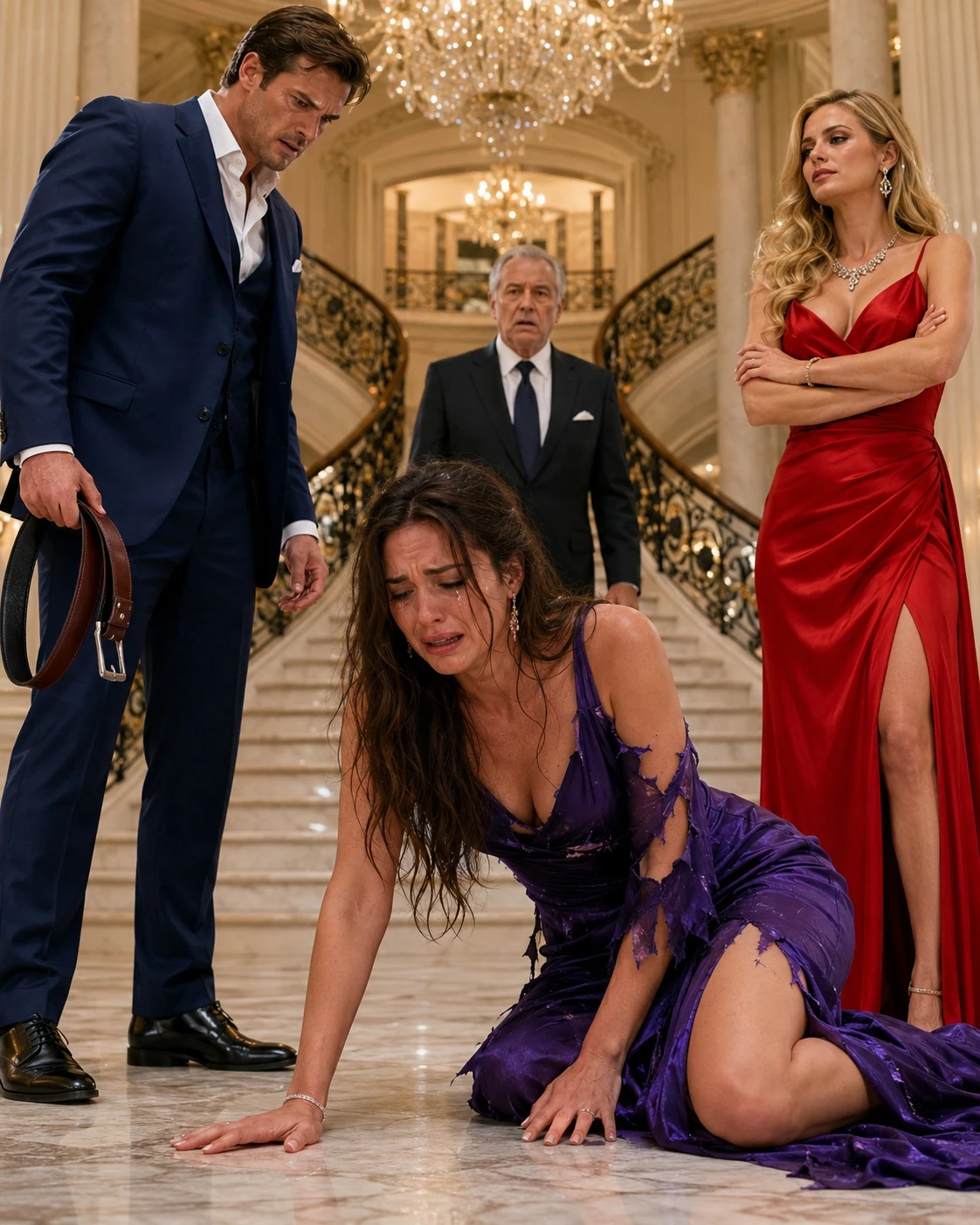
The grand hall seemed to draw in a breath. The chandelier light trembled over polished marble, over the fallen folder beside me, over the thin red line along my wrist where my bracelet had snapped. Vanessa stood slowly, her confidence disturbed but not yet defeated. Adrian straightened as if posture alone could protect him from whatever had entered the room through my phone.
“Adrian Vale,” my father said.
Adrian’s eyes narrowed. “Who is this?”
“You should have asked that question three years ago.”
The color drained from Adrian’s face in a way I had never seen before. Not completely. Just enough to prove his body understood something his pride refused to accept.
Vanessa looked between us. “Adrian?”
My father continued, calm and clear. “My daughter requires medical attention. You will step away from her now. You will not touch her phone. You will not block the door. The staff already know to let my people in.”
Adrian laughed once, but it came out dry. “Your people?”
As if summoned by the words, the front gates buzzed from the intercom panel across the hall.
Then again.
Then the sound of tires over the gravel drive rose faintly through the open windows.
Vanessa’s smile vanished.
Adrian turned toward the doors. “What did you do?”
I held the phone against my chest. “What you never bothered to find out.”
The first person through the door was not a bodyguard.
It was Mrs. Harlow.
Our housekeeper, gray-haired and usually silent, stepped into the hall with a wool coat thrown over her uniform, her face pale with fury. Behind her came Martin, the head driver, followed by two men I did not know and one I did.
Thomas.
My father’s chief of staff.
He was tall, spare, and meticulous, the kind of man who looked as if he had been born wearing a navy suit. I had known him since I was thirteen, when he found me crying behind a staircase after my mother’s funeral and sat beside me without saying anything until I was ready to stand.
Now he entered Adrian’s house as if it had already stopped belonging to him.
“Elena,” Thomas said, and for the first time in years, his composed expression faltered.
I tried to stand. My knees refused.
Mrs. Harlow made a sound deep in her throat and hurried to me. She knelt carefully, not touching until I nodded, then wrapped her coat around my shoulders. The fabric smelled of lavender soap and winter air.
“Oh, my dear girl,” she whispered.
I closed my eyes.
No one had called me that in this house. Not in a long time.
Adrian moved toward us. “Get away from her.”
One of the men with Thomas stepped into his path. He did not push. He did not threaten. He simply stood there, broad enough to make Adrian stop.
“This is my home,” Adrian snapped.
Thomas looked at him. “Not entirely.”
The words landed softly, but the effect was immediate.
Adrian’s mouth opened, then closed.
Vanessa folded her arms, recovering enough to sneer. “This is ridiculous. Adrian, call security.”
Mrs. Harlow’s hands shook as she adjusted the coat around me. “Security left ten minutes ago, Miss Delacourt.”
Vanessa turned on her. “Excuse me?”
Mrs. Harlow lifted her chin. “I said what I said.”
Thomas took the phone gently from my hand. “Mr. Ashford, I’m with her.”
Ashford.
My old name, spoken aloud in the house where I had buried it.
Adrian’s eyes snapped to mine.
“Elena Ashford?” he said.
Not Vale.
Ashford.
There it was—the name that had been removed from every article, every wedding announcement, every glossy society profile Adrian had carefully curated. He had introduced me as Elena Grey, an orphaned scholarship girl who had once worked for a nonprofit his company sponsored. That was true in the way a painting was true if you looked only at one corner.
I had been Elena Grey for five years because my mother had wanted me to live quietly after her death. Grey was her grandmother’s name. A sheltering name. A name without towers, banks, foundations, or boardrooms attached to it.
But Ashford was the name that opened doors before anyone touched the handle.
Adrian knew it now.
His face changed again.
This time, fear entered.
“Your father is Nathaniel Ashford?” Vanessa asked, her voice suddenly much smaller.
I looked at her. “Yes.”
The room seemed to tilt around that single word.
Adrian stepped back as if the marble had shifted under his feet. He knew my father, of course. Everyone in his world did. Nathaniel Ashford was not merely wealthy. He was old wealth, quiet wealth, the sort that did not need magazine covers because banks, hospitals, universities, and shipping routes carried his signature in private ink. His influence moved beneath the visible surface of things.
And Adrian Vale had built the last three years of his empire under the illusion that he had done it alone.
Thomas handed the phone back to me, still connected.
“Elena,” my father said, “an ambulance is on the way. Thomas will take care of immediate matters. You do not need to speak to Adrian tonight.”
“I want to,” I said.
Thomas looked down at me. Mrs. Harlow tightened her arm around my shoulders.
My father went quiet.
Then he said, “Then say only what you need to say.”
I lifted my head.
Adrian stood a few feet away with the riding crop hanging uselessly from his hand. Only then did he seem to realize he still held it. He dropped it as though it had burned him.
A small, ugly sound echoed when it struck the floor.
“I loved you,” I said.
The words surprised me. I had expected anger to rise first. Or triumph. But what came out was grief, raw and plain.
“I loved you when you had nothing but a good suit and a dozen impossible ideas. I loved you when you couldn’t sleep before your first investor pitch. I loved you when your mother called and you pretended you didn’t care that she was disappointed. I loved you through every version of yourself you were afraid the world might see.”
His jaw flexed.
“Don’t,” he said.
“You wanted a wife who made you look powerful,” I continued. “So I became quiet. You wanted someone who didn’t compete with you, so I stepped out of the light. You wanted the story of saving me because it made you feel noble. I let you tell it.”
“Enough,” he muttered.
“No,” I said. My voice trembled, but it did not break. “You never saved me. I was never helpless. I was protecting you from the one truth you could not bear.”
Vanessa swallowed. “What truth?”
I looked at Adrian.
“That I chose you when I could have chosen anyone.”
He flinched.
For a moment, the man I married appeared behind his eyes. Not the cold figure in the hall. Not the polished chairman with rehearsed smiles. The younger man who had once waited outside a rain-soaked community center for two hours because I had forgotten my umbrella. The man who had brought soup when I was sick and burned the toast because he didn’t know how to work my old stove. The man who had looked at me as if I were not a possession, not an accessory, not a stepping stone.
Then he was gone.
Vanessa touched his sleeve. “Adrian, don’t listen to this. She’s manipulating you.”
The softness vanished from his face, replaced by humiliation. He looked at her, then at the people in the hall, then at me. Pride rushed in to cover the wound.
“This doesn’t change anything,” he said. “I built my company.”
Thomas removed a slim folder from inside his coat. “Not exactly.”
Adrian’s eyes went to the folder.
Thomas did not open it. He did not need to. “Vale Capital’s expansion loan was guaranteed by Ashford Holdings through a private instrument. Your acquisition of Morland Systems was approved after Mr. Ashford personally reassured the lenders. Your last three manufacturing contracts were secured through relationships maintained by the Ashford Trust. There are also concerns about undisclosed leverage, irregular fund transfers, and personal expenses misclassified under corporate development.”
Vanessa stared at Adrian.
“What?” she whispered.
Adrian said nothing.
The silence answered for him.
My chest tightened. I had known some of it. Not all. I had suspected Adrian’s company was more fragile than he admitted, but I had not known how deep the cracks ran. I wondered if my father had told me to remain silent because he had seen what I could not bear to see.
Or because he was waiting for Adrian to reveal it himself.
The wail of an ambulance grew louder outside.
Adrian’s voice dropped. “You had me investigated?”
Thomas met his eyes. “No. We had our exposure monitored.”
That distinction seemed to frighten him more than an accusation would have.
My father spoke through the phone again. “Adrian.”
Adrian’s gaze lowered to the glowing screen in my hand.
“You will receive instructions through counsel,” my father said. “Tonight, you will cooperate with the medical team and allow my daughter to leave. In the morning, you will step down from operational control pending review.”
Adrian laughed, but there was no humor in it. “You can’t make me do that.”
“No,” my father replied. “Your board can.”
Adrian looked toward Thomas.
Thomas finally opened the folder and took out a single page. “A special emergency meeting was called seventeen minutes ago. Three independent directors have already confirmed attendance. Two major creditors requested immediate review after receiving documentation. By dawn, every person whose confidence you rely on will know there is a problem. Whether they learn there is also a scandal depends largely on your behavior in the next hour.”
Vanessa’s face sharpened with panic. “A scandal? What documentation?”
Adrian turned on her. “Be quiet.”
It was the first time I had ever seen him speak to Vanessa without softness.
Her eyes widened, not with hurt but calculation. Something passed across her expression—quick, ugly, frightened. She began to understand that the crown she thought she had won might be made of paper.
The paramedics entered then, carrying bags and a folded stretcher.
I did not remember much after that in a straight line.
Memory came in fragments: Mrs. Harlow holding my hand; Thomas giving quiet answers; Adrian standing rigid near the staircase; Vanessa whispering urgently into her phone until one of Thomas’s associates told her she might want to preserve all communications.
The air outside was cold when they carried me through the doors.
I turned my head once.
Adrian stood framed beneath the chandelier, smaller than I had ever seen him, surrounded by all the beauty he had mistaken for ownership. Behind him, Vanessa hovered with her arms wrapped around herself, the champagne silk dress catching the light.
For a brief second, Adrian looked at me not with anger, but bewilderment.
As if he could not understand how a woman he had treated as powerless had become the doorway through which consequence entered his life.
Then the ambulance doors closed.
And the house disappeared.
The hospital smelled like antiseptic, coffee, and rain-soaked wool.
A nurse with kind eyes asked me questions I answered automatically. Name. Date of birth. Allergies. Pain level. I said six because saying ten felt melodramatic, and the nurse looked at me as if she knew I was lying but would not challenge me.
My father arrived before dawn.
I knew he had entered the room before I opened my eyes. The atmosphere changed when he was near—not dramatically, not like in films where powerful men swept in and everyone scattered. It was subtler. Footsteps quieted. Voices lowered. The air gained a center.
When I looked over, he was standing just inside the door.
Nathaniel Ashford was seventy-one, though strangers often guessed younger because grief had sharpened rather than softened him. His hair was silver, his suit dark, his posture elegant. But his eyes were my mother’s eyes—deep brown, watchful, unable to hide tenderness from those who knew where to look.
For the first time since I was a child, I saw my father afraid.
“Elena,” he said.
I tried to sit up.
He crossed the room quickly and placed a hand on my shoulder. “Don’t.”
The word was gentle, but it undid me.
I covered my mouth with my hand, and the tears came silently at first, then all at once. I hated crying in front of him. Not because he was cold, but because he had already lost so much. My mother, my brother, years of laughter in a house too large for two people. I had not wanted to become another wound he had to carry.
He sat beside the bed and took my hand.
“I’m sorry,” I whispered.
His face tightened. “No.”
“I should have listened.”
“No.”
“I thought I could handle it.”
“Elena.” His voice broke slightly. “You are my daughter. You do not apologize to me for being hurt.”
I turned my face away, but he reached up and carefully brushed the hair from my cheek the way he had when I was small.
“I gave you freedom because your mother asked me to,” he said. “She wanted you to choose a life without my shadow over every door. I honored that. But I should have come sooner.”
“You warned me.”
“I warned you about men who loved what stood behind you more than they loved you. I did not imagine you would marry a man who failed to see either.”
Despite everything, a faint laugh escaped me. It hurt.
He smiled sadly. “There she is.”
I closed my eyes.
For a while, we said nothing.
Through the window, dawn slowly gathered behind the city skyline, turning the glass towers pale blue. Somewhere beyond them, phones were ringing in boardrooms. Lawyers were opening emails. Adrian’s carefully arranged life was beginning to shift.
But in that hospital room, none of it felt victorious.
It felt like waking from a long illness and realizing how much time had passed.
My father leaned back. “Thomas briefed me. The doctors say you’ll recover physically.”
Physically.
The word hung between us.
“And Adrian?” I asked.
“He has been advised to remain at the estate until counsel arrives.”
“Will he be arrested?”
My father studied me. “That depends partly on what you decide to report and how the authorities proceed.”
I looked down at the blanket. “I don’t know what I want.”
“That is allowed.”
“I thought I wanted him ruined.”
“You wanted the pain to stop.”
I swallowed.
He was right. In the hall, with blood on the marble and Vanessa’s smile above me, I had wanted destruction because destruction seemed like the only language strong enough to answer what had happened. But now, under hospital lights with bandages across my back and my father’s hand around mine, the word destroy felt too simple.
Lives did not collapse neatly.
They tangled. They revealed old mistakes. They pulled innocent people into the wreckage.
“What happens to his company?” I asked.
My father exhaled. “It depends on what the review finds. Vale Capital is not as strong as Adrian presented. There are liabilities. Some questionable transfers. A few decisions that may be negligence or something worse.”
“Will employees lose their jobs?”
“Not if we can prevent it.”
I looked at him sharply.
He understood the question beneath the question.
“I am not interested in burning down a building while people are inside,” he said. “Adrian’s choices will have consequences. That does not require chaos.”
Relief moved through me slowly, unexpected and deep.
There was a soft knock before Thomas entered carrying two paper cups of coffee and the expression of a man who had not slept but had made peace with it.
“Forgive the interruption,” he said.
My father accepted one cup. “What is it?”
Thomas glanced at me.
“I’m awake,” I said. “Say it.”
He hesitated, then nodded. “Adrian has refused to sign the temporary governance agreement. His attorney is arguing undue pressure and marital interference.”
My father’s expression did not change. “Expected.”
“There’s more.” Thomas opened his tablet. “Vanessa Delacourt left the estate at 5:42 a.m. despite instructions to remain available. She went to a private clinic on Mercer Street.”
I felt the room tilt.
“The pregnancy?” I asked.
Thomas’s face softened. “We don’t know. But the clinic is not obstetric. It specializes in cosmetic dermatology and discreet executive health screenings.”
My father’s eyes narrowed.
I stared at the thin hospital blanket.
Vanessa had placed her hand over her stomach with such perfect timing, such shining certainty. Adrian had believed her. Or wanted to believe her. A child would justify everything. His cruelty. His divorce. His need to rewrite me as the obstacle between him and happiness.
“What else?” I asked.
Thomas tapped the screen. “We reviewed the preliminary financial records Adrian’s office provided last quarter. Vanessa received payments through a consulting entity for the past eight months. Significant amounts.”
“How significant?” my father asked.
“Enough to suggest she was not merely his mistress.”
The word settled like cold water.
“What does that mean?” I asked.
Thomas looked at my father, then back at me. “It may mean she had access to company information. It may mean Adrian was hiding assets. Or it may mean someone else was using her to get close to him.”
My father set his coffee down untouched.
“Someone else?” I repeated.
Thomas brought up a photo on the tablet and turned it toward me.
It showed Vanessa leaving a restaurant three months earlier. Her hair was pinned up, her dress black, her expression serious rather than playful. Across from her at a small outdoor table sat a man with a trimmed beard and a familiar smile.
I knew him.
Not well. But enough.
“Julian Cross,” I said.
My father’s eyes moved to me. “You recognize him?”
“He was at our wedding.” I frowned, searching memory. “Adrian said he was an old university friend. They had some kind of falling out later.”
Thomas nodded. “Julian Cross owns a restructuring firm that profits from distressed acquisitions. He has been quietly purchasing debt connected to Vale Capital through intermediaries.”
The hospital room seemed suddenly too bright.
“So Vanessa was seeing Julian too?” I asked.
“We don’t know the nature of the relationship,” Thomas said carefully. “But they met at least six times in the past year.”
My father’s voice hardened. “And Adrian?”
“No indication he knew.”
A strange feeling moved through me then.
Not sympathy exactly. Not forgiveness. But recognition.
Adrian had thought he was controlling the story. Vanessa had thought she was writing it. My father had known pieces. Thomas had tracked shadows.
And I had been living at the center of it, unaware that my marriage had become a room full of hidden doors.
I leaned back against the pillow.
“What does Julian want?” I asked.
Thomas looked grim. “Possibly the company. Possibly leverage over Adrian. Possibly something involving you.”
“Me?”
My father’s hand tightened around the armrest.
Thomas swiped to another document. “Three days ago, someone requested sealed archival information about Elena Grey from a private records broker. The request was blocked by one of our safeguards.”
My pulse quickened. “Who requested it?”
“The account traces to a shell company associated with Julian Cross.”
My father stood.
It was a quiet movement, but the room changed with it.
“Why didn’t I know?” I asked.
“We confirmed it only this morning,” Thomas said. “At first, it appeared to be routine background digging. Now, with Vanessa involved, it may be connected.”
I looked between them. “Connected to what?”
Neither answered quickly enough.
A chill spread through me that had nothing to do with the hospital air.
“Dad.”
My father walked to the window, looking out at the waking city. For a moment, he was not the formidable Nathaniel Ashford. He was an old man carrying a memory he did not want to hand to his daughter.
“There are parts of your mother’s estate you never asked about,” he said.
I blinked. “Because you told me they were settled.”
“They were settled legally. Not completely.”
Thomas lowered his gaze.
I pushed myself higher despite the pain. “What does that mean?”
My father turned back to me.
“Your mother left more than money.”
The sentence opened something old inside me.
My mother, Isabelle Ashford, had been sunlight in every room she entered. That was how people described her. They remembered the charities, the concerts, the way she remembered birthdays and names of children. But to me she had been bedtime stories in French, cold hands wrapped around mugs of tea, laughter that made my father pretend not to smile.
She had died when I was twenty-one.
A private plane accident over the Atlantic.
A tragedy. A headline. A closed chapter.
At least, that was what I had been told.
“What did she leave?” I asked.
My father did not answer directly. “Before she died, Isabelle became concerned about certain investments connected to the family trust. She believed someone close to us was moving assets through charitable channels.”
“Stealing?”
“Perhaps. Or hiding something.”
“And Julian Cross?”
“He worked briefly for one of the firms involved.”
The room went very still.
I stared at my father. “You knew him?”
“I knew of him.”
“Was Adrian part of it?”
“No,” my father said. “Adrian was not in that circle then.”
“Then why is Julian near him now?”
“That is what we need to learn.”
A nurse entered to check my vitals, and the conversation folded itself away as if it had never existed. My father became courteous. Thomas stepped aside. I answered questions about pain, dizziness, medication. But my mind remained fixed on my mother’s name.
After the nurse left, my father told me to rest.
I refused.
“I’ve rested for three years,” I said. “Quietly. Politely. While everyone else made decisions around me. I’m done.”
He looked pained. “You are injured.”
“I’m also awake.”
Something like pride flickered in his eyes.
Thomas cleared his throat. “There is another matter.”
My father gave him a warning look.
Thomas ignored it with the bravery of a man who had survived decades in our family. “Elena should know.”
“Know what?” I asked.
He held out a sealed envelope.
It was cream-colored, thick, and old-fashioned, with my name written across the front in my mother’s handwriting.
My breath stopped.
“Elena,” it read.
Not Ella, the childhood nickname she used when I was sleepy. Not my formal name as written by lawyers. Elena, in the slanted script I had not seen in ten years except on birthday cards I kept locked in a drawer.
My fingers trembled as I took it.
“Where did this come from?”
My father’s face was unreadable. “Your mother left several letters with instructions. Some were to be given at certain milestones. Your wedding. Your thirtieth birthday. The birth of your first child.”
My throat tightened.
“I never received one at my wedding.”
“No,” he said softly. “Because the instruction attached to this one was unusual.”
I looked down at the envelope.
“What instruction?”
He answered quietly. “It was to be given only if you ever called me and used the phrase, ‘Destroy his life.’”
For a long moment, I could not speak.
The words I had said in desperation had not been mine alone. They had been a key.
A phrase planted years before I knew Adrian existed.
The envelope felt suddenly heavy.
“Why would Mom do that?” I whispered.
My father’s gaze lowered.
“Because she knew what it meant to love someone who made you doubt your own power.”
I looked up sharply.
Pain crossed his face before he hid it.
“My mother?” I said.
He said nothing.
The silence was answer enough to open a hundred questions I was not ready to ask.
I slid a finger under the envelope flap, but my hand shook too badly. My father stepped forward, then stopped himself, allowing me to do it.
Inside was a single folded sheet and a small brass key taped to the paper.
The key was old, delicate, and engraved with a symbol I recognized from my mother’s jewelry box: a crescent moon wrapped around a tiny branch of olive leaves.
I unfolded the letter.
My mother’s words waited there, patient as ghosts.
My dearest Elena,
If you are reading this, then you have reached the moment I feared and trusted would come. Feared, because pain has found you. Trusted, because you finally remembered you are not alone.
Do not let your father frighten the world on your behalf until you understand what frightened me.
There are truths buried in our family, not all of them noble. I made choices to protect you. Some were wise. Some were not. The key enclosed opens the blue cabinet in my study at Bellhaven. Inside, you will find a ledger, a photograph, and a name.
Trust Thomas.
Do not trust the man who says he loved me first.
I read the last line again.
Then a third time.
The hospital room faded at the edges.
“The man who says he loved me first,” I whispered.
My father had gone pale.
Not startled.
Pale.
As if my mother had reached through the years and touched a wound he had spent half his life covering.
“Dad?” I asked.
He did not look at me.
Thomas did.
And in Thomas’s careful, stricken silence, I understood something impossible.
My father knew exactly who the letter meant.
Before I could ask, Thomas’s phone buzzed.
He glanced down, and his expression changed.
“What is it?” my father asked.
Thomas looked at me, then at him.
“Adrian is missing.”
My heart struck once, hard.
“He left the estate?” my father demanded.
“Not willingly, it seems.” Thomas turned the screen toward us.
A security image filled the display: the side entrance of the estate, still gray with dawn. Adrian stood near a black sedan, coat half on, face tense. Beside him was Vanessa, no longer elegant, no longer smiling. She appeared to be arguing with someone inside the vehicle.
The image was blurred, but the man stepping from the shadows behind Adrian was clear enough.
Trimmed beard.
Familiar smile.
Julian Cross.
And in his hand was my mother’s crescent-and-olive symbol, hanging from a chain like a charm.
My fingers closed around the brass key.
For the first time that morning, my father looked truly afraid.
For one long moment, no one in the hospital room moved.
The image on Thomas’s phone glowed in the gray dawn light, small and silent, yet it seemed louder than every siren that had carried me through the night.
Adrian at the side entrance.
Vanessa beside him.
Julian Cross stepping from the shadows.
And in Julian’s hand, the crescent-and-olive symbol that had belonged to my mother.
My fingers tightened around the brass key until its edges pressed into my palm.
“Dad,” I said quietly, “who is he?”
My father did not answer at once.
That frightened me more than any immediate confession would have.
Nathaniel Ashford had faced collapsing markets, hostile takeovers, government inquiries, and men who smiled with knives hidden behind contracts. I had never seen him hesitate because hesitation gave other people room to strike.
But now he looked at the photograph as if it had reached into an old grave and pulled something living into the light.
“Julian Cross,” he said at last, “was born Julian Moreau.”
Thomas closed his eyes briefly, as though he had been hoping my father would choose any other beginning.
“Moreau?” I repeated.
“My mother’s maiden name.”
The room seemed to narrow around me.
My mother’s family had always been a soft blur in our history. French relatives, distant cousins, an old estate sold after the war, faded photographs in silver frames. Whenever I asked, my mother smiled and told me some stories were less interesting than they sounded.
Now I understood that adults often called things uninteresting when they were trying to keep children away from pain.
“Was he related to her?” I asked.
My father walked back from the window. In the pale hospital light, he seemed older than he had ten minutes before.
“He was her half brother.”
My breath caught.
Thomas looked down at his phone, giving us the mercy of not watching my face too closely.
“My mother had a brother?”
“A younger half brother,” my father said. “They were separated when they were children. Isabelle was raised by her aunt. Julian grew up with his father. By the time your mother inherited her portion of the Moreau estate, Julian believed he had been cheated out of what should have been his.”
I looked again at the frozen image on the screen.
The man with the trimmed beard and composed smile. The man Adrian had called an old university friend. The man Vanessa had met in restaurants. The man connected to debts, shell companies, and records brokers.
“He knew who I was,” I whispered.
“Yes,” Thomas said. “I believe he did.”
“And Adrian?”
My father’s expression tightened. “That is what we need to find out.”
Outside the door, a nurse laughed softly at something someone said down the hall. The sound was ordinary and warm. It felt impossible that the world had room for coffee cups, morning rounds, and casual laughter when my mother’s hidden brother had stepped into my life through betrayal and shadows.
I pushed the blanket aside.
“Elena,” my father warned.
“I’m going to Bellhaven.”
“No.”
The word came fast, hard, and frightened.
I stared at him.
He took a breath and softened his voice. “You need rest.”
“I need answers.”
“You need to heal.”
“I can do both.”
Thomas stepped forward. “The doctors won’t discharge you yet.”
“Then ask them what I’m allowed to do,” I said. “Because I’m not lying in this bed while Adrian disappears with a man connected to my mother’s death, my marriage, and the letter she left me.”
My father flinched at the words my mother’s death.
For years, our family had treated that tragedy like a locked room. We placed flowers outside the door. We dusted the frame. We spoke of what was beautiful before it happened, but never of the darkness inside.
Now my mother’s key lay warm in my hand.
“Dad,” I said, quieter now, “Mom left this for me. Not for you. Not for lawyers. For me.”
His eyes met mine.
For the first time, I saw the battle in him clearly. The father who wanted to shield me stood against the husband who had once promised my mother to trust the woman I would become.
Slowly, he nodded.
“We do this carefully,” he said.
Thomas was already moving toward the door. “I’ll arrange security and speak with the physician.”
My father turned to him. “And Adrian?”
Thomas paused. “We’ve alerted the police that he may be a witness in a larger financial coercion matter. Not a fugitive. Not yet.”
“And Julian?”
Thomas’s mouth became a thin line. “Julian Cross boarded no flights, checked into no hotels, and used no known cards after leaving the estate. Wherever he went, he planned for this.”
I looked down at the brass key.
“No,” I said.
Both men turned toward me.
“He went where my mother sent us.”
Bellhaven had always seemed less like a house than a memory that refused to fade.
It stood two hours outside the city, on a hill overlooking a stretch of silver water and wind-bent cypress trees. My mother had loved it there. She said the sea made secrets seem smaller.
As a child, I had run barefoot through its garden paths while she painted under the glasshouse roof. After she died, my father closed most of the rooms. The house remained staffed, maintained, polished, and lonely.
By afternoon, I arrived wrapped in a soft ivory cardigan, moving slowly but determinedly, with my father on one side and Thomas on the other. The doctors had allowed a temporary release only after my father promised enough medical oversight to equip a small country estate.
Mrs. Harlow met us at the entrance.
She had changed out of her uniform into a navy dress and sensible shoes, but her eyes were still red-rimmed.
“Elena,” she said, taking both my hands.
“You came.”
“I worked for your mother before I worked for you.” Her voice trembled. “I should have told you sooner.”
“Told me what?”
She looked past me at my father.
He gave the smallest nod.
Mrs. Harlow swallowed. “That your mother asked me to watch over you if you ever married a man who loved applause too much.”
Despite everything, a laugh escaped me. It turned into a wince, and then into something dangerously close to tears.
“That sounds like her,” I said.
Mrs. Harlow squeezed my hands. “She knew people. Sometimes too well.”
We crossed the entrance hall together.
The house smelled of lemon polish, old books, and the faint salt of the nearby coast. Sunlight stretched across the black-and-white marble floor. For an instant, I was eight years old again, chasing my mother’s scarf as it fluttered down the staircase.
The blue cabinet was in her study.
No one had opened that room in years except to clean it.
My father stopped outside the door.
“Do you want me inside?” he asked.
The question surprised me.
All my life, he had opened doors for me with a phone call, a name, a signature. But this door he left to me.
“Yes,” I said. “But let me turn the key.”
The study was exactly as I remembered and nothing like I remembered. The curtains were pale linen. Her books stood in careful disorder. A porcelain cup still sat on the windowsill, empty, as if she might return from the garden to finish her tea.
Against the far wall stood the blue cabinet.
Its paint had faded to the color of storm clouds.
My hand trembled as I fit the brass key into the lock.
It turned easily.
Inside were three things, just as the letter said.
A leather ledger.
A photograph.
And a folded card with one name written on it.
Julian Moreau.
Beneath the name was an address.
Not in the city.
Not overseas.
On the coast, twenty minutes from Bellhaven.
Thomas took a photograph of the card immediately. My father reached for the ledger, then stopped and looked at me.
I lifted it first.
The pages were filled with my mother’s handwriting. Dates. Donations. Company names. Trust transfers. Notes beside certain entries.
Some of the names I recognized as charities she had supported.
Others were unfamiliar.
On the last marked page, one sentence had been underlined twice.
Money is not disappearing. It is being redirected toward someone who knows our family from the inside.
Thomas leaned over the ledger, his expression sharpening.
“These accounts,” he said, “connect to entities currently holding Vale Capital debt.”
I looked at him. “Through Julian.”
“It appears so.”
My father took the photograph from the shelf.
His face changed before I saw it.
When he handed it to me, I understood why.
My mother stood in the garden at Bellhaven, younger than I had ever known her, her hair caught in the wind. Beside her stood a boy of perhaps twelve, thin and unsmiling, with dark eyes and one hand clenched around a wooden sailboat.
On the back, my mother had written:
Julian, before bitterness taught him to call love theft.
I touched the boy’s face lightly.
“He wasn’t always like this,” I said.
“No one is,” my father replied.
The words hung softly between us.
Then Thomas’s phone rang.
He answered, listened, and went very still.
“What is it?” my father asked.
Thomas looked at me.
“The police found Adrian.”
My heart leapt in a way that confused me.
“Where?”
“At the old Moreau boathouse.”
My father turned toward the window. In the distance, beyond the cypress trees and white road, the sea flashed cold and bright.
Thomas lowered the phone. “He’s alive. Unharmed. And asking for Elena.”
The boathouse stood where the hill dropped toward the water, half-hidden by reeds and weathered pines.
By the time we arrived, two police cars were parked along the narrow road. Officers moved quietly near the dock. The air smelled of salt, rope, and rain coming from far away.
Adrian sat on a bench outside the boathouse, wrapped in a dark blanket.
He looked nothing like the man from the grand hall.
His hair was disordered. His shirt was wrinkled. His face carried the gray exhaustion of someone who had looked into a mirror and not liked what looked back.
When he saw me, he stood too quickly.
An officer stopped him with one hand.
Adrian did not resist.
“Elena,” he said.
My father stepped forward. “Careful.”
Adrian’s eyes moved to him, then dropped. “I know.”
That was new.
Not defiance. Not performance.
Just two words, stripped bare.
I stopped several feet away. “Where is Julian?”
Adrian looked toward the water. “Gone.”
“Gone where?”
“I don’t know. He had a boat waiting. Vanessa went with him.”
Thomas exchanged a glance with one of the officers.
Adrian swallowed. “She told me she could fix everything. That Julian had documents proving your father manipulated my company, that I’d been trapped by the Ashfords from the beginning. I wanted to believe her.”
“Because believing her made you innocent,” I said.
The words were not cruel. They were simply true.
Adrian’s face tightened.
“Yes,” he said.
The honesty landed harder than any denial.
He sat back down slowly, as if standing required more strength than he had.
“She was never pregnant,” he said. “She admitted it in the car. Julian told her to say it because he knew I would do anything to preserve the story.”
“What story?”
Adrian looked at me with eyes red from sleeplessness.
“That I was chosen because I deserved to be chosen.”
The wind moved through the reeds.
For three years, I had waited for apologies that began with excuses. This did not sound like an apology yet. It sounded like the first stone removed from a wall.
“Julian said your mother stole his inheritance,” Adrian continued. “He said your father covered it up. He said you married me to keep watch over the debt he’d purchased. It sounded absurd at first, but then he showed me records. Transfers. Hidden names. The crescent symbol. He knew things about your family.”
“My mother was investigating him,” I said.
Adrian stared.
Then something in him seemed to collapse.
“Of course,” he whispered.
“What happened here?” Thomas asked.
Adrian rubbed his hands together, still cold despite the blanket. “Julian wanted me to sign control of certain company assets to his restructuring firm. He said if I didn’t, he would release everything—Vanessa, the debt, my financial misstatements, last night.”
He looked at me then, shame moving across his face.
“I refused when I realized he was using Vanessa too.”
I lifted my brows. “That was the line?”
Pain flickered in his eyes. He accepted the blow without flinching.
“No,” he said. “The line was when he said you were exactly like your mother. Too sentimental to use power properly.”
My chest tightened.
Adrian looked down. “I don’t know why that stopped me. It should have been you being hurt. It should have been everything before. But hearing him speak of you as a tool, as if your kindness made you foolish…” He shook his head. “I heard myself in him.”
No one spoke.
The sea slapped softly against the dock.
“I’m not asking you to forgive me,” Adrian said. “I don’t deserve it. I’ll cooperate with the police, the board, your lawyers, whoever comes. I’ll sign whatever protects the employees. I’ll give statements about Vanessa and Julian. But I needed to say one thing before I lose the right to say anything at all.”
I waited.
His voice broke.
“You were never dead weight. You were the only real thing in my life, and I mistook your gentleness for absence because I was too small to stand beside it.”
My hands curled inside my sleeves.
Part of me had imagined this moment as satisfying. Adrian humbled. Adrian exposed. Adrian finally understanding.
But it was not satisfaction I felt.
It was grief for the woman who had waited so long to hear words that came too late to save the marriage, yet not too late to save herself from believing she had imagined the love that once existed.
“Adrian,” I said, “I hope you become someone who never needs to lose everything to tell the truth.”
His eyes closed.
When he opened them, they were wet.
“That’s more mercy than I deserve.”
“Mercy isn’t about deserving.”
My father looked at me then, and something in his face softened with aching pride.
An officer approached Thomas and murmured something. Thomas turned to us.
“They found Vanessa’s phone in the boathouse. Julian left in a hurry.”
“Anything useful?” my father asked.
Thomas held up a clear evidence bag. Inside was a folded slip of paper, damp at one corner.
“The officers allowed me to read the visible part. It’s a ferry schedule. There’s a private crossing point south of here.”
My father’s gaze sharpened.
“How long?”
Thomas looked toward the darkening water.
“If he’s going there, we may still be ahead of him.”
The private crossing was not a dock so much as an old stone landing cut into the coast, reachable only by a narrow road between cliffs.
Rain began before we arrived, fine and silver, blurring the sea into the sky. Police lights flashed silently behind us, their colors catching on wet stone.
This time, my father insisted I remain in the car.
This time, I agreed.
Not because I was afraid, but because my body had begun to shake from exhaustion and pain, and courage, I was learning, did not require pretending limits did not exist.
Through the windshield, I saw officers move toward a low building near the landing. Thomas went with them. My father stood beside the car, one hand on the open door, unwilling to leave me completely.
Minutes passed.
Then the building door opened.
Vanessa came out first.
Her champagne confidence was gone. She wore a gray coat too large for her, her hair damp, her mascara blurred beneath her eyes. An officer guided her forward gently but firmly.
She looked toward our car and froze.
For a moment, hatred crossed her face.
Then fear.
Then something more fragile.
Shame, perhaps.
Or the beginning of it.
Behind her came Julian.
He did not struggle. He did not shout. He walked with the eerie calm of someone who still believed the final word belonged to him.
He was older than he had looked in photographs, with silver beginning at his temples and a face carved by restraint. Around his neck hung the crescent-and-olive charm.
My mother’s symbol.
My father saw it too.
He stepped away from the car.
Julian smiled when he recognized him.
“Nathaniel,” he called through the rain. “Still sending others to clean up family messes?”
My father did not answer.
Julian’s eyes shifted to me inside the car.
For a second, the world narrowed to the space between us.
He looked at me as if he were searching for my mother’s face.
Then he laughed softly.
“Isabelle’s daughter,” he said. “She even taught you to survive beautifully.”
Something in my father snapped—not violently, not loudly, but visibly. His shoulders squared, and the grief he had carried for years rose into his voice.
“She taught her to live,” he said. “That is why you failed.”
Julian’s smile thinned.
The officer began guiding him toward the second police car, but Julian stopped.
“I failed?” he said. “You built an empire on names you married into.”
My father stepped closer. Rain dotted his silver hair.
“I loved your sister.”
Julian’s expression flickered.
For the first time, he looked less like a mastermind and more like the boy in the garden photograph, clutching a wooden boat and believing the world had given everyone else more sky.
“She left me nothing,” Julian said.
My father’s voice was low. “She left you three letters, a trust, and a chance to meet her before the accident. You returned the first unopened. You liquidated the trust through intermediaries. You sold the second letter to a broker. You burned the third in front of her attorney.”
Julian went still.
I opened the car door despite the pain.
“Elena,” my father said.
I stepped into the rain.
Julian watched me approach.
“My mother wrote to you?” I asked.
His jaw worked. “She wrote lies.”
“What did she say?”
He looked away.
Thomas, standing nearby, reached into his coat and unfolded a plastic-protected document.
“One copy survived,” he said. “Her attorney kept a scan.”
My father looked surprised.
Thomas gave him a faint, apologetic smile. “Your wife trusted me too.”
He handed the page to me.
The rain tapped lightly against the plastic as I read.
My dear Julian,
I cannot return the childhood taken from us. I cannot make our parents kinder than they were. I cannot give you the years when you needed a sister and I did not know how to find you.
But I can tell you this: you were not forgotten.
What was set aside for you was never charity. It was belonging.
Come to Bellhaven. Bring the wooden boat if you still have it. I will bring mine. We will put them in the pond and decide, if we can, to begin somewhere gentler than where we were left.
Your sister,
Isabelle
By the time I finished, my throat ached.
Julian’s face had gone white.
“You had this?” he asked Thomas.
“Not until this morning.”
Julian looked at my father. “She never came.”
“She died before the meeting,” my father said.
The rain fell harder.
For years, Julian had built revenge on the belief that my mother had abandoned him. For years, my father had mourned a wife without knowing that one of her final acts had been an invitation.
Vanessa began crying quietly near the first police car.
Adrian, arriving in another vehicle with an officer, stood several yards away, hearing enough to understand how small his own lies looked beside a lifetime of misread grief.
Julian stared at the letter as if it were a door that had opened after the house burned down.
“She died,” he said, but now it sounded less like an accusation than a man speaking to a child inside himself.
“Yes,” I said.
He looked at me.
I held out the photograph from the blue cabinet. Thomas must have slipped it into the folder before we left.
Julian took it with trembling fingers.
His face changed completely.
The mask fell.
Rain streaked down his cheeks, but not all of it was rain.
“She kept this,” he whispered.
“My mother kept people,” I said. “Even when they hurt her. Even when she didn’t know how to reach them.”
For a moment, no one moved.
Then Julian bowed his head.
It was not redemption. Not absolution. Not a clean ending wrapped in forgiveness.
It was the first honest silence of a man who had mistaken old pain for purpose and found, too late, that the person he wanted to punish had been trying to love him.
The officers led him away.
This time, he did not look back.
The weeks that followed did not unfold like a fairy tale.
They unfolded like weather.
Some days were clear. Some days broke open without warning.
Adrian resigned from Vale Capital under board supervision and cooperated with investigators. The company survived, though not unchanged. My father’s team worked with the board to stabilize operations, preserve jobs, and unwind the debt Julian had weaponized.
Vanessa made a statement through counsel. Her role had been worse than foolish, less than mastermind. She had been ambitious, careless, and willing to wound another woman to secure a life she thought would save her from obscurity. But Julian had used her debts, her fears, and her hunger for recognition with precision.
I did not meet with her again.
One handwritten letter arrived three months later.
I opened it in my apartment, read the first line, and knew it was an apology.
I read the whole thing.
Then I placed it in a drawer.
Forgiveness, I had learned, was not always a conversation. Sometimes it was simply refusing to let someone’s worst act remain the center of your life.
As for Adrian, our divorce proceeded quietly.
He never contested it.
One afternoon in early autumn, we met in a mediator’s office overlooking a park bright with yellow leaves. He looked thinner, older, less polished, but steadier somehow. He wore no expensive watch. No perfect smile.
When the final papers were signed, he stood with his pen still in his hand.
“I found something,” he said.
I looked up.
He reached into his coat and placed a small object on the table.
A burnt piece of toast sealed in a tiny plastic sleeve.
I stared at it.
Then, unexpectedly, I laughed.
It was from our first winter together, when he had tried to make breakfast in my old apartment and set off the smoke alarm. I had saved the toast as a joke, labeling it: Evidence of attempted romance.
“I thought I threw that away,” I said.
“I kept it.” His smile was faint and sad. “Not everything I kept was useful.”
For a second, I saw the young man in the rain again. Not enough to return to. Enough to release.
“I hope you learn to keep better things,” I said.
He nodded.
“I’m trying.”
When I left, he did not follow.
That was his final kindness.
Bellhaven changed after that.
The locked rooms opened.
My father and I spent weekends there going through my mother’s papers, not as investigators now, but as family. We found recipes in her handwriting, sketches of gardens she meant to plant, birthday cards she had bought years in advance. We found proof that she had known more pain than she had ever shown, and more hope than any of us had understood.
In the back of the blue cabinet, hidden behind a loose panel, I found one last envelope.
This one had no dramatic instruction.
Only my name.
Inside was a second letter.
My dearest Elena,
One day you may discover that I kept secrets.
I hope you will be angry for a while. Anger is sometimes the soul standing up after being asked to kneel too long.
But after anger, I hope you choose wonder.
Wonder at how much survives.
Families survive foolishness. Hearts survive misjudgment. Love survives even when it cannot fix what broke.
Do not make a shrine of pain. Build a door from it.
Walk through.
I pressed the letter to my chest and cried until my father found me sitting on the study floor.
He lowered himself beside me with the careful dignity of a man whose knees preferred boardrooms to carpets.
“She was always better at endings than I was,” he said.
I leaned my head against his shoulder.
“No,” I whispered. “She was good at beginnings.”
The following spring, we opened the Isabelle Ashford Center for Women’s Renewal in the city.
Not a charity gala with crystal chandeliers and speeches written by committees. A real place. Warm rooms. Legal support. Counseling. Emergency housing. Job training. Childcare. A garden on the roof where lavender grew in long purple rows because Mrs. Harlow insisted healing needed a smell.
My father funded it.
Thomas organized it.
Mrs. Harlow ran it with the authority of a queen.
And I worked there three days a week, not as a symbol, not as a silent wife beside someone else’s name, but as myself.
Elena Ashford Grey.
I kept both names.
One for inheritance.
One for freedom.
On opening day, a little girl in red shoes tugged my sleeve and asked why the logo had a moon holding a branch.
I knelt carefully, smiling.
“Because the moon reminds us that light can return even after dark,” I said. “And the olive branch means peace.”
She considered this seriously. “So it means don’t give up?”
I looked across the room.
My father stood near the doorway, speaking with a young mother who held a baby against her shoulder. Thomas was pretending not to cry behind his glasses. Mrs. Harlow was correcting the placement of flowers with military focus.
Sunlight poured through the windows.
For the first time in years, I felt my mother everywhere without feeling haunted.
“Yes,” I told the little girl. “That’s exactly what it means.”
Late that afternoon, after the guests had gone and the center had quieted, my father and I climbed to the rooftop garden.
The city glowed around us, gold and glass and movement.
He handed me a small wooden box.
“What is this?” I asked.
“Something Thomas found among your mother’s things.”
Inside were two tiny wooden sailboats.
One had my mother’s initials carved beneath it.
The other had Julian’s.
I lifted them carefully.
The paint had faded, but their sails remained intact.
My father looked toward the horizon. “I spent years believing grief was something to guard. Your mother understood it was something to release.”
“What will happen to Julian?”
“He pleaded guilty to several charges. His cooperation may reduce the sentence.” My father paused. “He asked that the boats be returned to Bellhaven.”
I looked at the tiny vessels in my hands.
“Then we’ll take them there.”
A week later, we placed them in the pond behind my mother’s glasshouse.
The water was still at first.
Then a breeze came over the hill.
The two little boats drifted apart, circled once, and slowly moved in the same direction.
My father watched them with tears in his eyes.
I took his hand.
Neither of us said anything.
Some endings did not need words.
Years later, people would tell the story differently.
Some would say I was the hidden heiress who brought down a cruel husband. Some would say Nathaniel Ashford destroyed Adrian Vale in a single phone call. Some would whisper about Vanessa, Julian, secret debts, old family scandals, and a letter that changed everything.
They would all be wrong in the way people are wrong when they mistake the loudest moment for the truest one.
The truth was quieter.
A daughter called her father.
A father finally listened not only to fear, but to trust.
A mother’s love crossed time in the form of a brass key.
A broken marriage became a doorway.
An old wound, once exposed to light, lost its power to poison everything it touched.
And I, who had once knelt on cold marble believing my life had narrowed to pain, found myself standing beneath an open sky, holding my father’s hand, watching two small boats sail toward the sun.
THE END