The silence hit Emiliano Cárdenas before the front door even closed behind him.
His estate was never truly noisy. It was a large stone house tucked behind iron gates and old trees, the kind of place where sound traveled softly across polished floors and high ceilings. But there was always some trace of Camila in it. A wax crayon left near the breakfast room. Small shoes abandoned in the wrong place. A paper sun taped crookedly to the refrigerator. A quick rush of movement from the hallway when she heard the front door open. That evening, there was nothing.
Emiliano stood in the foyer with one hand still on the doorknob and listened. He had returned a day early from a business trip, too impatient to wait until morning. He was forty-two, wealthy enough that assistants handled his flights, drivers handled his routes, and managers handled most people before they ever reached him. But none of that mattered in the private corners of his life. In those corners, he was simply a father who had already missed too much. He wanted to make it home before dinner, scoop his daughter into his arms, and let one ordinary evening erase at least a little of his guilt.
Camila had never spoken. Not one word. Doctors had explained it in different ways over the years, layering clinical language over something he experienced more simply: she lived in silence, but not emptiness. She communicated with her eyes, her hands, her drawings, and the fierce force of her affection. She was eight years old, slight and watchful, with a way of pressing her cheek against his sleeve whenever she was happy. Since the death of her mother, that happiness had become more delicate, more easily frightened. Emiliano knew that. He knew it, and yet he had still convinced himself that the structure of a beautiful house, a polished routine, and a carefully chosen new wife were enough to protect her.
He set his briefcase down and called her name anyway.
“Camila?”
Only the echo answered.
Then, from beyond the kitchen, through the open line of the back corridor and down toward the garden, came a voice so sharp it made him stop breathing.
“You eat all of it. Not a spoonful stays. If you don’t finish, you stay here. No one is going to hear you.”
Renata.
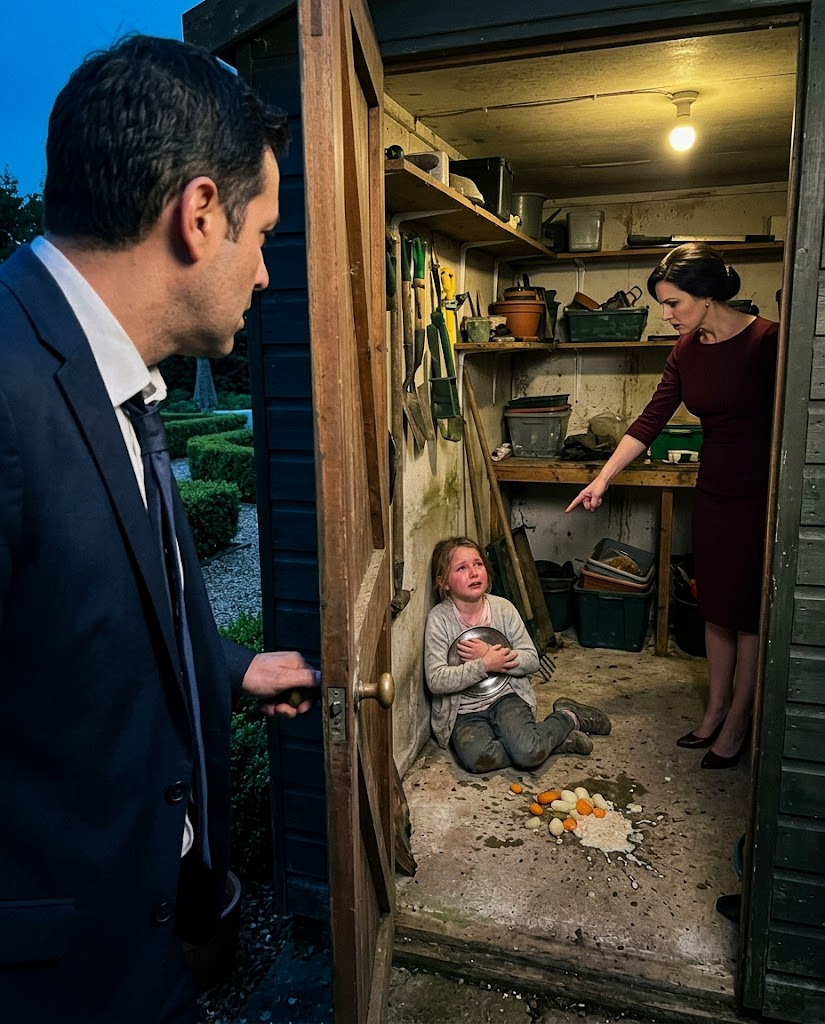
The tray of crystal glasses on the dining sideboard trembled when his shoulder brushed it. He barely noticed. He moved fast across the kitchen, pushed open the rear door, and stepped into the fading light of evening. The garden below the terrace looked blue in the dusk. At the far end stood the old storage room, a squat stone structure once used for tools and paint cans. Its door was half open.
He crossed the steps and pushed it wide.
The smell reached him first—damp concrete, stale air, and sour food. Then the image took shape all at once, so brutally that it seemed to strike his chest rather than his eyes.
Camila sat on the floor in the corner, knees drawn up, a metal plate balanced badly in her hands. Watery porridge had dripped onto her cardigan. Chunks of boiled vegetables lay scattered across the concrete. Her cheeks were wet. Her eyes were swollen and bright
Page 1 of 6