Thanks for coming from Facebook. We know we left the story at a difficult moment to process. What you’re about to read is the complete continuation of what this experienced. The truth behind it all.

There were six men at the round table, each dressed in understated wealth, the kind that didn’t rely on labels because it had long ago purchased the right not to care. A crystal decanter glowed at the center of the table. Folders and papers lay open beside half-finished cocktails.
But the room narrowed instantly to one man.
He sat at what should not have been the head of a round table and somehow was anyway. He looked to be in his mid-thirties, younger than she expected, with dark hair combed neatly back, a sharp jaw shadowed by expensive restraint, and a suit that fit him too perfectly to be accidental. His stillness was more commanding than anyone else’s movement. The others occupied the room. He possessed it.
His eyes settled on her and did not move.
They were dark, not in color alone but in weight, in the sense that they noticed too much and forgave too little.
Sophia lowered her gaze before she could help it.
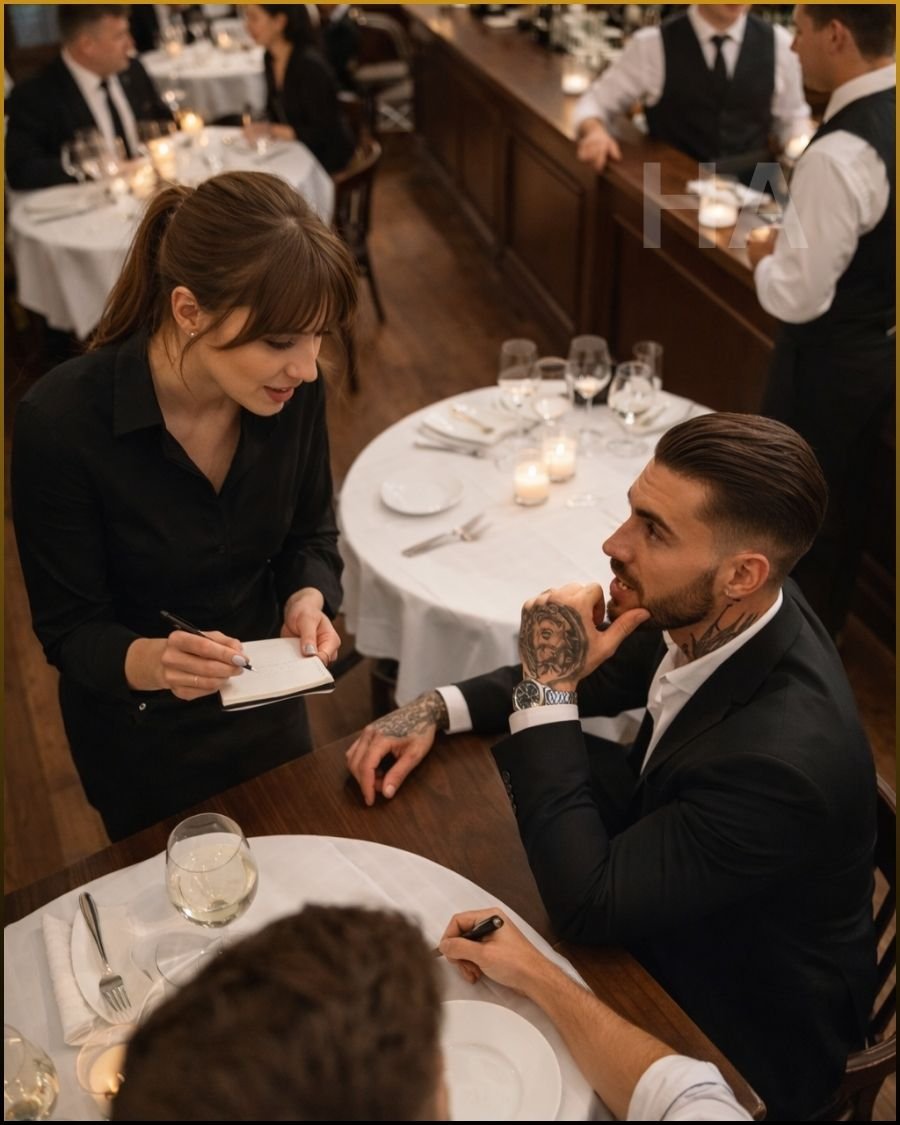
“Good evening,” she said. “I’m Sophia, and I’ll be taking care of you tonight. May I start you with drinks?”
She moved around the table, collecting orders. Negroni. Barolo. Sparkling water. Scotch. Her hand stayed steady, though she could feel his attention following her with unnerving precision.
When she reached him, he did not answer right away.
“You’re new,” he said.
It was not a question. His voice was low and smooth, with that faint East Coast cadence wealth sometimes wore like a secret.
“Yes, sir. Three months.”
A shadow of amusement touched his mouth.
“Scotch. Neat.”
She wrote it down and turned, relieved to retreat, but before she reached the door, another man in a black suit entered. He bent toward the dark-haired man and murmured something too quiet to catch.
Nothing changed in the man’s face.
Everything changed in the room.
Sophia felt it instantly. The atmosphere tightened, as if someone had wound invisible wire around the table. She slipped out with the drink order and only exhaled once the hallway door closed behind her.
When she returned with the tray, the conversation had dropped into lower tones. She served each man in silence. As she set the Scotch before the man at the head of the table, her phone vibrated in her apron pocket.
The tiny pulse ran through her like electricity.
She almost ignored it. At Bellavita, personal calls during service were the kind of thing that got shifts cut. But she had broken that rule for one reason only. For the last week, with her grandmother declining in a hospice facility in San Francisco, Sophia had kept the volume on.
Only one person would call this late.
She stepped backward toward the wall and glanced discreetly at the screen.
It was the nurse.
Her heart dropped.
“I’m sorry,” she whispered, then took two steps toward the door and answered in a low voice. “Pronto?”
The Italian left her without thought. It lived somewhere older than caution, somewhere beneath the layers of practiced American smoothness she wore in public. When fear reached deep enough, it called her home in her grandmother’s language.
The nurse spoke softly. Too softly.
Sophia closed her eyes.
Not gone. Not yet. But close. Very close. If Sophia wanted to see her grandmother awake again, she needed to come soon.
“Grazie,” Sophia whispered, because there was nothing else to say. “I understand.”
She ended the call and pressed her hand hard against the phone, as if she might keep her grief from spilling out by pinning it in place.
Then she opened her eyes and found the room completely silent.
Every man at the table was looking at her.
But only one gaze mattered, because his had changed.
Until that moment he had watched her like a curious employer watches a useful staff member. Now he was watching her like a man who had just recognized a face in a crowd that should not have been there.
Sophia slid the phone back into her pocket. “I apologize for the interruption. Are you ready to order?”
No one answered at first. Then the man with the Scotch leaned back slightly and said, in perfect Italian, “What region?”
The question hit her like a struck bell.
She could have lied. Should have lied. But something in his expression suggested he would hear the lie before she finished speaking.
“Originally?” she said, also in Italian. “My grandmother was from near Florence. I grew up mostly in Boston.”
One of the other men lifted a brow. Another gave a small, interested smile. The dark-haired man said nothing at all.
“English is fine for the table,” he said finally, switching languages with ease.
The dinner continued, but the balance had shifted.
Sophia moved in and out of the room with plates of burrata, veal chop, black truffle risotto, and Dover sole. Each time she entered, she felt his attention settle over her like a hand at the nape of her neck. The men drifted between business and casual conversation, and more than once Italian slipped through in quick bursts when they assumed the staff would not understand.
Sophia understood all of it.
Shipping routes. A warehouse acquisition in Newark. Delays at customs that sounded suspiciously negotiable. A company in Baltimore being bought not for what it claimed to be, but for what it could move quietly after midnight.
She kept her face blank and her eyes lowered. Invisible. Just as Marco had said.
Yet invisibility became harder under Dante Ricci’s gaze.
By midnight, dessert plates had been cleared and the final espresso cups drained. Sophia presented the check in a leather folder, though she knew from the restaurant’s whispers that this was theater. Men like these did not ask the price of dinner. They bought places whole.
Dante signed without looking at the total. When she returned with the receipt, he held the folder out to her, his fingers brushing hers for a fraction too long.
“Thank you, Sophia,” he said.
This time he said her name in Italian, each syllable softened and sharpened at once.
She nodded because speaking suddenly felt dangerous.
The men filed out. Dante was last. At the doorway, he paused and looked back.
“Buonanotte.”
Then he was gone.
Sophia stared at the empty door for a moment before forcing herself back into motion. She cleared plates, stacked glasses, wiped the tablecloth, and found the tip tucked under the folder.
It was more money than she made in a week.
For one irrational second she wanted to leave it there, as if taking it would make her part of something she did not understand. But rent was due in five days. Her grandmother needed her. Airline tickets did not care about pride.
She slid the cash into her pocket.
An hour later, the restaurant was nearly empty. Chairs were being turned upside down onto tables. The kitchen was closing down. Sophia had just shrugged into her coat when Marco appeared again, his expression unreadable.
“Mr. Ricci wants to see you before you go.”
Sophia went cold. “Mr. Ricci is still here?”
Marco blinked. “Of course he is. He was Table Seven.”
The truth rearranged itself in her mind with a strange, dizzying force. The man. The gaze. The perfect Italian. The way the entire room had orbited him.
Dante Ricci.
Marco led her to the small administrative office in the rear. He knocked once, then opened the door.
Dante sat behind the desk with his jacket off and the sleeves of his white shirt rolled to his forearms. A bodyguard stood near the door, big as a wardrobe and twice as still.
“Sit,” Dante said.
Sophia sat because it did not feel like a request.
For a moment he simply looked at her. Not hungrily. Not kindly. Appraisingly. As though he were comparing the real woman to some prior file.
“You speak Italian like family, not like a student,” he said.
“I am family,” she replied before thinking better of it. “At least on my grandmother’s side.”
“Your mother?”
“American.”
“And the call was about your grandmother.”
It was not phrased as a question, but she answered anyway. “She’s in hospice in California. The nurse said I should come as soon as possible.”
Something altered in his expression. Not softness exactly. More like attention stripped of ornament.
He opened a drawer and removed a slim folder. He slid it across the desk.
“Open it.”
Inside was a plane ticket to San Francisco for the next afternoon. First class. Beneath it was an envelope thick enough to make her pulse jump.
Sophia looked up. “What is this?”
“A proposal.”
She did not touch the envelope. “I don’t understand.”
“I leave tomorrow evening for meetings in California. San Francisco, then Napa. My translator is unavailable. I need someone who speaks fluent Italian and English, understands both cultures, and knows how to keep quiet in a room full of men who mistake silence for ignorance.”
Her mouth went dry.
“You want me to work for you?”
“For two weeks.”
“Doing what?”
“Translation. Administrative support. Presence.”
The last word landed oddly.
She held his gaze. “Why me?”
A faint smile, colder than humor, touched his mouth. “Because I prefer people I’ve observed myself.”
The answer made her skin tighten.
“How much have you observed?”
Instead of answering directly, he leaned back. “Enough to know you have no serious attachments in New York. Enough to know that California is where you need to be. Enough to know this solves a problem for both of us.”
Sophia’s fingers tightened around the folder. “And if I say no?”
Dante’s face remained calm, but the room changed temperature.
“Then I assume you will find your own way to San Francisco tomorrow,” he said. “And I wish you luck doing it on a waitress’s wages with no notice.”
It was not exactly a threat. Which made it worse. It was a fact sharpened into a blade.
She stood on unsteady legs. “I need to think.”
“Of course.” He glanced at the clock. “A car will pick you up at noon if you decide to come.”
Her heartbeat stumbled. “How do you know where I live?”
“Employee records,” he said easily.
The lie was polished. Too polished.
She turned for the door.
“Sophia.”
She looked back.
“Your grandmother doesn’t have much time,” he said. “Waste is a form of regret.”
Outside, the January wind felt cleaner than the air in that office. She took a cab home in a fog of exhaustion and dread, the folder heavy in her lap.
At three in the morning, sleep still would not come. She lay staring at the water stain on her ceiling, listening to the steam pipes clank and the sirens move through distant avenues, thinking of her grandmother’s hands, always warm, always smelling faintly of basil and soap.
By dawn, the choice had made itself.
At eleven-thirty, she stood by the window of her apartment and saw a man in a dark coat across the street pretending not to watch her building.
At exactly noon, a black SUV pulled up to the curb.
Sophia almost laughed.
Not because anything was funny, but because the day had become so absurdly precise it seemed to belong to someone else’s life.
She took one last look at her apartment, grabbed her suitcase, and went downstairs.
The driver did not speak except to confirm her name. He took her bag and opened the rear door. As the SUV pulled away, she glanced back. The man across the street was speaking into an earpiece.
So. She had not imagined the trap.
At a private terminal in Teterboro, an elegant woman in a cream coat met her at the curb.
“Miss Russo, I’m Elena. Mr. Ricci’s chief of staff.”
Chief of staff. Not assistant. The distinction felt deliberate.
Elena guided her through a lounge more luxurious than any hotel lobby Sophia had ever entered. Floor-to-ceiling glass overlooked the runway. Inside, by the window, Dante stood with one hand in his pocket, looking as composed as if he were waiting for a dinner reservation instead of rearranging a stranger’s life.
When he turned, his gaze flicked briefly over her suitcase, her coat, her face.
“You came.”
Sophia set the folder on a side table. “My grandmother is dying.”
He inclined his head once, accepting the rebuke inside the truth. “And you’re practical.”
That annoyed her more than it should have. “Don’t mistake necessity for agreement.”
A different man might have bristled. Dante looked almost pleased.
“Sit,” he said. “We board in twenty minutes.”
The jet was not merely private. It was obscene. Cream leather. Walnut trim. A bedroom in the rear. Two attendants who moved with the kind of discreet grace that suggested they had seen everything and discussed nothing.
Sophia took the seat across from Dante and tried not to look as overwhelmed as she felt.
For the first hour they reviewed documents. Or rather, he reviewed and she translated short sections of emails and acquisition notes involving an Italian-owned import company in San Francisco and a vineyard investment in Napa. The work was real. That unsettled her as much as the surveillance had.
If he had wanted to impress her, he could have invented something ornamental. Instead, he used her.
Halfway through the flight he closed the folder and regarded her in silence.
“You have a degree in international business,” he said.
Sophia froze.
She had never told him that.
He watched recognition strike her face and did not apologize. “You’re overqualified to carry risotto.”
Anger flared, hot and brief. “You had me investigated.”
“I have everyone investigated.”
“That does not make it less invasive.”
“No,” he said. “It makes it consistent.”
The answer was infuriating because it sounded honest.
She stared out the window until the clouds blurred. “I left Boston because I had to.”
“I know.”
That turned her back instantly. “You know too much.”
His jaw tightened almost imperceptibly. “Your former boyfriend can’t reach you through me.”
The fact that he had already considered that made her blood run cold.
“You looked into him too?”
“I removed the possibility of a problem.”
The words were clean. Efficient. Almost surgical. Sophia did not ask what removed meant in Dante Ricci’s vocabulary because she was suddenly certain she did not want the full answer.
They landed in California just after sunset.
A car took Sophia first to the hospice in Marin County. Dante did not accompany her. But when the driver handed her a bouquet of white lilies and said, “Mr. Ricci thought you might want these,” her throat tightened anyway.
Her grandmother looked smaller than Sophia remembered, as though illness had been carving her down to essence. But her eyes brightened when she saw Sophia.
“Tesoro,” she whispered.
Sophia fell apart then, quietly and completely, kneeling beside the bed and pressing her forehead to her grandmother’s hand.
For an hour they spoke in Italian, drifting between memory and present tense. About Boston winters. About Sophia’s parents. About recipes. About the old apartment in the North End where her grandmother had taught her that grief and garlic both softened under heat.
Then her grandmother squeezed her hand and asked, with startling clarity, “Who brought you here?”
Sophia hesitated. “A man I work for.”
“Dangerous?”
The question was so direct she almost laughed through her tears. “Probably.”
Her grandmother nodded as if that fit some private arithmetic. “And kind?”
Sophia thought of the plane ticket, the surveillance, the money, the arranged transport, the fact that none of it had truly been a choice.
“Yes,” she said at last. “Also probably.”
Her grandmother smiled faintly. “Those are the worst kind.”
When Sophia returned to the waiting SUV, the driver informed her that Mr. Ricci had arranged a private nurse and a specialist consult to review her grandmother’s pain management.
Sophia closed her eyes.
Every kindness from Dante came wrapped in control so seamless it was hard to separate one from the other.
At the hotel in San Francisco, she found clothes waiting in her suite. Elegant, expensive, exactly her size. There was also a note in a precise hand.
Dinner at eight. You’ll attend.
No greeting. No signature. He did not need one.
The dinner took place in a restored mansion in Pacific Heights, all limestone fireplaces and old California money. The guests were investors, lawyers, and two aging Italian-American businessmen from New Jersey who preferred to insult one another in dialect while pretending everyone else was too American to understand.
Sophia, seated at Dante’s right hand in a dark green dress she had not agreed to wear but somehow was wearing anyway, translated when asked and listened when not.
The first hour was all polished knives and polished lies.
The second hour was where the truth lived.
One of the older men, half-drunk and careless, joked in Italian that Dante was overpaying for a logistics firm that was worth less than its docks. The other replied that the docks were irrelevant, that the real value was in “what moves through Oakland after customs goes to sleep.”
Sophia went still.
Dante’s fork paused for the tiniest fraction of a second. He did not look at her.
Under the table, her hand tightened around her napkin.
When dessert arrived, Dante shifted the negotiation with effortless grace, revising terms to include warehouse access, inventory rights, and a level of disclosure that made the two men sober in real time.
One of them looked sharply at Sophia.
He smiled, but there was no warmth in it. “Pretty and useful. That’s a dangerous combination.”
Dante set down his glass. “Be careful,” he said mildly. “You sound jealous.”
Nothing else in the room changed. And yet the older man immediately looked away.
Later, in the car back to the hotel, Sophia turned to Dante. “You already suspected they were hiding inventory.”
“I suspected. You confirmed.”
“What exactly am I helping you buy?”
He looked out the window at the sweep of city lights. “A company.”
“That’s not an answer.”
“No,” he said. “It’s the only answer you get tonight.”
She should have stopped there. Instead she heard herself ask, “Am I just convenient?”
That made him turn.
The city passed across his face in bands of light and shadow. For the first time since she met him, he looked not powerful but tired.
“At first?” he said. “Yes.”
The honesty hurt more than a lie would have.
Then he added quietly, “You stopped being convenient the moment you mattered.”
Sophia stared at him, furious at the heat that rose in her chest anyway.
Over the next week, California became a strange corridor between grief and danger.
By day, she visited her grandmother, whose good hours grew rarer but more precious. By afternoon, she worked beside Dante in meetings in San Francisco, Napa, and Los Angeles, translating contracts, smoothing tempers, and watching him move through rooms the way some men move through water, without resistance because everything around them had learned to part.
By night, she learned the edges of him.
He never raised his voice. Never repeated himself. Never explained more than he wished to. Yet he also noticed when she had not eaten, when she was tired, when a conversation had unsettled her. He sent security to trail her without asking. He had tea delivered to her room when she could not sleep. He treated boundaries like doors, interesting only because they could be opened.
The contradiction of him became its own weather.
Then the storm finally broke.
It happened at a charity gala in Los Angeles, the kind where actresses wore diamonds borrowed from men richer than their husbands and politicians smiled as if cameras were oxygen. Dante attended because appearances mattered. Sophia attended because he said, “You’re with me.”
She had stopped pretending that meant only translation.
Midway through the evening, a man she recognized from the San Francisco dinner approached them. Vincent Moretti. Shipping heir, donor, public gentleman, private snake.
He kissed Sophia’s hand with a fraction too much familiarity.
“You’re causing problems,” he said to Dante, smiling.
“Then I must be in excellent health,” Dante replied.
Moretti’s eyes shifted to Sophia. “Some distractions are expensive.”
Before she could step back, his hand closed lightly around her wrist, as if to examine the bracelet Dante had lent her.
Dante moved so quickly she barely saw it.
One second Moretti was smiling. The next, Dante had removed his hand from Sophia and was holding Moretti’s wrist in a grip so controlled it looked almost polite.
“Don’t,” Dante said.
Just that.
Not louder than conversation. Not dramatic. But every man within ten feet went still.
Moretti gave a strained laugh. “Relax.”
Dante released him. “I was perfectly relaxed.”
They left three minutes later.
In the car, Sophia’s pulse still ran high. “Who is he?”
“A man who mistook access for permission.”
“That’s not what I meant.”
“I know.”
She turned toward him. “Then stop answering the easier question.”
For a long moment he said nothing. Then, finally: “He and others like him think I’m getting sentimental. They think that creates leverage.”
“And do you?”
His gaze met hers in the dark.
“Yes.”
The word sat between them like live current.
By the time they reached the hotel, Sophia’s anger had burned down to something more complicated and far more dangerous. In the suite doorway she turned to him.
“My grandmother asked me if you were kind.”
A flicker crossed his face. “And what did you say?”
“I said you were. But not safely.”
He stood very still.
“That sounds accurate.”
She laughed once, softly, because accuracy was a ridiculous foundation for whatever this was becoming. “You don’t get to rearrange my life and then look surprised when I notice.”
“No,” he said. “I suppose I don’t.”
His hand came up, not touching her, only hovering near her cheek as if he had learned that wanting was not the same as taking.
“Sophia,” he said, and her name in his voice sounded less like possession than restraint under strain, “I know how this began. I know I forced circumstances you did not choose. If you want to leave after your grandmother…” He stopped, jaw tightening. “I’ll make sure you can.”
It was the first time he had offered her an exit with no visible hook attached.
That, more than any gift, undid her.
“Why?” she whispered.
His mouth curved without humor. “Because by some cosmic joke, you matter more to me than winning does.”
She did not let herself think.
She stepped forward and kissed him.
For a man whose entire existence seemed built on control, Dante kissed like someone at war with it. Careful first. Then with a depth that felt less like conquest than confession. When he pulled away, his forehead rested briefly against hers.
“This,” he said quietly, “is exactly why you should run.”
“Maybe,” Sophia said, breathless. “But I’m tired of running from men who mistake fear for devotion. I’d rather stand where I can see the danger.”
Something fierce and almost tender passed through his expression.
“That,” he murmured, “is the most dangerous thing about you.”
Two days later, her grandmother died.
Peacefully. In the early morning. Sophia holding one hand, the nurse holding the other.
Dante arrived before the paperwork was even finished. He said nothing at first, only stood beside her in the pale hush of the room, one hand steady at the center of her back while grief moved through her like weather finally breaking.
The funeral was small, in a hillside cemetery above the Pacific where cypress trees leaned toward the ocean. Sophia cried until there was nothing left to cry. Afterward, when the last condolences had dissolved into fog, Dante stayed.
Not to command. Not to organize. Just to remain.
That was when she understood the shape of his humanity. It was not soft. It did not announce itself. It did not ask forgiveness for the darkness it had grown beside. But it was real.
Months later, the legal news called Vincent Moretti’s empire a casualty of federal investigations and hostile takeovers. Several shell companies collapsed. Warehouses were raided. Men disappeared from public boards and private clubs. Dante never explained the mechanics. Sophia did not ask for all of them.
Some truths wore steel teeth.
She did ask one question.
“What are you building?” she said one night, standing beside him on the terrace of his home overlooking the Hudson, where the city glittered below like a field of broken glass.
He looked out at the skyline before answering. “Something that can survive me.”
She studied him. “And something that deserves to?”
That made him smile, a real one this time, rare as winter sunlight. “That depends on whether you stay and civilize it.”
She took his hand.
“I’m not here to civilize you, Dante.”
“No?”
“No,” she said. “I’m here to make sure you remember you’re human.”
He lifted her hand to his mouth and kissed her knuckles, old-world and devastating. “That may be harder.”
“Good,” she said. “You were getting arrogant.”
His laugh startled both of them.
A year after the night she answered a call in Italian at the wrong table, Sophia stood beside him in a private garden ceremony in upstate New York. No magazine coverage. No cathedral. No spectacle. Only a handful of trusted witnesses, river light in the trees, and vows spoken plainly enough to sound like truth.
He did not promise safety.
She did not ask for innocence.
He promised this instead: “You will never stand alone again.”
And Sophia, who had crossed a country trying to disappear, looked at the man who had first seen her as useful, then necessary, then beloved, and answered with the only vow that fit the life they had chosen.
“Then don’t ask me to become smaller to love you. I won’t.”
His eyes, dark and impossible and no longer unreadable to her, softened.
“Never.”
Years later, when people asked how they met, the polished version changed depending on who was asking. At charity dinners, they said she had worked in one of his restaurants. At business events, they said she had translated for him during a negotiation. In family rooms, to the few people allowed close enough to earn the truth, Sophia would smile and say:
“I answered the phone in Italian.”
Then Dante would look at her with that same dangerous, astonished tenderness and add, “And from that moment, I was finished.”
It was not a clean love story.
It was not simple, or soft, or free of shadow.
But it became, in its own strange and hard-won way, a human one. A story about a woman who refused to stay invisible. A man who learned that power without tenderness was only another form of poverty. A goodbye that became a beginning. A language that opened a door neither of them had meant to walk through.
And once they did, neither of them ever truly turned back.
THE END
𝑫𝒊𝒔𝒄𝒍𝒂𝒊𝒎𝒆𝒓: 𝑶𝒖𝒓 𝒔𝒕𝒐𝒓𝒊𝒆𝒔 𝒂𝒓𝒆 𝒊𝒏𝒔𝒑𝒊𝒓𝒆𝒅 𝒃𝒚 𝒓𝒆𝒂𝒍-𝒍𝒊𝒇𝒆 𝒆𝒗𝒆𝒏𝒕𝒔 𝒃𝒖𝒕 𝒂𝒓𝒆 𝒄𝒂𝒓𝒆𝒇𝒖𝒍𝒍𝒚 𝒓𝒆𝒘𝒓𝒊𝒕𝒕𝒆𝒏 𝒇𝒐𝒓 𝒆𝒏𝒕𝒆𝒓𝒕𝒂𝒊𝒏𝒎𝒆𝒏𝒕. 𝑨𝒏𝒚 𝒓𝒆𝒔𝒆𝒎𝒃𝒍𝒂𝒏𝒄𝒆 𝒕𝒐 𝒂𝒄𝒕𝒖𝒂𝒍 𝒑𝒆𝒐𝒑𝒍𝒆 𝒐𝒓 𝒔𝒊𝒕𝒖𝒂𝒕𝒊𝒐𝒏𝒔 𝒊𝒔 𝒑𝒖𝒓𝒆𝒍𝒚 𝒄𝒐𝒊𝒏𝒄𝒊𝒅𝒆𝒏𝒕𝒂𝒍.