The first tomato hit the ground like a small red confession.
It bounced once, rolled through a thin veil of dust, and disappeared under a wooden table stacked with peppers. Another followed. Then another. In the noise of Oyingbo Market, where bargaining voices rose and fell like waves and the air smelled of smoked fish, diesel fumes, and ripe fruit, nobody would have noticed the tomatoes if not for the scream.
A woman screamed near the yam stall.
And billionaire CEO Jerry Okafor forgot how to breathe.
Because right there, between baskets of ugu leaves and loud arguments over price, he saw a face that had haunted his nights for seven days.
Mirabel.
His wife.
The same wife whose “body” was still lying in a cold drawer at the morgue, tagged and signed, prayed over and cried over, visited again and again by a husband who had stopped believing his own eyes.
Jerry’s fingers tightened around the black nylon bag of groceries he’d just paid for, so hard the plastic bit into his skin. His driver, Tundai, stood behind him with the car keys and the expression of a man whose job consisted of waiting in traffic and watching rich people do strange things.
“Sir,” Tundai muttered, already glancing toward the road beyond the market. “We should go. Traffic is building.”
Jerry didn’t answer.
Mirabel stood with a woven basket in the crook of her arm, choosing yams as if nothing had happened, as if she hadn’t been dead on the news, dead in the whispers, dead in the pitying glances of staff and strangers. She tilted her head at the vendor’s insistence, rubbed her thumb across her palm in that tiny habit she had when she was thinking, and Jerry’s throat closed.
Even the scar near her eyebrow was there, the one he used to kiss when she got nervous. He had kissed it the last time she fell asleep on his chest, murmuring about how the air-conditioning was too cold.
No.
This couldn’t be.
His stomach flipped. His chest tightened. For one dizzy second, he truly believed his mind had finally snapped under grief, that he was seeing a ghost stitched from longing.
Then Mirabel turned slightly and sunlight caught her cheekbone, clean and real.
Not a lookalike.
Not a stranger.
Her.
Jerry moved before his brain could warn him.
He walked through the crowd like a man chasing air, pushing past a man carrying onions, past a girl balancing a tray of sachet water, past two women who paused mid-argument just to stare at his polished shoes and the expensive watch that looked ridiculous in this place of dust and shouting.
He kept going until he was close enough to smell her.
Not perfume heavy with money. Not the sharp, loud scents some women wore to announce their power.
Mirabel’s scent was softer. Clean. Familiar. The kind that had settled into his clothes after she hugged him, the kind that had made their bedroom smell like home.
His hands began to shake.
His throat burned.
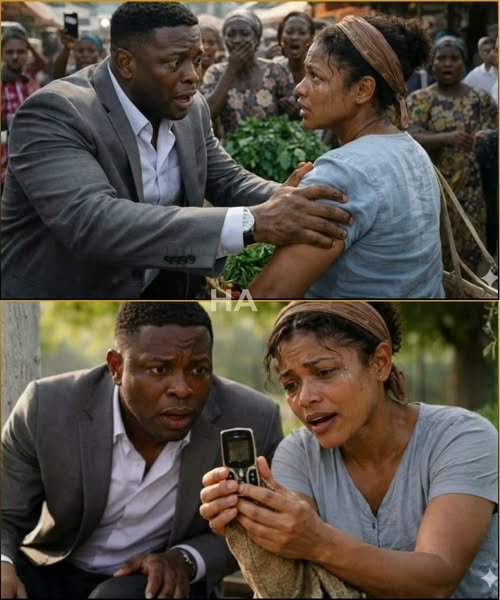
He came behind her, reached out, and grabbed her arm.
Mirabel froze.
Her basket tilted. A yam shifted dangerously near the edge.
Jerry leaned in, voice low and broken, like he didn’t want the world to hear the madness inside him.
“Mirabel… how is it possible you are alive?”
Her body stiffened as if electricity ran through her. She didn’t scream. She didn’t slap him. She only turned her head slowly and looked at him.
And when she saw his face, her eyes filled up so fast it scared him.
Tears gathered there, heavy and real.
“Jerry,” she whispered, like she’d been holding his name inside her chest for too long.
The women around them went quiet.
A market woman holding ugu leaves frowned deeply. “Ah-ah! Wait, is that not Madam Okafor we heard died?”
Another woman hissed, “Keep your voice down. That’s Chief Jerry Okafor.”
But the crowd was already pulling closer, curiosity drawn by wealth and scandal like moths to a bright bulb. Phones lifted. Whispers spread.
Jerry felt the attention pressing against his skin, but he didn’t care. Not for a second.
He only cared about the trembling woman in front of him.
“Mirabel,” he said again, voice cracking now. “Your body is in the morgue. I was there. I saw it.”
Mirabel flinched like the word morgue slapped her.
Her fingers tightened around his wrist, pleading and terrified at the same time.
“Please,” she whispered. “Not here.”
Jerry opened his mouth, but no words came. His mind had too many doors and none of them led to safety.
Mirabel’s eyes scanned faces like she expected someone to step out from behind a pepper stall with a knife and a smile. Her shoulders rose and fell quickly, as if she was running without moving.
Then she leaned closer, voice small enough to almost vanish in the market noise.
“Jerry… don’t ask questions here. Just… take me away.”
Something in Jerry woke up, sharp and cold.
Move now.
He wrapped an arm around her, not like romance, but like a shield. He guided her through the crowd. Some women stepped back, shocked. Some followed. One woman shouted, half-laughing, half-fearful, “Awo! This one is film trick abi?”
Tundai’s eyes widened when they reached the SUV.
“Sir… that is—”
“Open the door,” Jerry said sharply.
Tundai obeyed immediately.
Mirabel climbed in quickly, pulling her headscarf lower over her face like cloth could hide the impossible. Jerry got in beside her. The door slammed, and the world outside felt distant, like a radio turned down.
Inside the SUV, there was only breathing.
Jerry stared at her. His hands were still shaking. His voice came out small, almost childish, like he was afraid the truth would disappear if he spoke too loudly.
“Mira… talk to me.”
Mirabel’s lips trembled. She looked down at her hands.
“I didn’t plan for you to see me like that,” she said softly.
“How else would I see you?” Jerry asked, and the grief rose again like a tide. “I attended meetings with a dead heart for one week. I haven’t slept. I’ve been going to the morgue like a madman, asking attendants to open the drawer again and again because I kept thinking maybe they made a mistake.”
Mirabel squeezed her eyes shut. A tear escaped.
Jerry leaned closer, voice rising without permission.
“Then today I come to the market to buy groceries like a normal man, trying to pretend life can still move forward, and I see you standing there like nothing happened.”
He looked away and pressed his palm against his forehead.
He was a billionaire, yes. He owned a glass office building in Victoria Island. People called him “sir” with fear. He controlled boardrooms and budgets and reputations.
But right now he felt like a lost boy who had misplaced the only thing that made home feel like home.
“Mirabel,” he whispered. “Please tell me I’m not dreaming.”
She turned her face to the window, wiping tears quickly like she was ashamed to be seen breaking.
“I’m not dead,” she said.
Jerry laughed once, sharp and pained.
“Then who is dead?” he asked. “Because there is a body in the morgue and everyone says it’s you.”
Mirabel’s jaw tightened.
Her eyes didn’t leave the passing streets.
“Drive,” she said quickly. “A quiet place.”
“Where?”
“Not your house. Not the office. Not anywhere your mother’s people can reach fast.”
That word landed inside Jerry like ice.
“My mother?” he asked slowly.
Mirabel finally looked at him, and the fear in her eyes answered him before her mouth did.
“Please,” she said. “Just drive.”
Jerry’s fingers closed around the armrest.
Tundai glanced at Jerry through the rear-view mirror, confused and tense. “Sir, where exactly?”
Jerry swallowed, then forced his voice steady.
“Ikeja. The garden. JJT Park.”
Tundai’s eyebrows lifted, but he started the car.
As the SUV pulled away, the market faded behind them. Jerry watched it disappear and felt something else rise under the shock, a small sharp seed.
Anger.
Because if Mirabel wasn’t dead, then what had been happening for the past week?
Who had watched him break and kept quiet?
Who had staged a funeral for a living woman?
He glanced at her again.
She sat very still, hands folded like a child trying to be good in front of strict adults. Her face looked thinner than before. Her blouse was wrinkled like she’d slept in it. Her sandals were cheap, not the kind he bought her. Her fingernails were bare.
Mirabel used to love small neat polish, even clear.
“Where have you been?” Jerry asked gently, trying not to scare her.
“Not far,” she said. “But far enough.”
“And your phone?”
“I can’t use it,” she said quickly. “They can track it.”
“They,” Jerry repeated.
Mirabel pressed her lips together.
The silence stretched as Lagos moved around them, alive and indifferent. They passed the billboard near Maryland. They passed bus stops with shouting conductors. They passed pedestrians weaving through traffic as if danger was a daily meal they’d learned to swallow.
Finally, they entered the garden area in Ikeja. Green plants. Softer air. People walking calmly. It felt like another country after Oyingbo’s chaos.
Tundai parked.
Jerry turned toward Mirabel.
“Here,” he said softly. “No crowd.”
Mirabel nodded, but her hands were trembling.
Jerry opened the door and helped her out, still half afraid she would vanish like smoke. They walked into the garden slowly. Jerry kept glancing at her face like he needed to keep checking the miracle was real.
They sat on a bench under a tree.
For a moment, neither spoke. Birds argued in the branches like they didn’t know a world could collapse.
Jerry finally asked the question tearing him open.
“Mirabel… why?”
Her eyes filled again. She stared up at the leaves as if the sky might offer an easier answer, then looked back at him.
“Because I heard your mother say she was going to kill me.”
Jerry went still.
His heartbeat seemed to pause, then pound harder as if trying to escape.
“My mother?” he repeated, roughly. “Madam Hannah?”
Mirabel nodded.
“She came when you traveled,” Mirabel said, voice low and shaky. “She didn’t greet me like a normal person. She walked into the house like she owned my breath.”
Jerry blinked hard, memories rushing in: his mother in public, elegant and generous, smiling for cameras at charity events, calling Mirabel “my daughter,” patting her hand like the world was watching.
“My mother said she would kill you,” he said, as if repeating it might make it less real.
“She called me barren,” Mirabel whispered, wiping her cheek with the back of her hand. “She said I’m wasting your time. She said you’re her only child and I’m blocking her from holding her grandchildren.”
Jerry swallowed. His lips trembled.
Mirabel exhaled sharply, still inside that memory like a room she couldn’t exit.
“That night I wasn’t feeling fine. I told her I couldn’t cook. I was dizzy. My stomach was turning.” She looked away, then back, eyes darting as if danger could still enter the garden. “She suddenly became nice.”
Jerry’s brows pulled together.
“She came into my room,” Mirabel continued. “Touched my forehead like a caring mother. She said, ‘Lie down. I will make you jollof rice.’”
Jerry’s throat tightened.
“But before I ate, I heard her outside my door on the phone.” Mirabel’s fingers gripped her knees until her knuckles whitened. “She said she had poisoned the food.”
Jerry’s stomach turned.
“She said, ‘Even if it doesn’t work, I already paid boys to finish the job.’”
“No,” Jerry whispered. “No, no.”
“My love,” Mirabel said, and her voice steadied. “I know you want to defend her. That’s your mother.”
Jerry’s jaw clenched, shame mixing with disbelief.
Mirabel reached into a small bag she’d brought from the market and pulled out an old phone, small and plain, the kind people used when they didn’t want to be traced.
Jerry stared at it.
“What is that?”
“It’s the reason I’m alive,” she whispered.
Then she looked him straight in the eyes and said words that turned his blood cold.
“I recorded her.”
Jerry’s breath stopped.
Mirabel held the phone tightly like it was both weapon and shield.
“I recorded the call,” she repeated, voice shaking. “And I recorded something else too.”
Jerry leaned forward without realizing, tension gathering in his shoulders like armor.
“What else?”
“The doctor,” Mirabel whispered.
Jerry’s eyes widened. “The family doctor?”
“He helped her.”
The world tilted.
Jerry’s ears rang. His mouth went dry.
Mirabel swallowed hard.
“Jerry,” she said softly but sharply enough to cut. “Your mother didn’t just try to kill me. She planned how to bury me while I was still breathing.”
Jerry’s heart slammed against his ribs.
“Play it,” he whispered.
Mirabel nodded, thumb moving toward the audio button.
And at that exact moment, Jerry’s phone began to ring in his pocket.
The caller ID flashed like a warning light.
MADAM HANNAH.
Mirabel’s grip tightened on his wrist.
“Don’t answer,” she whispered urgently.
Jerry stared at the vibrating phone. His mother rarely called twice. She believed people should always be available for her.
The phone kept ringing.
Jerry’s breathing slowed, then he pressed decline.
Silence rushed back in.
Mirabel exhaled shakily.
Jerry turned fully toward her.
“Play it,” he said again.
Mirabel pressed play.
At first, static hissed, thin and ghostly. Then a familiar voice emerged, calm and controlled, a voice Jerry had trusted since childhood.
“Doctor, I am telling you, it must be done quietly.”
Jerry’s heart skipped.
His mother’s private voice. Not the public charity voice. The cold one.
“She is weak already,” Madam Hannah said. “The girl barely eats. Everyone already believes she is sick from stress.”
Mirabel watched Jerry’s face carefully as if bracing for him to deny what his ears were hearing.
“I have waited five years,” Madam Hannah continued. “Five years without a child. My son is the last of this family name. That woman will not bury my lineage.”
Jerry felt something crack inside him, like an old bone breaking.
“If the food fails,” Madam Hannah’s voice went on, casually, “the boys will handle the rest. A robbery gone wrong. Lagos is unsafe these days.”
The doctor’s voice returned, nervous. “And my role?”
“You will certify the death,” Madam Hannah replied. “Natural complications. I will compensate you properly.”
The recording ended.
The garden suddenly felt too quiet. Even the birds sounded far away, as if they’d moved to another world out of respect.
Jerry didn’t move.
He couldn’t.
He stared ahead like a man watching his childhood collapse in slow motion.
He remembered his mother feeding him as a child, smoothing his school uniform, defending him when he fought boys older than him, holding his hand at his father’s burial, promising she would never let the world swallow him.
She had been strong.
Protective.
Unbreakable.
And now that same voice had arranged murder with the calm of someone ordering groceries.
Jerry pressed his palms against his face.
“This… this is edited,” he said weakly, though even he didn’t believe it.
Mirabel shook her head gently.
“There’s more.”
She tapped another file.
The second recording began. The doctor again, lower, uneasy.
“I cannot keep her here long. Someone may ask questions.”
Madam Hannah answered immediately: “Declare her dead tomorrow morning. I will arrange the morgue. After burial, nobody will question anything.”
Jerry’s chest tightened painfully.
“And the husband?” the doctor asked.
A pause.
Then Madam Hannah sighed like someone bored.
“My son trusts me completely.”
That sentence stabbed deeper than the rest.
Not because it was cruel, but because it was true.
The recording stopped.
Jerry stood abruptly, walked a few steps, stopped, walked again, as if movement could outrun betrayal.
He turned back sharply.
“Why didn’t you come to me?” he demanded, voice shaking. “Why didn’t you tell me immediately?”
Mirabel’s eyes filled again.
“I tried,” she said. “You were on the flight to London. Your phone was off. And after I heard the second part of her plan, I knew I wouldn’t survive the night.”
Jerry swallowed.
“So you… pretended to die?”
Mirabel nodded.
“I called Dr. Musa,” she said. “Remember him? The elderly doctor who treated your father years ago. The one your mother never liked because he couldn’t be bought.”
Jerry nodded slowly. Dr. Musa had been an old stubborn man with honest eyes.
“He believed me,” Mirabel continued. “He helped me fake symptoms. Slow breathing. Weak pulse. Enough to convince your mother’s doctor that the poison worked.”
Jerry sat back down as if his legs had suddenly forgotten how to hold him.
“My God,” he breathed.
“They brought my body to the morgue,” Mirabel said quietly. “But before midnight, Dr. Musa came secretly and moved me out.”
Jerry stared at her.
“For one week,” she said, “I have been hiding, changing locations, avoiding anyone connected to your family. I didn’t know who else was involved.”
Jerry’s jaw tightened. The weight of betrayal settled on him in layers: anger, grief, and something worse.
Betrayal from strangers hurts.
Betrayal from family changes something permanent inside you.
“And you came to the market today?” he asked, voice softer now.
Mirabel nodded faintly. “I ran out of money. I needed food. I thought maybe I could stay hidden a little longer.”
Jerry let out a broken laugh.
“One week,” he murmured. “I mourned you for one week.”
Mirabel reached for his hand. “I’m sorry.”
“No.” Jerry shook his head quickly. “No. You survived. That’s what matters.”
He pulled her into an embrace, tight and protective. In that moment, he didn’t care about cameras, gossip, scandal. He cared about warmth and breathing and the fact that his wife’s heartbeat was real under his palm.
When he pulled back, his eyes were wet, but his expression had changed. The grieving husband was still there, but the CEO had stepped forward, the man who made billion-naira decisions without trembling.
“We’re going to the police,” he said.
Mirabel nodded immediately. “I was waiting for you to say that.”
Jerry dialed a number.
“Commissioner Bello,” he said when the call connected. “I need you immediately. It’s urgent and sensitive.”
He paused, then added quietly, “Yes. Attempted murder.”
Mirabel watched him, and for the first time since Oyingbo, she looked… not safe, exactly. But less hunted.
Still, deep inside Jerry, another fear grew teeth.
If his mother had gone this far, what else had she prepared?
Thirty minutes later, two unmarked police vehicles rolled into the garden. Commissioner Bello stepped out with the serious face of a man who had seen too much to be surprised easily.
Jerry approached him.
“Mr. Okafor,” Bello said. “You sounded disturbed.”
Jerry stepped aside.
Mirabel stepped into the light.
The commissioner froze. His eyes widened.
“Madam Mirabel?”
Jerry handed him the small phone.
“Listen.”
Bello played the recording. His jaw hardened by degrees, like stone setting.
When it ended, he looked up.
“This is serious evidence,” he said.
“I want it handled legally,” Jerry replied. “No scandal tricks. No cover-ups.”
Bello nodded. “We move now.”
Mirabel’s breathing quickened. Jerry squeezed her hand once.
As they walked toward the vehicles, Jerry’s phone buzzed again. A message from Madam Hannah.
My son, come home tonight. We need to talk about your future.
Jerry stared at the message.
His expression went dark.
“Yes,” he whispered. “We will talk.”
The convoy started moving.
Destination: the Okafor mansion, where a mother waited behind elegant walls, not knowing her “dead” daughter-in-law was coming back with the law.
Or perhaps…
Knowing.
Because when the gates opened, they opened too slowly.
Jerry noticed the hesitation. The security guard’s eyes flicked from Jerry’s SUV to the police vehicles, and fear flashed across his face like a warning.
Jerry’s jaw tightened.
She already knows.
The mansion stood tall under the evening sky, white walls glowing under soft lights, fountains flowing like innocence, palm trees swaying as if nothing evil had ever been planned here.
Home.
The house where Jerry grew up.
The house where Mirabel once laughed freely.
The house where someone planned her burial.
Jerry stepped out first. Mirabel followed slowly, her legs trembling the moment her feet touched familiar ground.
Commissioner Bello signaled officers forward.
“Stay alert,” he murmured.
The front door opened before anyone knocked.
Madam Hannah appeared, elegant, composed, wrapped in deep purple lace, gold jewelry catching the light. Her smile came easily when she saw Jerry.
“My son. You finally came.”
Then her eyes moved past him.
She froze.
The smile vanished like someone had switched off a bulb.
Her face drained of color.
Because beside Jerry stood Mirabel.
Alive.
Breathing.
Looking directly at her.
Madam Hannah staggered back one step.
Her voice came out thin and cracked.
“You… you are dead.”
Silence swallowed the compound. Even the fountain seemed to hush.
Mirabel stepped forward, calm. Not angry. Not shouting.
And that calm frightened Madam Hannah more than rage ever could.
“I survived,” Mirabel said softly.
Madam Hannah’s hands began to shake. Her eyes flicked to the police officers, to the commissioner, to Jerry. Understanding dawned, and fear followed like a shadow.
“You brought police to your own mother’s house?” she snapped at Jerry, forcing strength into her voice.
Jerry didn’t answer immediately. He simply looked at her. Really looked.
For the first time in his life, he didn’t see a loving mother.
He saw a stranger wearing his mother’s face.
“Mom,” he said quietly. “We need to talk.”
Madam Hannah straightened, pride returning like armor.
“This is unnecessary drama,” she said coldly. “I mourned that woman. If this is some sick joke—”
Commissioner Bello stepped forward.
“Madam Hannah Okafor,” he said formally, “we have evidence connecting you to an attempted murder investigation.”
Her eyes flashed.
She laughed sharply, too loud, too quick.
“Attempted murder? Of who?”
Mirabel’s voice was steady.
“Of me.”
For a moment, Madam Hannah’s mask slipped. A flicker of anger, then disgust, then calculation.
“You should have stayed dead,” she muttered.
Jerry heard it.
The words hit him harder than the recordings.
“Mom,” he whispered, pain flooding his voice. “You actually meant to kill her.”
“You don’t understand,” Madam Hannah snapped. “I was protecting you.”
Jerry’s face twisted.
“By poisoning my wife?”
“She is barren!” Madam Hannah shouted, and the word echoed off white walls like a curse. “Five years. Five wasted years. No child, no heir. Do you know what people say about our family name?”
Jerry’s fists clenched.
“Enough,” he said.
But Madam Hannah’s emotions spilled now, unfiltered.
“You are my only son. Everything your father built ends with you, and she…” She pointed at Mirabel as if pointing could erase a human being. “She kept smiling while denying you legacy.”
Mirabel’s eyes shone with tears, but she didn’t speak.
Jerry stepped forward slowly. His voice lowered, and when he spoke, it carried a quiet weight that silenced everyone.
“Mom… I am the one with the medical issue.”
The compound went still.
Madam Hannah blinked, confused. “What?”
“I am infertile,” Jerry said calmly. “Mirabel stayed with me knowing that. She protected my dignity. She carried my shame so nobody would mock me.”
Madam Hannah stared at him, as if the truth had slapped her.
“You… you never told me,” she said weakly.
Jerry laughed softly, painfully.
“Because I trusted you.”
Those words landed like a verdict.
Commissioner Bello nodded to an officer. The officer stepped forward with handcuffs.
Madam Hannah backed away, voice rising desperate.
“Jerry, say something. I did this for you, for your future!”
Jerry’s eyes were wet, but his voice held.
“I can’t believe you could do this, Mom. But the law must take its course.”
The handcuffs clicked.
Metal against wrist.
Final.
Madam Hannah gasped, pride shattering.
“No, no, Jerry. Tell them to stop. I am your mother!”
She turned toward Mirabel with hatred that had nowhere to go.
“You destroyed my family!”
Mirabel didn’t respond. She simply stood beside her husband.
Alive.
Unbreakable.
The officers guided Madam Hannah toward the vehicle. She struggled weakly, repeating, “I was protecting you,” as if saying it enough times could transform poison into love.
Jerry looked away. He couldn’t watch the car door slam.
When the convoy drove off, the mansion felt emptied of something Jerry hadn’t known he needed.
That night, Jerry and Mirabel sat in the living room where Madam Hannah used to host charity dinners, smiling for cameras while darkness sat politely inside her chest.
Everything looked normal.
Nothing felt the same.
“I keep thinking I will wake up,” Jerry murmured, staring at his hands.
Mirabel leaned her head on his shoulder. “I kept thinking I would die.”
He turned toward her quickly, grief and guilt twisting.
“I’m sorry,” he said. “I should have protected you.”
Mirabel shook her head. “You didn’t know.”
Silence stretched between them, heavy, healing.
Then Jerry’s phone rang. Commissioner Bello.
“She has been formally detained,” the commissioner said. “We will charge her tomorrow.”
Jerry closed his eyes briefly. “Thank you.”
After the call ended, he exhaled slowly. Justice had started moving, but consequences were only beginning.
By morning, reporters crowded the mansion gates. Lagos loved news the way fire loved fuel.
“Billionaire’s mother arrested!”
“Attempted murder scandal!”
Cameras flashed. Security held them back.
Inside the courthouse, Madam Hannah walked between officers. Her elegance remained, but her eyes looked smaller now, cornered.
Jerry and Mirabel entered together. Whispers followed them, some sympathetic, some hungry.
Madam Hannah turned when she saw Jerry.
“My son,” she whispered.
Jerry didn’t move.
The judge entered. Proceedings began.
Evidence played. The recordings echoed through the courtroom, every word heavier than the last. Madam Hannah’s shoulders dropped slowly, like a statue losing its balance.
After hours, the judge spoke.
“Madam Hannah Okafor, you are hereby sentenced to twenty years imprisonment for attempted murder and conspiracy.”
Gasps filled the courtroom.
Madam Hannah’s composure finally broke. Tears streamed down her face as officers led her toward the prison van.
She turned toward Jerry, desperate.
“I only wanted to protect you!”
Jerry stood still.
He couldn’t answer. Not because he didn’t have words, but because none of them could untangle what love had become in her hands.
The van door closed and drove away.
Justice had been served.
But peace did not arrive like a neat package.
Back at the mansion, staff moved carefully, whispers replacing laughter. The house still had its fountains and marble and expensive silence, but now it also had ghosts: not Mirabel’s, but the ghost of the mother Jerry thought he had.
That night, unable to sleep, Jerry wandered the halls and stopped outside his mother’s study. For a moment he hesitated, then opened the door.
The room smelled faintly of her perfume. Everything was arranged with obsessive control, papers stacked neatly, books aligned like soldiers.
Then Jerry noticed a locked drawer.
His mother had never locked things from him.
He searched the desk, found a small key inside a jewelry box, and opened the drawer.
Inside: files.
And a small envelope labeled, in his mother’s handwriting:
JERRY PERSONAL
His heart stumbled.
He opened it.
A medical report.
His eyes scanned quickly, then stopped.
The report wasn’t about Mirabel.
It was about him.
It confirmed his infertility diagnosis.
Dated three years earlier.
Underneath it: a fertility specialist recommendation, and handwritten notes in his mother’s tight script.
He must never know how weak he is.
Jerry felt cold.
More notes followed.
Mirabel encourages his acceptance. Makes him comfortable without heirs. Dangerous influence.
Jerry sat back slowly.
So his mother hadn’t only acted out of anger.
She had built a story in her mind, a twisted mission: to “save” her son from shame by erasing the woman who refused to blame him for it.
Understanding arrived like a blade.
Not forgiveness.
Not yet.
But understanding, and sometimes understanding hurts more because it shows you the architecture of evil, the way it is constructed from fear and pride and obsession.
Jerry returned to the bedroom. Mirabel sat awake on the bed, looking small under warm light.
“You couldn’t sleep too?” she asked.
He shook his head and sat beside her.
“I found something,” he said.
He handed her the papers.
Mirabel read slowly, her expression softening with sadness.
“She blamed me,” Mirabel whispered. “For accepting your condition.”
Jerry nodded.
“She thought you were stopping me from seeking treatment, from finding another woman.”
Mirabel looked up quickly. “I never wanted you to feel incomplete,” she said. “You are more than children, Jerry.”
His eyes filled.
He pulled her into a gentle hug.
“I know,” he whispered.
They stayed like that for a long time, two people holding each other after surviving a storm that came from inside the family house.
Time passed.
Scandal faded.
News moved on like it always did, hungry for the next thing to chew.
Jerry and Mirabel rebuilt quietly: therapy sessions, private vacations, healing conversations, laughter returning carefully, like a shy visitor.
And then one rainy morning, Mirabel stood in the bathroom staring at a pregnancy test.
Two lines.
Her hands trembled.
Her breath came fast.
She walked into the bedroom and handed it to Jerry without speaking.
Jerry stared.
Blink.
Look again.
His voice came out barely audible.
“Mirabel…”
Tears streamed down her face as she nodded.
“Yes.”
Jerry laughed, then cried, then laughed again, lifting her into his arms and spinning gently as if he could whirl away every ugly memory.
Against predictions.
Against heartbreak.
Life chose them anyway.
Nine months later, a baby boy filled the mansion with crying, laughter, and a strange new softness.
Jerry held his son for the first time with trembling hands, terrified of breaking something so small and sacred. Mirabel watched, smiling through tears.
Healing arrived quietly.
Not as revenge.
Not as victory.
As grace.
Years passed.
The mansion felt lighter, warmer, reshaped by a child’s footsteps. Five-year-old Daniel Okafor ran across the garden chasing butterflies while Mirabel watched from the balcony.
Jerry joined her, arm around her waist.
“Hard to believe everything that happened,” he murmured.
Mirabel nodded. “Yes.”
Silence lingered, then Mirabel spoke carefully, like someone touching an old scar.
“Jerry… I want to talk about your mother.”
Jerry stiffened. In five years he had visited Madam Hannah only twice. Each visit had left him emotionally bruised, as if the prison walls weren’t the only bars.
Mirabel turned to face him fully.
“I think it’s time to forgive.”
Jerry stared at her.
“She tried to kill you,” he said quietly.
Mirabel nodded. “I know.”
She looked toward their son, laughing freely, innocent of the history that almost erased him.
“But hate cannot raise a child peacefully,” she said. “Forgiveness doesn’t erase what happened. It just stops the pain from controlling tomorrow.”
Jerry’s chest felt pulled in two directions: rage and love, memory and responsibility.
After a long silence, he nodded.
“Okay,” he whispered. “Okay.”
Processes began. Lawyers spoke. Papers moved. Mirabel wrote a letter, not excusing the crime, but choosing to release the grip it still had on their lives.
Weeks later, approval came.
Madam Hannah would be released early.
On the day of her release, Jerry stood outside the prison gates. Mirabel stood beside him. Daniel held her hand, curious and impatient, unaware of the heavy story waiting to be introduced.
The gates opened.
Madam Hannah walked out slowly.
Older.
Thinner.
Humbled.
Her eyes searched, then landed on Jerry, then Mirabel, then the little boy.
Her lips trembled. Tears fell silently as if her face had forgotten how to hold pride.
She took one hesitant step forward.
In that fragile moment, no one knew what would happen next, because forgiveness is not a ribbon you tie once. It is a road you walk again and again.
Daniel looked up at Jerry.
“Daddy,” he asked innocently, “who is she?”
Jerry knelt beside him, heart pounding not with fear now, but with the weight of truth.
“This is your grandmother,” he said gently. “My mother.”
Daniel studied Madam Hannah’s face with the fearless curiosity of children, the kind adults lose when they learn what people can do.
Madam Hannah’s voice broke.
“I don’t deserve that title,” she whispered.
Mirabel stepped forward.
Her voice was calm, not angry, not trembling.
“People are more than their worst mistake,” she said. “But they must also live with the truth of it.”
Madam Hannah looked at her, shocked, tears sliding down.
“You… you forgave me?” she asked, almost afraid to hear yes.
Mirabel nodded slowly.
“I chose peace,” she said. “Not because what you did was small, but because carrying hate was destroying all of us.”
Daniel suddenly walked toward Madam Hannah and held out his small hand like an offering.
“Hello, Grandma.”
The simple gesture cracked something open inside her that prison hadn’t managed to reach.
Madam Hannah dropped to her knees, crying openly, holding his tiny hand carefully as if touching something sacred.
“I almost destroyed the greatest blessing of my life,” she sobbed.
Jerry watched quietly, and something in him loosened, not forgetting, not pretending, but softening enough to breathe.
He stepped forward and helped his mother stand.
“We move forward,” he said gently. “But we never forget the truth.”
Madam Hannah nodded repeatedly, tears still falling.
“I will spend the rest of my life making things right,” she whispered.
And for once, her voice did not sound like control.
It sounded like surrender.
Life found a new balance.
Madam Hannah moved into a smaller house nearby, choosing humility over luxury. She attended counseling, sat in church without cameras, did charity work without announcements. She learned to laugh again, softly, carefully.
Every weekend, Daniel ran into her arms without fear, and Mirabel watched with a guarded peace, the kind you build brick by brick.
One evening, Jerry and Mirabel sat in the garden, watching the sunset paint Lagos gold. Daniel chased fireflies across the lawn while Madam Hannah watched him with quiet gratitude.
Jerry turned to Mirabel.
“I almost lost everything,” he said.
Mirabel’s smile was faint but real.
“But truth saved us,” she replied.
Jerry nodded, squeezing her hand.
Truth, and courage, and the strange stubborn mercy of life.
As night settled gently over Ikeja, Jerry looked at his wife, the woman he had mourned while she was alive, the woman who had survived poison and betrayal, the woman who chose peace without becoming weak.
“We didn’t just survive,” he whispered. “We became a family again.”
Mirabel leaned her head on his shoulder.
“And this time,” she whispered back, “no one gets to rewrite the story with lies.”
In the distance, Daniel’s laughter rose like light.
And for the first time in a long time, the Okafor name didn’t feel like a lineage to defend.
It felt like a home to protect.
THE END