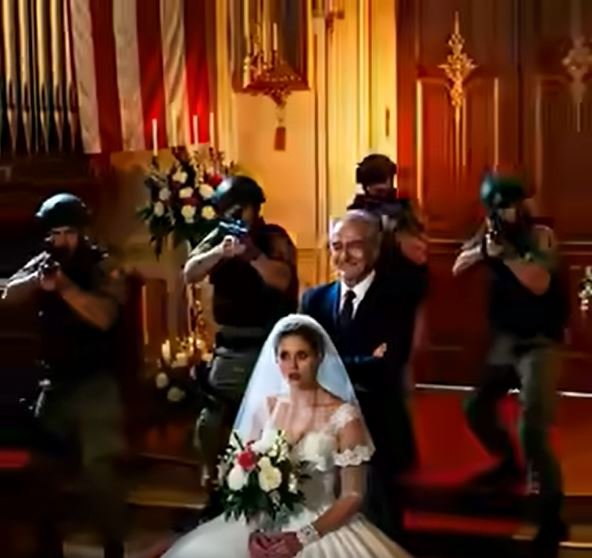
The organ held a single, trembling note so long it felt like the whole church was breathing it in.
High above us, winter light spilled through stained glass in pale ribbons—blue, gold, crimson—painting the aisle like a promise. The air smelled like lilies and old wood and a little bit of wax from the candles. Guests shifted softly in the pews, a hush of fabric and perfume, polite smiles and camera phones tucked away, everyone pretending they weren’t watching for imperfections.
At the altar, I stood in ivory satin and lace, my bouquet cradled at my waist, and for the first time in years I let myself feel something I’d learned to ration.
Peace.
Not the fragile, borrowed peace I used to fake at family dinners. Not the peace you earn by swallowing your own opinion to keep someone else comfortable. Real peace—solid, clean, almost unfamiliar. The kind you can stand on.
Liam’s hand brushed mine. He looked at me with that quiet steadiness that had made me believe in a different life. He didn’t need to fill silence with noise. He didn’t need to win every room. His love didn’t come with conditions or tests.
The officiant began speaking again, his voice warm and practiced, words shaped to make a crowd feel like a community. I watched Liam’s mouth curve into a barely-there smile and I thought, This is it. This is where the old story ends.
Then the grand oak doors at the back of the sanctuary slammed open so hard the sound rolled down the aisle like thunder.
A collective gasp rose from the pews. Heads snapped around. A ripple of panic moved through the room—people shifting, hands reaching for spouses, someone dropping a program on the polished floor.
A team in dark raid jackets strode in fast and controlled, their boots striking stone in clean, rhythmic beats. Earpieces, agency markings, the blunt efficiency of professionals who don’t come to negotiate. One voice—amplified, commanding—cut through the organ’s fading note.
“Federal agents. Nobody move.”
The church froze.
I didn’t.
My heart didn’t race. It didn’t even flutter. It went cold, the way it does when you’ve already rehearsed a moment so many times in your mind that your body stops treating it like a surprise.
From the front pew, my father rose as if he’d been waiting for his cue.
Robert Jensen—former police commissioner, fallen from grace, still addicted to the idea of his own authority—stood tall in his tailored suit like he was stepping onto a stage he owned. His jaw tightened. His eyes gleamed with triumph. Then he pointed at me with the confidence of a man who believed he could still command the world with a gesture.
“Did you really think I wouldn’t find out about your lies?” he bellowed, loud enough to rattle the chandeliers. “Arrest the bride.”
A murmur surged. People leaned in, hungry and horrified at the same time. Someone whispered my name like it was suddenly a scandal instead of a person.
My father’s smile spread wider, crueler, as if he could already taste the moment he’d tell later. The moment he humiliated me in front of everyone who mattered. The moment he “saved” the family by exposing his disappointing daughter.
He looked at me with a lifetime of contempt in his eyes, as if he was finally seeing the failure he’d always believed I was.
But I didn’t flinch.
I didn’t cry.
I didn’t rush to explain.
I let him have his moment because men like my father need an audience the way they need air.
Then I lifted my bouquet just slightly.
Inside the lilies, tucked beneath silk ribbon and greenery, there was a tiny microphone no one could see.
I leaned in, the way a bride might lean in to whisper a prayer before vows.
And I spoke one quiet word.
“Nightingale.”
For one heartbeat, nothing happened. The sanctuary held its breath.
Then the entire team of agents stopped.
They pivoted in unison—smooth, practiced, almost surgical—and turned toward my father.
Robert’s triumphant smirk collapsed like a bad mask.
Confusion replaced it first, wide-eyed and slack-jawed, as if the script had suddenly changed in a language he couldn’t read.
Three months earlier, he had been laughing at my expense with a glass of sparkling water in his hand, convinced the world still belonged to him.
Three months earlier, at our engagement party, he had handed me everything I needed to end him—without even realizing he’d done it.
Back then the air was warm, filled with polite laughter and music and the clink of glasses. We’d rented a bright little venue not far from Georgetown, the kind of place with exposed brick and string lights and a patio that made everyone feel romantic even if they weren’t. Liam stood beside me in a navy suit, looking slightly overwhelmed but happy, his arm around my waist like I was something precious.
My father made his way through the crowd, cutting straight lines through conversations the way he always had, as if people should part automatically. He clapped Liam on the shoulder. The gesture was meant to look friendly, but it was too hard, too possessive, like a warning disguised as warmth.
“An architect, huh?” my father said, loud enough for three nearby groups to hear. “Cute. Hope you know what you’re getting into.”
Liam’s smile faltered politely.
My father turned his gaze on me. “My daughter’s never really had any ambition,” he announced. “Good thing she found someone to take care of her.”
The words were familiar. The casual dismissal. The public little jab that made everyone laugh uncomfortably and made me look like the uptight one if I dared to object.
I smiled anyway. I was good at smiling. I’d been trained.
Then he turned to the quiet man standing beside me—Director Evans—who had attended as a family friend, though his posture and eyes belonged to a very different world than my father’s.
My father leaned in conspiratorially, as if he was sharing a joke among men.
“Don’t worry,” he said, winking. “I’m using my old contacts to run a real background check on him. Can’t be too careful these days.”
My blood went cold.
It wasn’t just an insult anymore. It wasn’t just my father being “protective” or “old-school.” It was a confession. A boast about doing something illegal. He said it casually, like it was his right.
And the worst part was that he said it in front of a ranking federal officer.
He thought he was showing strength.
In reality, he had just handed me the justification to end his war for good.
He had no idea who I really was.
To my family, I lived the life they’d written for me—a beige little story where I was always almost impressive but never quite. They had cast me as the quiet daughter, the pretty face who wasted her “potential” on computers. The one who never made the kind of headlines my father could brag about at dinners. The one who made choices he couldn’t control.
My father was the chief editor of that narrative.
My mother was the copywriter, smoothing his sharp lines, rewriting his cruelty as “stress” and “pride” and “it’s just how he is.”
If you want to understand why I laid a trap at my own wedding, you have to understand the kind of childhood that makes a woman stop asking for kindness and start calculating exits.
One Sunday dinner not long after my engagement felt like a summary of my entire life.
We were at my parents’ place in Northern Virginia, the same dining room where I’d learned to swallow tears and pretend condescension tasted like normal family conversation. My cousin Mark had just passed his physical for the city fire department. My father stood up with his glass raised and his chest full of pride I had never once heard directed at me.
He talked about real service. About grit. About a job where a man could see the impact of his work.
Then he turned his gaze to me and waved his hand like I was an afterthought.
“And my daughter,” he said, letting the pause hang heavy and thick with condescension, “well, she’s doing her thing. Playing on the computer in a basement somewhere.”
Polite chuckles. Uncomfortable smiles.
I smiled too, porcelain perfect, as if my worth had never mattered enough to bruise.
Inside, I didn’t feel anger. Not anymore. Anger requires hope. Anger implies you still believe someone might change.
What I felt was weary. A tiredness so deep it felt ancient.
His words didn’t just hang in the air. They stacked themselves onto a mountain of similar moments.
The robotics award I won in high school that he called a nerd trophy.
The scholarship to a top engineering program that he dismissed as a waste of a pretty face.
The internship offer he sneered at because it didn’t come with a badge or a headline.
After dinner, while I cleared dishes, my mother cornered me in the kitchen, her voice urgent and soft the way it always was when she wanted me to fold.
“Just let it go,” she whispered. “You know how he is since he was forced into retirement. His pride is all he has left.”
And I nodded, because what was there to say?
His pride was treated like a national monument. Mine didn’t even warrant a signpost.
The funny part was, I did work in a basement.
Just not the kind of basement my father imagined.
You can’t hear the outside world in a SCIF. There are no windows. No phones. No casual conversations. The air is climate-controlled and constant. The only sound is the whisper of industrial ventilation and the frantic, quiet clicking of keyboards. A dozen monitors glow like a night skyline. The room is built to keep secrets from escaping.
This was my real office.
In that world, I wasn’t my father’s disappointing daughter.
I was Oracle.
I led a Level Four counterintelligence cyber team under a federal task force, and when we were working, we didn’t talk about feelings. We talked about chain-of-custody. We talked about traces, anomalies, and state-sponsored intrusions that would never make the news because the public doesn’t sleep well when you tell them how close chaos gets to the edge of their daily life.
The day my father boasted at the engagement party, we were already buried in a crisis.
The digital infrastructure of the Port of Baltimore—one of the largest shipping arteries on the East Coast—was being probed and pressured from multiple angles. It wasn’t random criminals. It wasn’t petty theft. It was a mapping effort, an attempt to understand the country’s logistics network, to find the weak points that could ripple outward into supply chains and public order.
My team sat in the dark with code cascading on screen. The pressure was heavy, but my voice stayed calm because panic doesn’t solve anything. Panic only makes people sloppy.
“The packet analysis confirms it,” I said, pointing to a section of data that looked like noise to anyone without training. “This isn’t about stealing money. They’re building a map.”
Across from me, Alex Martinez—call sign Ghost—watched my face. He trusted my instincts more than his own eyes, which is why he was alive and effective.
“We’ve isolated the command-and-control node,” I continued. “Ghost, I need the trace started now. Full documentation. Chain-of-custody matters.”
He nodded once, fingers already moving, and the room snapped into motion like a machine.
In that room, my father’s opinion didn’t exist.
My mother’s pleas didn’t exist.
Only competence mattered. Precision. Trust.
Leaving that world and re-entering my other life always felt like decompression after deep water. I’d pass security checkpoints, each one stripping away a layer of authority. I’d change out of a government-issued polo into a simple blouse, trading clearance for camouflage. I’d climb into my ten-year-old sedan—so boring it was almost invisible—and drive to meet Liam for dinner.
He knew I worked for the government. He knew my job mattered. But the details were locked away behind rules and oaths and security protocols that weren’t romantic and weren’t negotiable.
“How was your day?” he’d ask, and I’d hate myself a little for the vague answer I had to give.
“Long meetings,” I’d say. “Network issue. You know.”
I hated the wall between us, this massive part of my identity I couldn’t lay on the table like a normal person’s life.
It was lonely, carrying a secret that made you powerful at work and invisible at home.
My father saw my boring car and my simple clothes and my vague job title, and he built his entire narrative of my failure on that flimsy foundation.
He judged the cover story and assumed the book was empty.
He only respected one language: the power of the badge.
So I decided to finally speak to him in the only language he could understand.
The day after the engagement party, I didn’t call my mother to cry. I didn’t vent to Liam. I scheduled a secure meeting with Director Evans.
His office was sterile in the way government offices always are—clean lines, muted colors, the faint hum of a building designed for function, not comfort. He sat behind his desk, hands folded, expression unreadable. A man who had spent decades watching people lie to him with straight faces.
I didn’t speak like a daughter complaining.
I spoke like an agent reporting a credible threat.
I laid out my father’s history, his connections, his recent boast. I said it without emotion, because emotion is what men like my father use to paint women as unstable.
“He represents a potential compromise,” I said. “He’s actively leveraging old contacts to pursue unauthorized database access. That’s a direct threat to operational security and a violation of federal law.”
Director Evans didn’t blink.
I proposed a solution. A formal, fully documented counterintelligence sting—within policy, within regulation, clean enough to withstand scrutiny.
He studied my file, then looked at me like he was seeing the sharp edge of a tool he’d always known I was.
“Approved,” he said simply.
That was it. No drama. No pep talk. Just a decision.
The operation became real the moment he said yes.
I built the trap like I built everything: with quiet precision.
First, a digital honeypot—a fabricated sealed record for Liam. A ghost file. Detailed enough to look authentic. Buried in a state-level database I knew one of my father’s lazier contacts could still reach if pressured. The moment anyone queried it, the system would trigger a silent alarm and log everything: user credentials, terminal ID, timestamp, access route.
A tripwire.
Then I briefed Ghost.
In a secure room, I laid out the mission schematic. Code name: Operation Nightingale.
Operational theater: my wedding.
The team would be embedded as staff—caterers, musicians, technicians, even the videographer. Their gear would not be for capturing memories. It would be for evidence. Audio, video, documentation. The kind that stands up in court, the kind that turns arrogance into a paper trail.
Ghost didn’t flinch. He just asked questions about sightlines, comm channels, contingencies.
It was almost absurd, using wedding planning language as cover for federal logistics. Seating chart meets operational map. Registry meets surveillance placement. Floral arrangements hiding microphones. A dress fitting scheduled around briefings and secure calls.
The invitations went out.
My father RSVP’d with the confidence of a man who thought he was coming to reclaim control.
He had no idea he was signing his name on the first page of his indictment.
On the morning of my wedding, I felt a calm so deep it scared me a little.
The church was already filling. The scent of lilies drifted through the air. The organist warmed up softly, notes floating like prayer.
In the small room off the chancel, I watched my family arrive through a crack in the door.
My mother fluttered with nervous energy, smoothing details that didn’t need smoothing. Her anxiety was devotion. Her devotion was habit.
Then my father arrived.
He walked in like a general inspecting troops, eyes cold, jaw set. Not the proud father of the bride. A man convinced he had to “save” his family from the mistake he believed his daughter was making.
He passed right by the man adjusting the floral centerpieces—my comm tech—without a second glance.
He ignored the videographer setting up a tripod—Ghost—like the camera was beneath him.
He saw nothing because he believed nothing could exist without his permission.
That was his weakness.
Arrogance doesn’t just make people loud. It makes them blind.
At the altar, when I finally stepped out in my dress, the room turned the way rooms do when people see a bride. Phones lifted discreetly. Faces softened. My mother’s eyes filled with tears.
My father’s expression didn’t change.
He watched me like I was a problem he still intended to fix.
Liam stood waiting. His eyes widened when he saw me—real emotion, real awe—and for a second the operation, the trap, the decades of tension fell away.
It was just us.
The officiant spoke. The music swelled. The ceremony moved forward.
Then came the question—the one everyone knows, the old line that’s supposed to be symbolic now but still carries power if someone wants to use it.
“If anyone has reason why these two should not be joined…”
That’s when the doors slammed open.
And the rest unfolded exactly as planned.
My father stood at his cue, voice booming, pointing his finger like he still owned the room.
“Arrest the bride.”
He began his performance immediately.
“I am a man of the law,” he declared, chest puffed. “My entire life I served justice. I had to protect my family from her lies.”
He was painting himself as the hero.
Every word was a confession.
Every sentence was motive.
I stood still, face calm, letting him hang himself with his own righteousness.
Then I whispered, “Nightingale.”
The agents stopped and turned toward him.
Director Evans rose from the front pew like gravity itself had shifted.
His voice was quiet, but it cut clean.
“Robert Jensen,” he said, “you are not the law. You’re a disgrace to it.”
Ghost stepped forward, and suddenly the “videographer” was not a guy with a camera. He was an operator with authority, voice flat and official.
“Robert Jensen, you are under arrest for unauthorized access, conspiracy, and federal violations. You have the right to remain silent.”
My father’s face went blotchy red.
“This is insane,” he sputtered. “You have no authority—”
He stopped when the screen descended behind the altar—hidden all along—and lit up with a log file so cold and clear it might as well have been a mirror.
Date. Time. Credential. Query.
The fabricated sealed record.
The digital tripwire triggered.
There it was, undeniable, in stark black and white for an entire wedding to witness.
Then the audio played—his own voice, recorded legally, pressuring his contact, promising favors, calling in old debts.
A hush fell over the room so thick it felt physical.
The camera zoomed, capturing his face as it changed in stages: confusion, then realization, then horror.
For the first time in my life, my father didn’t look at me like I was a disappointment.
He looked at me like he finally understood what I was capable of.
Not because I told him.
Because I showed him.
They led him out in restraints, not gently, not cruelly—professionally. The way consequences are delivered when they’re finally official.
My mother’s face crumpled, not in anger at me, but in the realization that the monument she’d spent her life protecting was built on sand.
I felt a flicker of sadness for her—not pity, not guilt, just the quiet grief of watching someone wake up too late.
Liam’s hand found mine, steady and warm.
The officiant cleared his throat, voice trembling slightly.
“Well,” he said, glancing between us, “shall we continue?”
Nervous laughter rippled through the pews. Not cruel laughter. Relief laughter. The kind people make when they’ve survived something they didn’t understand.
I looked at Ghost. He gave me a subtle nod.
I looked at Director Evans. There was something almost paternal in his eyes.
I looked at Liam—my partner, my future—and squeezed his hand.
“Yes,” I said softly. “We continue.”
And we did.
We said our vows in a church that still smelled like lilies and shock. We promised each other a life that didn’t require hiding behind masks.
After the ceremony, guests stumbled out into winter sunlight whispering to each other like they’d just witnessed a movie twist in real life. The story would spread. Of course it would. People talk. People always talk.
But I didn’t chase the narrative.
I didn’t need to.
Because for once, the truth had the power.
In the months that followed, the fallout was quieter but deeper.
My father’s case moved through the system with the slow, grinding inevitability of law. He tried to spin it. He tried to argue “misunderstanding,” “protective father,” “concern.” None of it mattered against documented evidence.
Operation Nightingale didn’t just take him down. The evidence led to a wider investigation that uncovered a network of old contacts trading favors, accessing systems they had no business touching, clinging to power they didn’t deserve.
My father’s obsession with his legacy created one. Just not the one he imagined.
He became a cautionary tale in internal training slides. A name in reports. A warning about entitlement wearing a uniform.
And me?
I didn’t become the villain in his story. I didn’t become the bitter daughter. I didn’t become the woman who “ruined her father.”
I became what I had always been, minus the need to pretend.
Six months later, I was promoted. The nameplate on my office door felt heavier than any trophy.
Section Chief. Cyber Special Investigations.
More responsibility. Higher stakes. More nights under fluorescent light with code and crisis.
But the work fit me. It always had.
At home, life softened in ways I hadn’t known were possible.
Liam learned to read the edges of my silence without taking it personally. I learned to let him hold my stress without feeling like I was burdening him. We built routines—coffee in the morning, walks at night, weekends where we cooked together and laughed at nothing important.
One evening, we hosted Director Evans and Ghost for dinner in our small townhouse outside D.C. No tension. No eggshells. No forced smiles.
Ghost told a story about a botched early operation where he’d tripped over a cable and nearly taken down an entire surveillance setup. Director Evans laughed so hard he had to wipe his eyes. Liam listened, amused and fascinated, finally seeing the outlines of the world I’d carried alone.
This was my real family—earned, not inherited. Built on respect, not obligation.
A year after the wedding, a letter arrived.
Standard envelope. Return address: a federal correctional facility.
My father’s handwriting.
I held it in my hands and waited for the old reaction—anger, dread, guilt, the reflex to manage his emotions the way my mother always had.
Nothing came.
It was just paper.
A final attempt to reach into my life and make me feel something on his terms.
I walked into my home office, not with drama, but with calm purpose. I didn’t open it. I didn’t need his excuses. I didn’t need his blame dressed up as apology.
His words had no power over me anymore.
I fed the sealed envelope into the shredder.
The machine swallowed it without ceremony, turning his last attempt at control into thin, useless strips.
I stood there for a moment listening to the quiet whir, then walked back into the living room where Liam was waiting.
He looked up. “Everything okay?”
I nodded, and the truth of it settled in my chest like a warm stone.
“Yes,” I said. “I’m okay.”
He came to me, kissed my forehead, and I felt what I had felt at the altar before the doors ever opened—peace. Not the peace of pretending. The peace of a life that finally belonged to me.
My father believed legacy was something you could demand.
I learned legacy is what remains when you no longer need to demand anything at all.
And if you’ve ever lived in the shadow of someone determined to keep you small—if you’ve ever been told your gifts don’t count because they don’t look like the version of success someone else worships—remember this:
You don’t have to argue your worth into existence.
Sometimes all you have to do is document the truth, hold your ground, and wait for the moment when reality finally speaks louder than ego.
In the weeks after the wedding, the world did what it always does after a public collapse: it moved on faster than the people inside the wreckage were ready for.
News cycles compressed my father’s arrest into a few neat paragraphs. A disgraced former police commissioner. Unauthorized access. Abuse of influence. A cautionary headline that disappeared beneath newer scandals by the following Monday. People skimmed, shook their heads, and scrolled. They didn’t see the quiet mornings afterward. They didn’t see the way a family fractures not in explosions, but in silences.
For me, the silence was the loudest thing.
I woke each morning beside Liam, sunlight filtering through our curtains, and felt something unfamiliar settle into my chest. Not fear. Not tension. Space. A wide, unclaimed quiet where my father’s voice used to live. No criticism waiting to ambush me before coffee. No anticipatory dread about the next family gathering. No instinctive need to rehearse explanations for choices I had already made.
At first, the absence felt wrong. Like stepping off a boat and still feeling the sway of the water beneath your feet. I’d spent my entire life adjusting myself around my father’s gravity. When it vanished, my body didn’t immediately trust the stillness.
My mother didn’t call.
That alone told me everything.
She had always been the bridge, the translator, the one who asked me to be understanding, patient, smaller. Her silence wasn’t punishment. It was collapse. Without my father’s authority to orbit around, she had no language left for me. I understood that. Understanding didn’t mean returning.
Work filled the days.
The promotion came quietly, without ceremony. A new office. A new title. A larger team. More responsibility. Less room for error. I stepped into it without hesitation, because competence had never been the part of my life that scared me. What scared me was the emotional echo that followed me into quiet rooms.
Late at night, after Liam fell asleep, I sometimes sat alone at the kitchen table, fingers wrapped around a mug gone cold, and replayed the wedding in fragments. Not the arrest. Not the evidence. The look on my father’s face right before he understood. That flicker of recognition. That split second where power shifted and he felt it.
I didn’t feel joy when I thought about it.
I felt finality.
People imagine revenge as heat. As rage. As shouting and satisfaction. What I felt was closer to closure. The kind that locks into place and doesn’t move again. A door shut so firmly you don’t need to lean against it anymore.
Liam noticed the change before I did.
“You’re sleeping better,” he said one morning, brushing crumbs off the counter. “You don’t wake up tense anymore.”
I hadn’t realized how tightly I’d been holding myself until my body stopped doing it on its own.
We talked more openly after that. Not about classified work. Not about operations. But about the parts of me I’d never made room for before. The girl who learned early that excellence was safer than honesty. The woman who mistook endurance for loyalty. The daughter who thought love meant adaptation.
Liam listened without trying to fix it. He didn’t offer platitudes. He didn’t rush me toward forgiveness. He simply stayed present, steady, letting me rewrite myself aloud.
That was new. And healing in a way I hadn’t expected.
Three months after the wedding, I was called to testify.
Not in a dramatic courtroom scene like the movies. Just a federal building downtown, beige walls, fluorescent lights, a glass of water sweating on the table. I answered questions calmly, precisely, the way I always did. Dates. Actions. Evidence. Motive. I didn’t embellish. I didn’t editorialize.
I didn’t have to.
The truth was sufficient.
When it was over, I walked out into crisp autumn air and stood on the steps for a long moment, letting the city move around me. Cars honked. Someone laughed into a phone. Life continued, indifferent to personal reckonings.
I felt lighter than I had in years.
My father pleaded not guilty.
Of course he did.
Men like him don’t surrender narratives easily. They reinterpret them. He framed himself as misunderstood, overzealous, protective. A relic of a different era unfairly judged by modern rules. His legal team leaned into that image hard.
It didn’t matter.
Evidence is an unromantic thing. It doesn’t care about reputation.
When the verdict came down, I wasn’t in the courtroom. I was in my office, standing in front of a whiteboard covered in diagrams, briefing my team on a completely different case. My phone buzzed once in my pocket. A single message from Director Evans.
It’s done.
That was it.
No satisfaction surged through me. No vindication fireworks. Just a quiet exhale. Like finishing a marathon you’d been running since childhood without realizing it.
The night after sentencing, I dreamed of my childhood home.
Not the house itself, but the hallway outside my old bedroom. The one where I used to stand listening to my parents argue in low voices, trying to decide whether it was safe to emerge. In the dream, the hallway was empty. Silent. No raised voices. No tension leaking through walls.
I walked down it and opened my bedroom door.
The room was empty too.
No trophies. No judgments. No expectations nailed to the walls.
Just space.
I woke up crying.
Not from sadness. From release.
My mother wrote me a letter six months later.
Not from a correctional facility. From her apartment. The handwriting was careful, restrained, as if she were afraid the page itself might argue back. She didn’t ask to meet. She didn’t ask for forgiveness. She didn’t accuse.
She apologized.
Not for everything. Not in a sweeping, cinematic way. Just for the things she could finally name. The times she asked me to be quiet. The times she told me to let it go. The times she chose peace over protection.
“I didn’t know how to stand up to him,” she wrote. “And I didn’t know how to stand up for you without losing everything I thought I needed to survive.”
I read the letter once. Then again.
I didn’t respond right away.
Forgiveness isn’t a reflex. It’s a process. One I was finally allowing myself to experience on my own timeline.
A year passed.
Life settled into a rhythm that felt almost ordinary. Mornings with Liam. Work that mattered. Evenings that belonged to us. Friends who knew me as I was, not as someone’s daughter. Holidays that no longer came with emotional negotiations.
Sometimes, at quiet dinners, someone would ask about my family.
I learned how to answer without flinching.
“It’s complicated,” I’d say. And then I’d change the subject without apology.
That, too, was growth.
On the first anniversary of the wedding, Liam and I returned to the church.
Not for a ceremony. Just to sit.
The building was empty, echoing softly as we walked down the aisle hand in hand. Sunlight filtered through the same stained glass, casting the same colors on the floor. It felt different now. Not charged. Just peaceful.
We sat in the front pew for a while, not speaking.
“Do you regret it?” Liam asked eventually. Not accusing. Just curious.
I knew what he meant.
“No,” I said. And it was the easiest answer I’d ever given. “I regret that it took so long to trust myself.”
He nodded, like he understood exactly what that cost.
When we left, I didn’t look back.
I didn’t need to.
Two years after Operation Nightingale, my team received recognition at a national level. Not public praise. Not headlines. Just internal acknowledgment that what we were doing mattered. That systems were cleaner. That risks were lower. That quiet work saved loud disasters.
Director Evans retired not long after.
At his farewell dinner, he raised a glass and said something that stayed with me.
“Leadership,” he said, “isn’t about power. It’s about restraint. Knowing when to act. Knowing when to wait. And knowing when to let someone else believe they’re in control until the moment they aren’t.”
He looked at me when he said it.
I didn’t smile. I didn’t need to.
I understood.
The letter from my father came last.
Years later. After appeals were exhausted. After time had carved lines into consequences. After his voice had lost its authority everywhere except his own memory.
The envelope sat on our kitchen counter for a full day.
Liam didn’t touch it. He let me decide.
When I finally picked it up, I didn’t feel fear or anger. Just curiosity. Like examining an artifact from a past civilization.
I opened it.
It wasn’t long. No grand apologies. No self-awareness breakthroughs. Mostly regret filtered through self-pity. He wrote about betrayal. About humiliation. About how he never imagined I would do this to him.
Not once did he ask how I was.
Not once did he acknowledge why.
I folded the letter neatly and placed it back into the envelope.
Then I walked to the trash and dropped it in.
That felt like the real ending.
Not anger. Not forgiveness. Just release.
That night, lying beside Liam, I stared at the ceiling and thought about legacy.
My father believed legacy was dominance. Control. Being feared enough to be obeyed.
I had learned something different.
Legacy is the quiet confidence of knowing who you are when no one is watching. It’s the work you do without applause. The boundaries you hold without cruelty. The truth you defend without needing permission.
It’s building a life where your past doesn’t get to vote.
If someone had told me years ago that my greatest victory wouldn’t look like triumph, I wouldn’t have believed them. I thought winning meant proving something. Exposing someone. Being seen.
I was wrong.
Winning looked like peace.
It looked like waking up without bracing.
It looked like a marriage built on honesty instead of silence.
It looked like a career defined by respect rather than approval.
It looked like standing in the quiet and realizing the war was over because I no longer needed to fight it.
I didn’t destroy my father.
I outgrew him.
And that, in the end, was the most complete ending I could have written.
The silence after the wedding was nothing like the silence before it.
Before, silence had always felt like a threat, a held breath, a warning that something sharp was about to land. Afterward, it became something else entirely. It became space. Real space. The kind that doesn’t rush to fill itself with noise or explanations. The kind that lets you breathe without asking permission.
In the days that followed, the story traveled faster than I ever could have. People who had been at the church replayed it again and again, each retelling growing sharper, more dramatic. Some said they’d known something was wrong the moment the doors opened. Others claimed they’d sensed it years ago, that my father had always seemed brittle beneath the authority. Everyone suddenly became an expert in hindsight.
I didn’t correct them.
I didn’t add my own version.
The truth had already done its work.
My father was processed quietly. No cameras. No spectacle. His name appeared briefly in a local paper under a headline that used words like “former” and “alleged,” language that softened the blow for public consumption. To the outside world, it was just another fall from grace in a long list of fallen men who mistook power for immunity.
To me, it was the end of a lifetime of gravity.
My mother didn’t call.
For weeks.
That hurt more than I expected, even though I had known it was coming. She had spent her life cushioning herself between my father and the truth, translating his cruelty into something survivable. Without him, she didn’t know how to speak to me without confronting her own silence. I understood that. Understanding didn’t make it easier.
Liam became my anchor in those first weeks.
He didn’t ask questions I couldn’t answer. He didn’t push for details he knew I couldn’t give. Instead, he did small, steady things. He made coffee every morning and slid the mug toward me like it was a promise. He held my hand when we walked through the grocery store, like the world wasn’t watching, like nothing had changed except that we had chosen each other.
At night, when the adrenaline finally drained and left me alone with my thoughts, he listened.
Not to the story of the operation. To the story of me.
To the girl who learned early that being exceptional was safer than being vulnerable. To the woman who built her identity on competence because love had always felt conditional. To the daughter who thought if she just did enough, achieved enough, stayed quiet enough, she might one day be seen.
“I saw you,” Liam said once, quietly, after I had finished talking myself into a familiar spiral. “Long before any of this. I didn’t need the reveal.”
That was when I cried.
Not the sharp, panicked tears of fear or humiliation. The slow kind. The kind that comes when your body finally realizes it doesn’t have to be on guard anymore.
Work didn’t slow down. If anything, it intensified.
Operation Nightingale had been clean, precise, devastating in its efficiency. But it had also opened doors. The evidence chain my team uncovered didn’t stop with my father. It led outward, into old favors and quiet abuses of access that had survived for decades under the protection of reputation and loyalty. A broader investigation followed. Names surfaced. Retirements were suddenly expedited. Internal audits multiplied.
None of it made headlines.
That was the point.
I was promoted three months later.
Not ceremonially. No applause. Just a meeting, a handshake, and a new set of responsibilities that weighed heavier than any title ever could. Section Chief. Cyber Command Special Investigations. A role that required judgment more than force, restraint more than speed.
It fit.
For the first time, the person I was at work and the person I was at home felt aligned. There was no longer a performance to maintain, no version of myself split between secrecy and survival. I didn’t have to shrink or deflect or soften my edges to make someone else comfortable.
I had built a life where competence wasn’t a threat.
My mother eventually wrote.
A letter. Not a call.
Her handwriting was careful, smaller than I remembered, like she was afraid the page might argue back. She didn’t defend herself. She didn’t excuse him. She didn’t ask me to come home or to forgive or to pretend nothing had happened.
She apologized.
Not in sweeping declarations. In specifics.
She named moments. Dinners where she had asked me to “let it go.” Conversations where she had minimized my achievements to avoid provoking him. Years where she had chosen peace over protection because she didn’t believe she was strong enough to demand both.
“I thought if I kept things calm, we could all survive,” she wrote. “I didn’t realize survival was costing you so much.”
I read the letter twice.
Then I set it down and didn’t answer.
Not because I didn’t care. But because for the first time in my life, I understood that responding was a choice, not an obligation. Healing didn’t require immediate reconciliation. It required honesty, and honesty sometimes needed time.
Life settled.
That was the strangest part.
No dramatic fallout. No constant reminders. Just days that unfolded quietly, predictably, beautifully. Mornings with sunlight through the windows. Evenings with takeout containers and shared exhaustion. Weekends that belonged to us instead of to family politics.
I slept through the night.
I stopped bracing myself before conversations.
I stopped anticipating conflict that never came.
A year after the wedding, Liam and I returned to the church.
Not for a ceremony. Just to sit.
The building was empty, echoing softly under our footsteps. The stained glass caught the late afternoon light, scattering color across the aisle in familiar patterns. We sat in the front pew and let the silence settle.
It felt different now.
Not charged. Not heavy.
Just still.
“Do you ever wish it had been… simpler?” Liam asked.
I thought about that.
About a version of my life where my father had never tried to assert control one last time. Where the wedding had been quiet, uneventful, forgettable in the best way.
“No,” I said finally. “I wish I had trusted myself sooner. But I don’t wish this hadn’t happened.”
Because without that moment, without that rupture, I might have spent the rest of my life negotiating my worth in rooms that never intended to honor it.
Six months later, my father was sentenced.
I wasn’t there.
I was in my office, standing in front of a board filled with timelines and threat assessments, briefing my team on an entirely different case. When my phone buzzed, I glanced at it, saw Director Evans’ name, and tucked it back into my pocket until the meeting was over.
Afterward, alone, I read the message.
It’s finished.
That was all.
No relief flooded my chest. No triumph. Just a quiet sense of completion. Like closing a book you’d been reading for so long you forgot what it was like not to be inside its pages.
The letter from my father came later.
Years later.
By then, his voice no longer lived in my head. His judgments had lost their sharpness. His presence had faded into something distant, almost abstract.
The envelope sat on our kitchen counter for an entire day.
I picked it up. Turned it over. Felt nothing.
When I opened it, I found exactly what I expected. Regret tangled with resentment. Apologies diluted by blame. A man still convinced he had been wronged, unable to see that his downfall had been authored by his own choices.
He wrote about betrayal.
He wrote about humiliation.
He wrote about how he never thought I would do this to him.
Not once did he ask how I was.
Not once did he acknowledge why.
I folded the letter neatly and placed it back inside.
Then I walked to the trash and dropped it in.
No ceremony. No anger.
Just release.
That night, lying beside Liam, I thought about legacy.
My father believed legacy was something you enforced. Something you demanded through authority and fear. Something that survived because people were too afraid to challenge it.
I had learned something else.
Legacy is what remains when control is gone.
It’s the systems you leave cleaner than you found them. The people you empower instead of intimidate. The quiet decisions that hold when no one is watching.
It’s building a life where your past doesn’t get a vote.
If someone had told me years ago that my greatest victory wouldn’t feel like revenge, I wouldn’t have believed them. I thought winning meant exposure, confrontation, vindication.
I was wrong.
Winning looked like peace.
It looked like waking up without bracing.
It looked like a marriage built on truth instead of endurance.
It looked like a career defined by respect rather than permission.
It looked like standing still and realizing the war was over because I no longer needed to fight it.
I didn’t destroy my father.
I outgrew him.
And that, in the end, was the most complete ending I could have written.