Judge Herrera didn’t need to hear any more. Doña Isabella’s confession, though twisted by the excuse of the latticework, confirmed the conspiracy.
“Ms. Vargas is declared innocent of all charges,” the judge ruled firmly. “And not only that. The court orders the immediate arrest of Ms. Isabella Montalvo for perjury, obstruction of justice, and conspiracy to commit fraud.”
The bailiffs moved quickly, placing handcuffs on Isabella’s wrists. She screamed, protesting her status and her right not to be touched, but no one heard her. Her husband, Don Ricardo, didn’t even get up to look at her, already busy calling his crisis lawyer.
The Judge, with a stern look at Don Ricardo, continued: “As for Mr. Ricardo Montalvo, although his direct involvement in concealing the necklace has not been proven, his negligence and haste in incriminating a loyal employee is morally reprehensible and has caused incalculable harm. The court will also open an investigation into his possible complicity in the insurance fraud.”
Then the Judge turned to Maria, who was crying with relief.
“Ms. Vargas, you have endured an injustice few can imagine. The law must protect the innocent. In addition to the acquittal, the court orders the Montalvo family to pay compensation for moral damages, emotional distress, and lost wages, in the amount of one million dollars.”
One million dollars. Maria, the woman who could barely afford her mother’s treatment, was now a millionaire. Not through theft, but through justice.
The Final Encounter
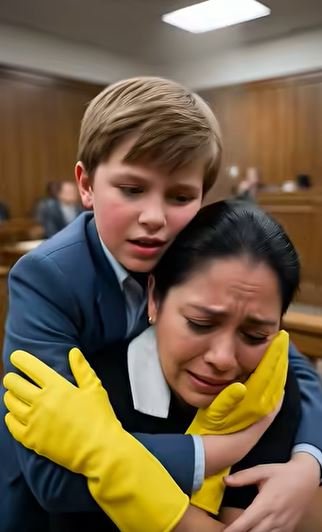
As soon as the judge adjourned the session, Lucas let go of his nanny’s hand. He ran across the courtroom, dodging reporters, and threw himself into Maria’s arms.
“Maria! I missed you!” cried the boy, hugging her with desperate force.
Maria embraced him tenderly, feeling the warmth of his small body. He was her only witness, her savior.
“My brave little one,” she whispered. “Thank you for telling the truth.”
Don Ricardo Montalvo approached, his face a mask of defeat. Money couldn’t buy dignity, and his reputation was ruined.
“Maria,” he said in a strained voice. “I’m sorry. For everything.”
“No, Mr. Montalvo,” Maria replied, rising and looking him in the eye for the first time without fear. “You don’t feel it. You only feel that you’ve lost your status and that your wife is ruining your company. I was loyal to you for fifteen years. You repaid me with prison. The money you’re giving me now isn’t an apology. It’s the price of your cruelty.”
She took Lucas’s hand. The boy didn’t want to let go.
“Lucas, you must stay with your father for now,” Mary said gently. “But I will come to visit you. And I will write to you every day.”
Mr. Torres approached, smiling. “Maria, you’re free. With this money, you can start a new life, take care of your mother, and maybe even open that little restaurant you always wanted.”
The Karma of Status
The Montalvo family’s downfall was as spectacular as their rise. The fraud scandal and false accusations destroyed their stock. Don Ricardo faced civil lawsuits and a thorough tax audit. Isabella served a short prison sentence, but the social stigma of having tried to imprison an employee out of jealousy was her true downfall.
Lucas, removed from his mother’s toxicity and his father’s coldness, went to live with his paternal grandmother, but Maria always maintained contact, acting as the stable maternal figure he so desperately needed.
María Vargas didn’t just use the million dollars to save her mother and open her small restaurant, “La Cocina de la Verdad” (The Kitchen of Truth). She used the money to demonstrate that humility is not synonymous with weakness and that the truth, however small the voice that shouts it, always has the power to tear down the walls of injustice.
The real luxury wasn’t the inherited diamonds, but the unwavering honesty of a five-year-old boy.