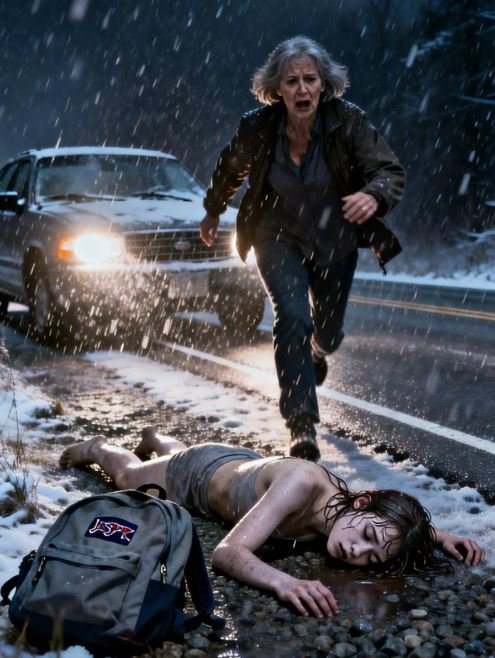
The last thing my father ever said to me as a child was a sentence that would haunt us both: “I don’t need a sick daughter.” He believed I was someone I wasn’t, a fiction crafted by my jealous older sister, and so he cast me out into a freezing downpour. I was fifteen, alone, and utterly unprepared for the world. That single act of abandonment set off a chain of events—a police call, a hospital stay, a social services investigation—that would expose the ugly truth and ultimately free me. But first, I had to survive the long, cold walk toward a hope I couldn’t even feel.
The betrayal was a two-part poison. First, there was my sister Karen’s elaborate scheme. Motivated by greed and a twisted need to be the only “good” child, she planted stolen money and pills in my room, framing me as a addict and a thief. She sold the story to our grieving, checked-out father with Oscar-worthy tears. Then came the second, deeper betrayal: my father’s willingness to believe it. He didn’t investigate or listen. He needed a simple villain for the problems in our home, and my sister handed him one on a silver platter. His rejection was absolute, physical, and dangerous.
My rescue and the subsequent fallout read like a courtroom drama. Found nearly frozen on the roadside, I was brought to a hospital where a team of advocates assembled. My grandmother arrived like an avenging angel, a retired social worker named Gloria became my guardian in the waiting room, and a sharp caseworker named Maria began pulling threads. They saw what my father refused to: a scared kid, not a criminal. As Maria dug, the frame-job unraveled. Security footage showed my sister at the ATM, not me. The pills were traced to her deadbeat boyfriend. The motive—control of my inheritance—became glaringly obvious.
The legal resolution was a quiet vindication. My sister faced consequences for fraud and endangerment. My father lost all parental rights and was ordered to support my future. Most importantly, I was given a real home with my grandmother. She offered stability, unconditional belief, and the chance to just be a kid again. In her care, the ice inside me slowly thawed. I rebuilt my life on a foundation of truth, not lies, and pursued an education and a career far from the shadows of my old town.
Years later, a letter arrived from my dying father, full of regret. I went to see him, not for reconciliation, but for my own closure. I looked at the frail man in the nursing home bed and said the words I needed to say: “I forgive you.” But I also made it clear that forgiveness is not an invitation back into my life. I told him about my happiness, my career, my loving fiancé—the full, beautiful life I built without him. I walked away for the final time, feeling not victory, but a profound and peaceful lightness. The storm was finally, completely over.