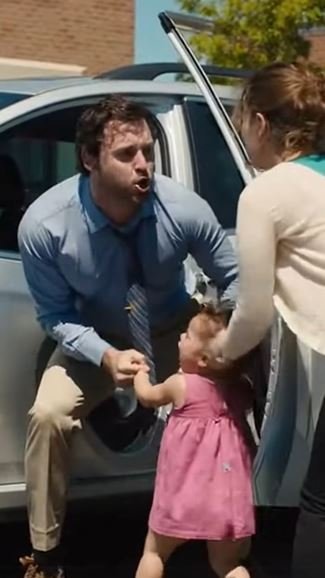
For three years, I existed in a suspended state, a monument to loss. Every August 14th, I bought a cupcake I wouldn’t enjoy, singing “Happy Birthday” to an empty kitchen. I believed my story was over. But in a Kroger parking lot, fate offered a chapter I never could have written. Witnessing a man brutally drag a screaming toddler, I was paralyzed not by the bystander effect, but by a devastating sense of déjà vu. Had someone seen my Maya this way and done nothing? That thought propelled me forward, turning a specter of grief into an active protector.
The confrontation was chaotic. The man’s exhaustion masked a deeper panic. His claim of fatherhood was undermined by a car devoid of any trace of child’s life. When the little girl locked her hazel eyes on mine, a jolt of connection passed between us that defied reason. It was the final, impossible confirmation—the unique, heart-shaped birthmark behind her ear—that brought me to my knees. It was my daughter’s signature, etched on another child’s skin. The world narrowed to that mark and the roaring truth that my daughter’s identity had been replicated.
The police saw a distraught woman and a messy domestic scene. They gently reminded me of timelines and impossibilities. But a crumpled receipt told a more urgent tale: black hair dye and children’s sleep aid. This was a kidnapping in progress, a disguise being applied. My investigation, fueled by a mother’s singular focus, led me down a rabbit hole of scientific ethics gone horrifically wrong. Dr. Mark Solano wasn’t just a kidnapper; he was a fugitive geneticist who had stolen his own experiment—a clone grown from my daughter’s stolen cells.
Finding them at the abandoned gas station, I learned the terrifying truth. This child, Subject 7-Alpha, was a clone accelerated in growth. She was a “prototype” deemed a failure because she remembered things she had never experienced—a blue bear, a spinning park, a lullaby. She remembered me. The company saw a glitch; I saw a soul. Solano, in his final act of redemption, sacrificed himself so we could escape, revealing they were already preparing the next subject. My home was being “sanitized,” and I was being framed.
Armed with nothing but a broken lamp handle and a fury that eclipsed my former despair, I realized the scope of the battle. This wasn’t about getting one child to safety. It was about dismantling an assembly line that produced and discarded children. The little girl sleeping beside me, calling me “Mama,” was both a miracle and a declaration of war. They had used science to violate the sacred bond between mother and child. In doing so, they had not created a passive experiment; they had created a cause. And they had given that cause a mother with a heart full of fire and nothing left to lose.