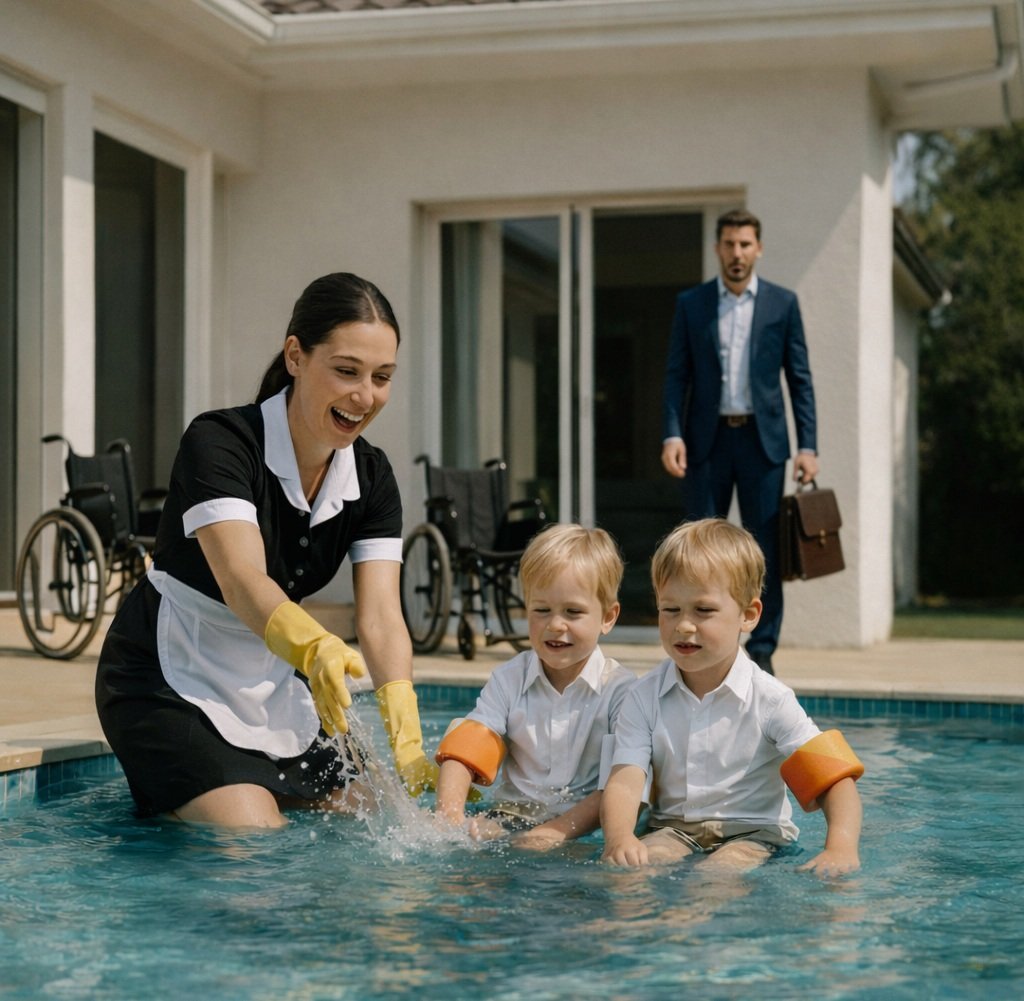
We often confuse protection with love, building elegant cages in the name of safety. In the pristine Hale mansion, this philosophy was lived to its extreme. Millionaire Jonathan Hale had constructed a world of silent luxury for his four-year-old twin sons, Ethan and Leo. Their every need was anticipated, every potential danger mitigated. The boys, who used wheelchairs, were the quiet center of this hushed universe—well-behaved, calm, and never laughing. Their father believed he was giving them the ultimate gift: a risk-free life. But the human spirit, especially a child’s, thrives not on perfection, but on experience.
The family’s maid, Maria, moved through the home like a ghost, polishing surfaces that saw no life. But she observed the boys’ silent communication, their shared glances, and their fixed gaze on the forbidden swimming pool. She saw not just children with physical challenges, but children whose emotional world had been put under glass. One afternoon, driven by a memory of her own joyless childhood, she broke the unspoken rules. Kneeling by the pool with the twins, she introduced them to water not as a hazard, but as a source of play. A tentative splash led to a touch, which sparked an unexpected, glorious sound: laughter.
When Jonathan returned to find his sons laughing, his world view shattered. The meticulously controlled environment he had built was designed to prevent exactly this kind of unpredictable moment. Yet, seeing the pure, unfiltered joy on their faces, he realized his error. He had been managing their lives instead of nurturing their spirits. The laughter was not a breach of protocol; it was a sign of life he had been missing. His emotional breakdown by the poolside was not one of grief, but of awakening.
This moment sparked a fundamental shift in the household’s ethos. Safety was redefined not as the absence of risk, but as the presence of support that allows for exploration and delight. The pool was adapted, and joy was intentionally woven into the fabric of their days. The story is a powerful metaphor for our own lives. How often do we, in our quest for security and control, sterilize our experiences of spontaneity and happiness? It challenges us to ask: are we building a sanctuary or a museum? Sometimes, wellness means letting go of perfect control to embrace the beautiful, messy, and wonderfully noisy reality of being alive.