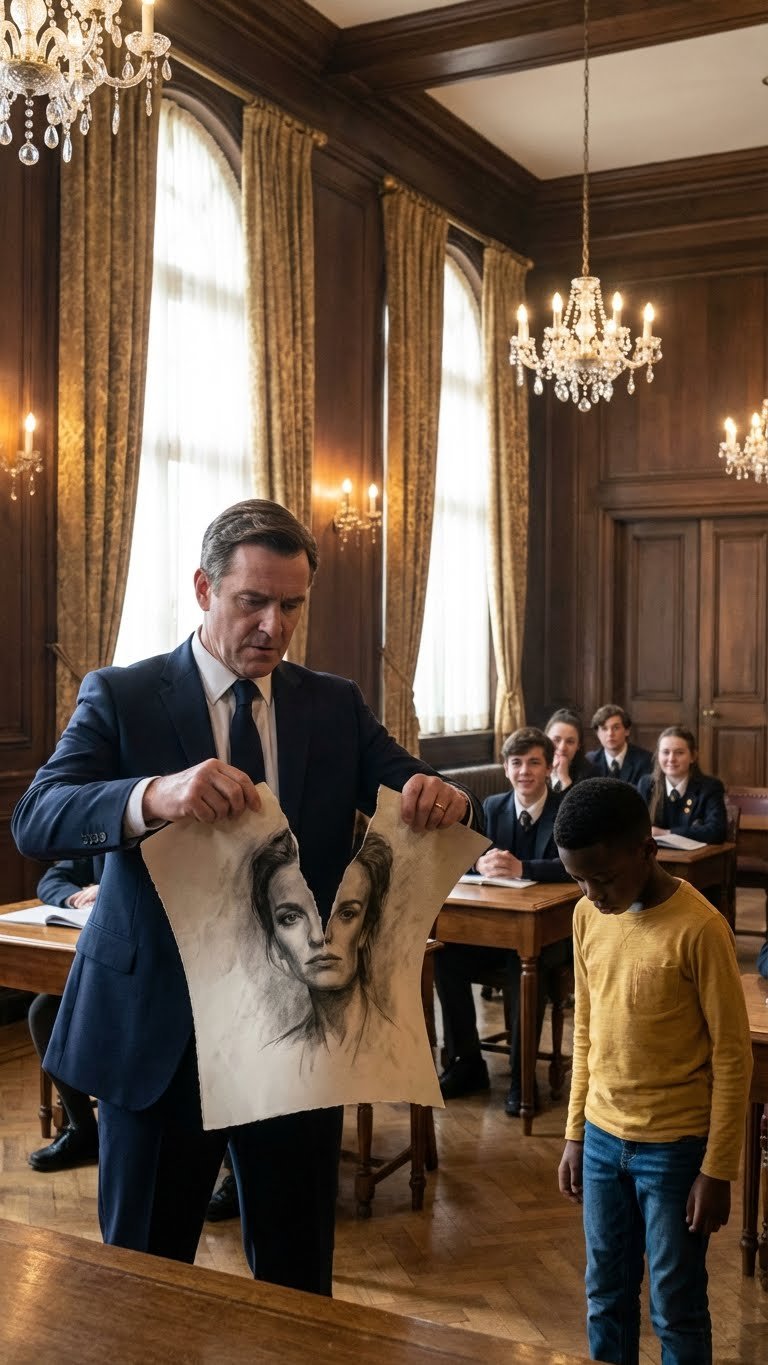
The art room at San Pedro Elite Private School was a temple to materialism, where the cost of your supplies often mattered more than the creativity in your heart. For scholarship student Mateo Navarro, this disconnect was a daily reality. His final project was a quiet rebellion: a soulful charcoal portrait of his mother, drawn on repurposed paper with charcoal taken from his family’s wood-burning stove. It was a piece born of observation, love, and necessity, meant to capture “The Essence of the Soul.” To his professor, Alfonso Alcántara, it was an affront.
Professor Alcántara believed art was defined by its materials—a doctrine of privilege. Holding Mateo’s drawing aloft, he ridiculed it before the class, calling it dirt and trash. To drive his point home, he committed a pedagogical crime: he tore the drawing to pieces in front of its creator. This act was meant to be a lesson in conformity, a demonstration of power meant to crush a student’s spirit for daring to be different with his humble resources. He ordered Mateo to clean up the mess and leave, believing the incident was over.
But a single scrap of that torn drawing, carried by the wind, became the instrument of justice. It landed at the feet of Valeria Benítez, a newspaper editor with an eye for authentic storytelling. Seeing the profound emotion in just one fragment of the portrait, she sought out the artist. Finding Mateo in distress, she did what a true educator should: she listened, she validated, and she acted. She physically repaired the artwork, honoring its scars, and professionally amplified its story to the world.
The following day, the professor’ intended lesson was rewritten on the front page of The National Daily. His act of cruelty was framed not as discipline, but as a glaring example of elitist hypocrisy. The school’s administration, faced with public outcry, had no choice but to fire him. The real lesson for the classroom that day was about integrity, empathy, and the dangerous arrogance of judging worth by appearance alone. Mateo’s “imperfect” materials had created a perfect storm of accountability.
The aftermath was a redefinition of value. Mateo received a scholarship to a premier art academy, and his taped-up drawing was exhibited in a gallery. The scars from the tearing were left visible, a permanent testament to resilience. The story concludes not with the punishment of a teacher, but with the vindication of a student. It proves that the most powerful lessons are sometimes taught not by those in authority, but by those who challenge it, and that true artistry lies in vision, not in vanity.