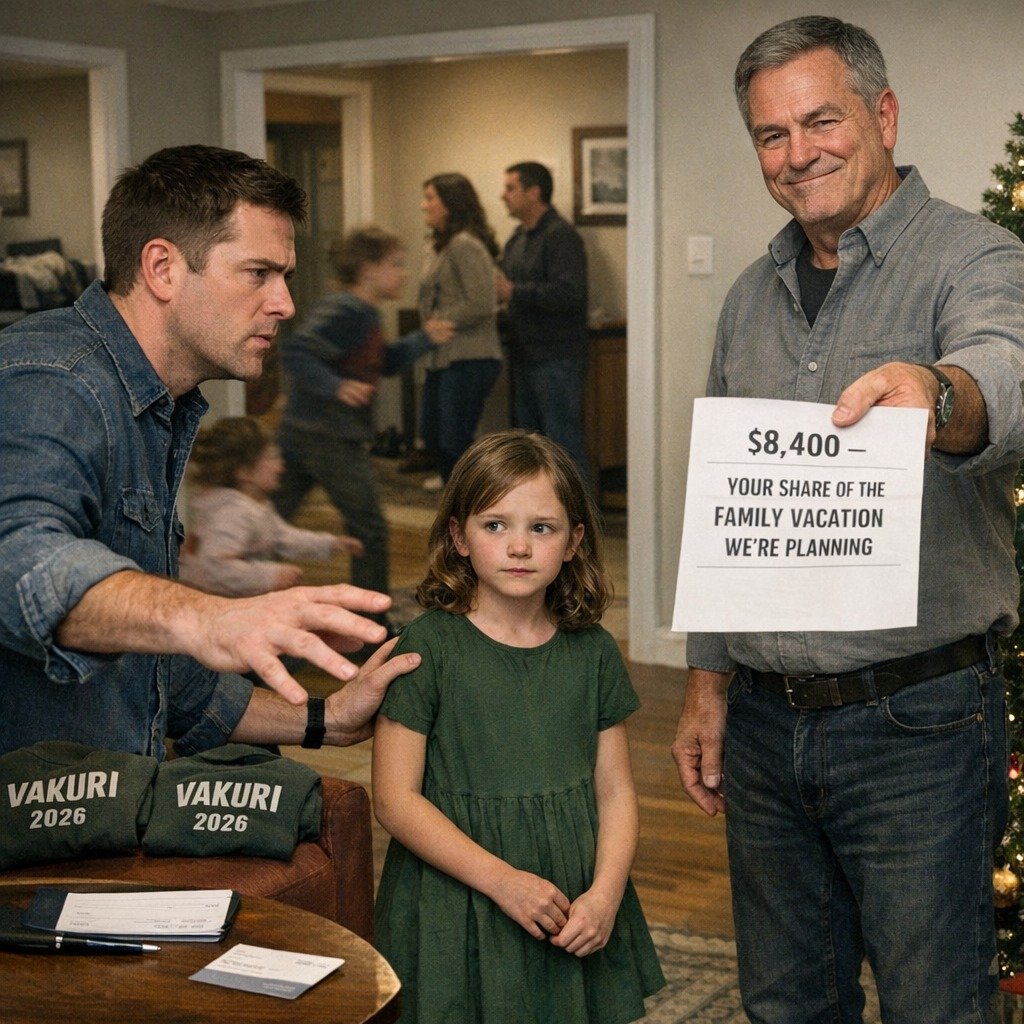
The holidays are supposed to be about warmth and togetherness, but in my family, they had become a ritual of quiet exclusion. Last Christmas, that ritual took a brutally clear turn. I arrived at my dad’s with my nine-year-old daughter, Nora, who was dressed in her finest, hoping to feel like a real grandchild. The first clue was the set of matching vacation sweatshirts on the couch, sized only for my sister’s three kids. Nora pretended not to notice, and so did I, both of us falling into our familiar roles of not making waves.
The evening played out as usual until the gift exchange. My father, beaming with pride, presented his grandchildren with envelopes containing tickets for a dream family trip. The kids screamed with excitement, and my sister watched with joy. Then his attention turned to me. There was no envelope for Nora. Instead, I received a formal invoice for $8,400, my “share” of the vacation I was not invited to join. My dad explained it simply: I was expected to fund the trip for my sister’s family, not participate in it. The message was impossible to miss.
In that moment, with my daughter standing beside me, a lifetime of smaller slights came into sharp focus. I had always been the dependable son, the one who covered bills and solved financial “emergencies.” Nora, whom I had adopted after her aunt—my late wife—passed away, was never fully embraced. She was the polite shadow in family photos, the one whose stocking was forgotten. My family’s affection seemed conditional, and their latest demand made those conditions painfully clear. My role was provider, not participant, and Nora was not part of the equation.
Nora’s whispered question, “Did I do something wrong?” was the breaking point. I knew then that no amount of money could buy her acceptance or my rightful place. The next day, I began the quiet, firm process of cutting the financial cords. With legal help, I removed my father and sister from my credit cards and closed our joint accounts. The reaction was explosive. They called me selfish and accused me of punishing the children. They arrived at the airport for their trip only to find the funding had vanished, leading to panic and frustration.
Their anger, however, only confirmed my decision. They were not upset about losing me or Nora; they were upset about losing access. That winter, I started building a new kind of holiday for Nora, filled with people who chose us for who we were, not what we could provide. My father’s bill was meant to be a demand, but it became a gift. It showed me the exact cost of my old place in the family, and I decided my daughter and I were worth so much more.