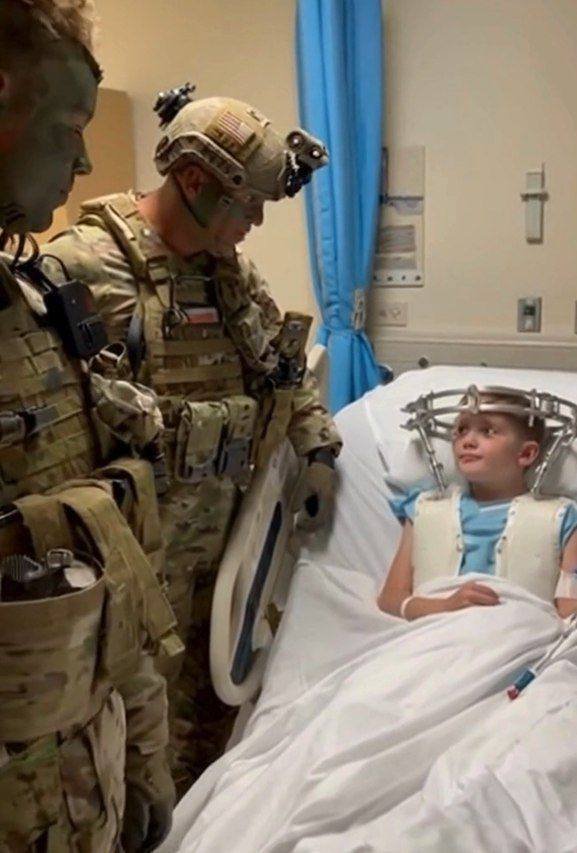
In the landscape of childhood, heroes often seem like distant, mythical figures. For Cody, a ten-year-old bearing the pain of a halo brace and the terror of major spinal surgery, that distance felt infinite. His world had shrunk to the four walls of a hospital room, a place of pain and anxious waiting. Yet, in a beautiful twist of fate, his longing to meet a hero did not require him to bridge that distance. Instead, the heroes came to him, crossing from their world of extreme training into his world of extreme vulnerability, closing the gap with purposeful strides.
The visit was orchestrated with the precision of a tactical operation, but its execution was all heart. The two Navy SEALs, still wearing the grit and face paint of a two-day drill, chose to appear in their authentic, imposing regalia. For Cody, this was crucial. They weren’t pretending to be something softer or more approachable; they were offering him the raw, respected reality of their service. Their presence in his room was a silent, powerful declaration: “You are important enough for us to come as we are, at our most real.”
The most poignant moment came with the gift of the patch. This wasn’t a generic trinket bought from a gift shop; it was a piece of their own identity, earned and worn with pride. By unpinning it and offering it to Cody, they performed a sacred act of inclusion. “We only give this to the toughest guys we know,” one SEAL told him, placing the fabric in his hand. In that instant, Cody was knighted. His battlefield was different, but his courage was now deemed equal. The patch became a physical anchor for a new, powerful feeling: he was not facing this alone, and he was stronger than he knew.
What followed was a lesson in the psychology of strength. Cody’s mindset shifted from passive endurance to active resolve. The language of the hospital—of patients, procedures, and pain—was temporarily replaced by the language of the SEALs: missions, toughness, and perseverance. He internalized their belief in him, carrying it into the operating room like a shield. The medical team performed the surgery on his spine, but the SEALs had already performed surgery on his spirit, removing the tumor of fear and suturing in a graft of confidence.
Cody’s story is a ripple that continues to spread. It illustrates that the most profound heroism often lies in the conscious decision to uplift. The SEALs, symbols of peak physical and mental fortitude, used their status not for glory, but to grant power to a child. They understood that their uniform held a magic for him, and they willingly shared that magic. It’s a timeless reminder that our greatest strengths gain their true meaning not when we hoard them, but when we use them to light the way for others who are walking through their own dark valleys. In the end, they gave Cody more than a patch; they gave him a compass pointed toward bravery, and the belief that he could follow it.