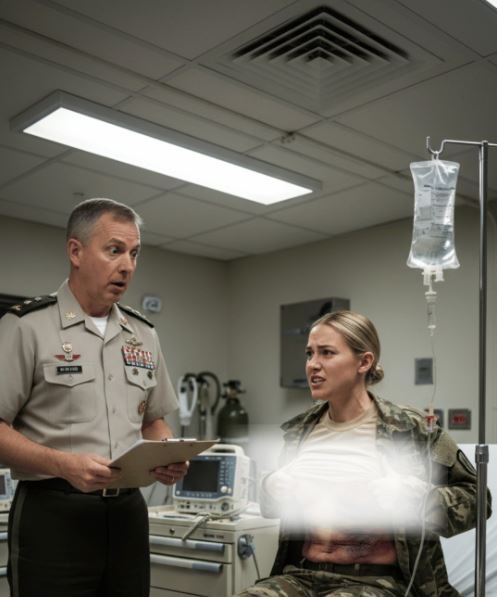
The most pivotal moment in Lieutenant Sarah Collins’ naval career involved no engine room, no stormy sea, but the quiet of an Admiral’s office. Admiral Theodore Grant had reviewed the file of an exceptionally gifted engineer, a woman who solved mechanical impossibilities with eerie calm. Yet, a hint in her psychological evaluation—a note about unexplained stress markers—nagged at him. During their meeting, he observed a faint, instinctive flinch, a hand that drifted toward her side when asked about her past. It was the clue that led him to ask the question that changed everything. His query wasn’t about protocols, but about her. And in the space that followed, Sarah made a choice that would redefine her life: she showed him the scars.
Beneath her crisp uniform lay a brutal, silent testimony. A series of precise, geometric scars mapped her ribs, the product of years in a facility known as Project Mindbridge. Here, children were treated as laboratory specimens, their pain thresholds and psychological limits coldly measured and documented. Sarah’s uncanny ability to compartmentalize, which served her so well aboard the USS Valor, was a skill forged in that crucible of suffering. When she revealed these marks to Admiral Grant, the air left the room. The theoretical “trauma” in a file became a tangible, horrifying reality etched into flesh. The Admiral’s long military silence was one of mourning—for her stolen childhood, and for the integrity of institutions he had sworn to serve.
This shared moment of awful truth forged a powerful bond. Admiral Grant mobilized his resources not to sideline Sarah, but to arm her. He provided a secure platform from which she could use her unique intellect as a weapon against her own tormentors. Together, they spearheaded an off-the-books investigation, uncovering the vast network of Project Mindbridge and tracking its architect, Dr. Hale, who was still active. Sarah’s genius, once exploited to break her, was now directed at breaking open encrypted files, finding other survivors, and building an ironclad case. The hunt was a redemption mission, transforming her from a victim of hidden systems into their most formidable analyst.
The path to justice culminated in a hearing room where power and pain stood face-to-face. When asked for evidence, Sarah Collins did the unthinkable: she presented her own body. As she revealed the scars to the committee, the clinical, deliberate nature of the marks cut through political spin and legal obfuscation. They were proof that could not be debated, dismissed, or filed away. Her calm narration of their origin, coupled with the devastating visual, created a wave of moral clarity that led to swift arrests and the exposure of related programs. In that act, she reclaimed complete ownership of her story, turning the marks of her victimization into the instruments of her victory.
Today, Commander Sarah Collins’ scars are no longer secrets to be hidden. They are part of a legacy of resilience and reform. The Navy, guided by Admiral Grant’s advocacy and Sarah’s firsthand experience, now employs her to ensure such darkness cannot flourish again. Their story illustrates a profound principle: that seeing someone—truly seeing their hidden pain—is the first step toward healing and justice. Sarah’s scars, a geometry of pain imposed by the cold hand of science, ultimately drew a new blueprint for accountability, reminding us that the courage to be vulnerable can be the most powerful force for change in the world.