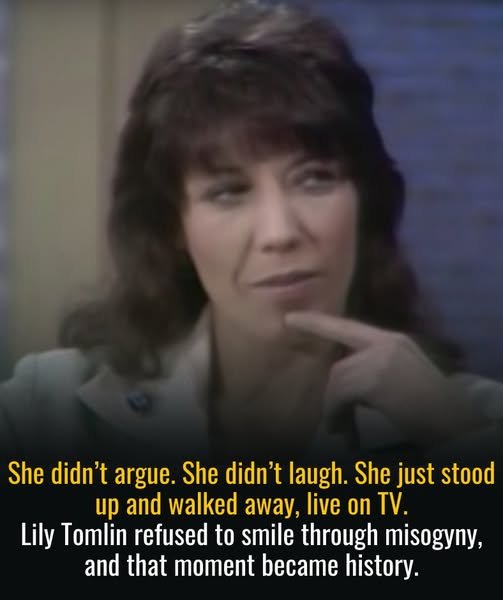
Some moments in culture become landmarks, not for their volume, but for their profound silence. For Lily Tomlin, that moment came during a casual talk show appearance when a fellow guest objectified his wife. As uneasy laughter trickled through the studio, Tomlin listened, assessed, and followed a deep moral instinct. She stood and exited. There was no speech, no dramatic confrontation—just a clear, physical statement that she would not lend her presence to such disregard. This instinctual act of resistance became a defining thread in a legendary career, illustrating that for Tomlin, comedy and conscience were always intertwined, each giving weight and wit to the other.

Tomlin’s unique perspective was forged early. Growing up with a sharp eye for life’s absurdities, she developed a comedic style that was as thoughtful as it was funny. Her apprenticeship in New York’s clubs was a crucible, from which emerged a performer of remarkable range. Her star-making turn on Laugh-In provided the perfect canvas. Through characters like the know-it-all Edith Ann and the formidable Ernestine, Tomlin did more than entertain; she offered sly social satire. She used these personas to question authority and explore human nature, establishing a new blueprint for the female comic as a savvy commentator, not just a punchline deliverer.

Throughout the 1970s and 80s, Tomlin steadily dismantled limitations. She ascended to the top of her field not by conforming to a stereotypical “funny woman” image, but by defiantly expanding it. Her success in television, records, and on Broadway was a quiet victory for creative autonomy. She demonstrated that a woman’s humor could stem from a place of intellectual observation and emotional truth, garnering critical acclaim and a devoted following. This period established her not merely as a comedian, but as a multifaceted artist whose work resonated because it was rooted in authentic human experience.
The film *9 to 5* transformed Tomlin from a celebrated performer into a cultural symbol. The movie’s premise—three women taking power back from a chauvinist boss—tapped into the collective yearning of a generation. As Violet, Tomlin embodied the intelligent, capable woman stifled by a broken system. The film’s huge popularity proved that feminist ideas could drive blockbuster comedy, and Tomlin’s performance was central to its balance of heartfelt grievance and cathartic humor. It was a project that perfectly married her comedic genius with her commitment to speaking to women’s realities.
Decades later, Tomlin continued to pioneer with Grace and Frankie, a series that celebrated the messy, vibrant lives of women in their seventies. In doing so, she challenged one of Hollywood’s most stubborn biases: the invisibility of older women. Her character Frankie, with her quirky optimism and artistic soul, became an icon for aging with spirit and defiance. Lily Tomlin’s career, bookended by that early walk-off and her late-career renaissance, is a testament to the power of consistent integrity. She redefined what it means to be a woman in comedy by simply being herself—observant, principled, and unafraid to follow her instincts, whether they led her off a stage or into uncharted creative territory, forever changing the landscape she walked through.