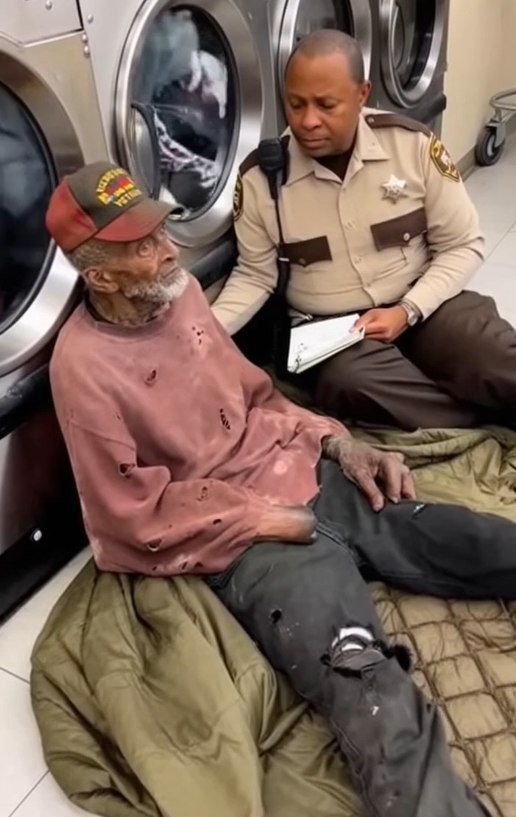
Sometimes, humanity shines brightest in the most ordinary places. On a bitter night, in the fluorescent-lit ordinary of a laundromat, an extraordinary moment unfolded. It began with an old man seeking warmth from a dryer vent and a deputy answering a call to remove him. It ended with two men sitting side-by-side on a hard floor, one listening, the other finally being heard. This is the story of Elijah, a forgotten veteran, and Deputy Carter, who chose to remember.
Elijah had become a ghost of his own life, a silhouette others glanced at with discomfort. The world saw a homeless man loitering. Deputy Carter, upon arriving, saw a veteran’s cap and the man wearing it. In that split second, Carter made a decision that would define the night. He replaced judgment with curiosity, authority with alliance. He sat down. That simple act—choosing the floor over a standing position of power—communicated more than words ever could. It said, “You are my equal here. Your story matters.”
What passed between them was a quiet transfusion of dignity. Elijah spoke of memories heavy with war and years light on kindness. He spoke of beds that never felt like home. Carter offered no empty platitudes, just the gift of unwavering attention. In a world that constantly hustles past those in need, Carter gave the one thing Elijah had lacked for so long: his full, unhurried presence. He saw the person, not the problem.
Walking out together, they didn’t just leave a laundromat; they left behind an old narrative of neglect. Carter guided Elijah toward warmth, shelter, and recognition. This story isn’t just about one officer’s kindness. It’s a mirror held up to all of us. It asks: Where do we choose to see a nuisance instead of a neighbor? A statistic instead of a story? In a cold world, the warmest place can be the space we make for another person’s truth. Deputy Carter didn’t just give Elijah a bed for the night; he gave him the profound message that he was seen, he was valued, and he was, at last, no longer alone.