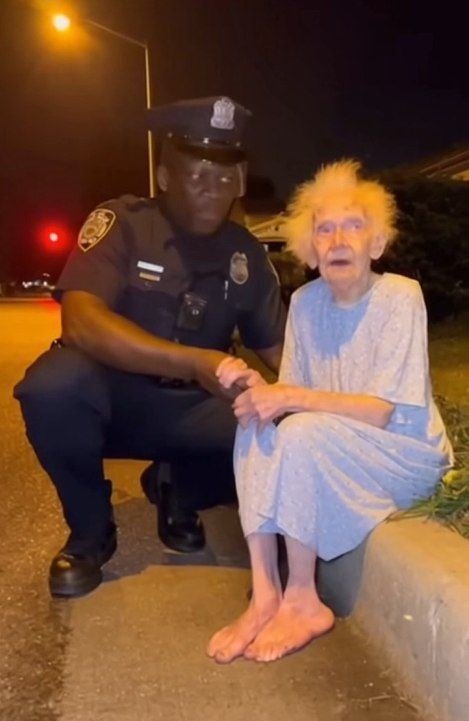
The midnight call presented a clinical scenario familiar to many families: an individual with dementia, lost and disoriented. For Officer James Trent, arriving at the scene meant quickly diagnosing a situation far beyond a simple trespass. Before him stood Margaret, 88, barefoot and bewildered, a grandmother whose dementia had quietly piloted her away from everything she knew. The incident was a stark, real-time illustration of the disease’s isolating power, where familiar walls become prison bars and the outside world turns into a threatening maze.
For those living with dementia, fear is a constant companion. Margaret’s trembling was a physical manifestation of the internal chaos caused by her condition. The flashing lights of a police car, intended to signal help, can instead scream danger to a confused mind. Officer Trent, in a moment of intuitive understanding, recognized this. He shifted from being an official figure to a calming one. His first intervention was to remove the stressors—turning off the lights, approaching slowly, and ultimately taking a seat on the curb beside her. This deliberate de-escalation is a fundamental, yet often forgotten, principle of compassionate care.
What happened next was a masterclass in communication. By sitting down, Officer Trent entered Margaret’s space without invading it. Taking her hand established a gentle, grounding connection. When she voiced her core fear—“I don’t know where I am”—he offered reassurance without contradiction. He didn’t explain where she was; he assured her that he knew, and that he would stay. This met her emotional need for security, not her cognitive need for facts, which her mind could no longer process. He validated her feelings, which is the first step in connecting with someone lost in dementia’s fog.
As they waited, Officer Trent practiced another critical skill: he listened. He allowed Margaret to share her fragmented memories without correction or redirection. In that moment, he wasn’t managing a patient; he was honoring a person. This empathetic listening is a powerful therapeutic tool, reducing agitation and restoring a sense of personhood. It provided a vital emotional safe harbor while the practical logistics of her safe return were arranged, showing that care for the mind and spirit is as urgent as care for the body.
The reunion with Margaret’s daughter highlighted the relentless nature of the caregiver’s journey. While this chapter closed with relief, the road ahead remains long. Officer Trent’s unexpected intervention offers a powerful takeaway for both professional responders and family caregivers. The most effective response is often not the fastest, but the most human. It teaches us that patience, a quiet presence, and the courage to connect on a heartfelt level can be the most profound medicines we offer, cutting through confusion and offering a genuine, if temporary, sanctuary.