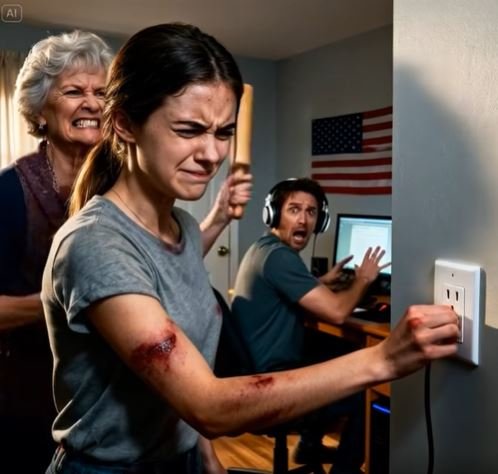
In the cramped apartment, two parallel realities existed. In one, Mark was immersed in a digital universe, cushioned by headphones. In the other, his wife, Emily, was being beaten with a rolling pin by his mother. The two realities were separated by only a few feet of carpet, yet they were worlds apart. Emily absorbed the blows, hearing the shouted words about trash as a pathetic excuse for pure hostility. She knew better than to fight back directly. Instead, she retreated into a strategic patience, letting the physical storm rage until it wore itself out on her body.
When Patricia finally stopped, panting, Emily saw her opening. Words had failed for months. Tears were ignored. So she chose a new form of communication—action. She walked calmly to the wall and reached for the power outlet, the lifeline to Mark’s computer. It was not an act of vengeance, but a desperate bid for witness. The reaction was more effective than any scream. Patricia’s panic was immediate and deafening. “No, don’t… not that…” Her scream was the alarm clock that finally jolted Mark from his stupor. He turned, and the fantasy of a peaceful home dissolved before his eyes.
What he saw was a still-life of dysfunction: his mother clutching the weapon of her rage, his wife standing with silent resolve beside the plug, the fresh bruises painting a clear picture of the last five minutes. His confused question hung in the air, and the two women offered competing explanations. Patricia’s was full of indignant deflection. Emily’s was simple, factual, and illustrated by the marks on her skin. Mark was paralyzed, a man realizing the foundation of his daily life was built on sand and willful ignorance.
In that moment, Emily saw everything clearly. Her husband’s headphones were more than a device; they were a metaphor for his choice to tune out her suffering. Her calm statement, “You didn’t want to know,” was the truest sentence spoken in that room. It stripped away the pretense. Her announcement that she was leaving was not a dramatic exit, but the logical conclusion of that truth. She was removing herself from the equation, forcing the remaining variables—mother and son—to solve for peace without her as a punching bag.
The door closed behind Emily, and the apartment was left in a new kind of quiet. It was no longer the quiet of suppressed misery, but the heavy quiet of consequence. As Emily breathed in the free night air, she felt a profound release. She had spoken the only language left that could be heard, the language of a hand nearing a plug. It was a language that said, “Notice me. Protect me. Or lose me.” And in speaking it, she had finally started a conversation that mattered, beginning a chapter where her safety was the first priority, not an afterthought drowned out by someone else’s soundtrack.