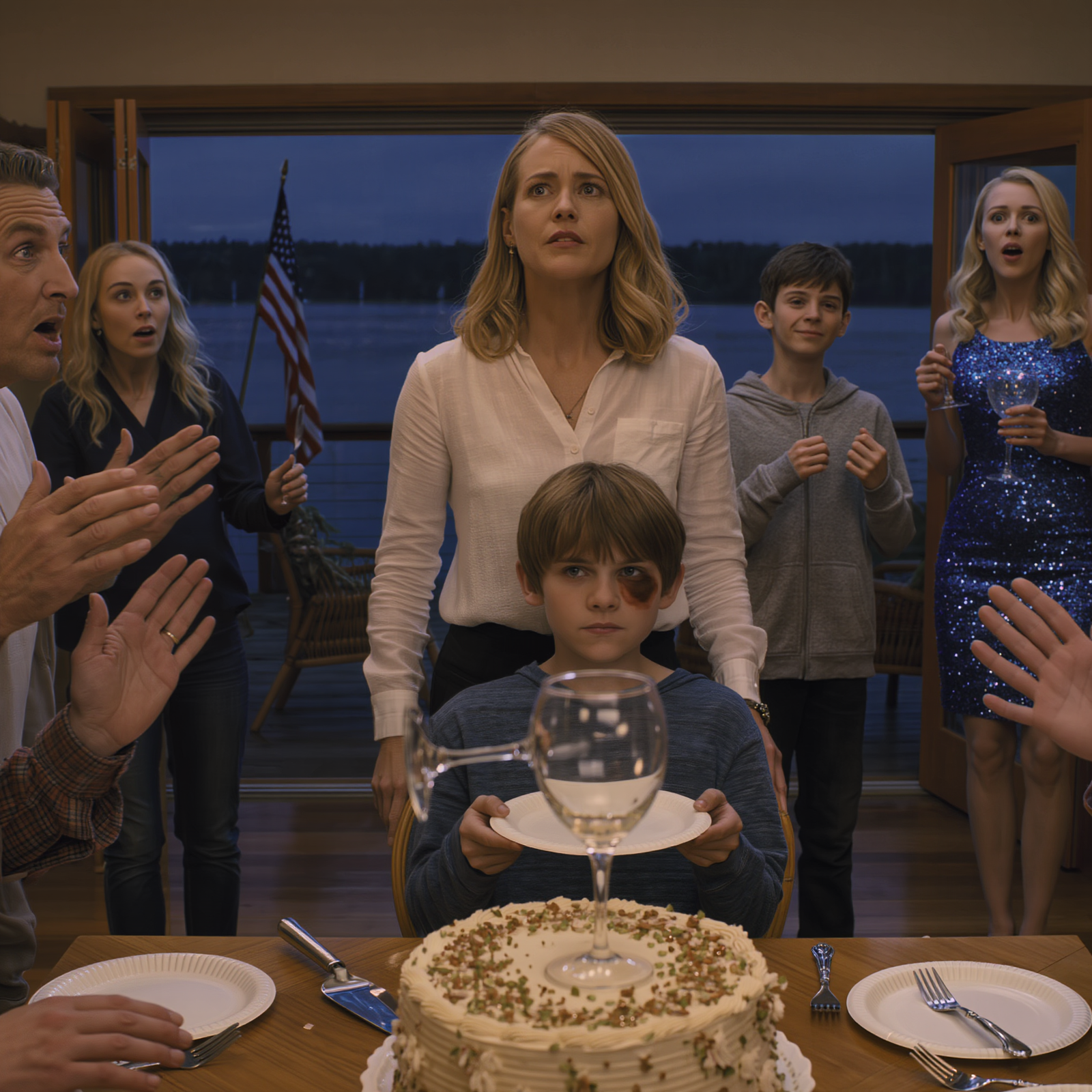
The clink of a wine glass hitting the floor is a small sound, but in the crowded dining room of my son’s birthday party, it was deafening. It was the period at the end of the sentence my twelve-year-old son, Theo, had just spoken. His face was bruised, his voice was quiet, but his question to my sister echoed louder than any birthday toast: “Why did you let him?”
Until that moment, the party had been a masterpiece of family illusion. Laughter, cake, and the gentle breeze from the lake covered the cracks in our foundation. My nephew, Tucker, had just bragged about giving Theo “a lesson,” and the family had laughed—the kind of nervous, complicit laughter that excuses cruelty. But Theo’s question tore the facade away. My sister, Mara, let the glass slip from her hand, and in her shocked, pale face, I saw the truth I had been afraid to name.
That truth had a history. It was in the way my parents always doted on Mara’s family and dismissed my quiet son as “too sensitive.” It was in the conversation I’d overheard a week earlier, where Mara seethed with jealousy over our father’s affection for Theo. Her words, “maybe it’s time he learns what responsibility feels like,” were no longer an abstract threat. They were a blueprint for the bruise on my son’s face.
What followed was a quiet war fought with security footage and legal documents, instead of shouts and accusations. I discovered the video of the attack by the dock, with Mara as a silent, approving witness. I faced pressure from my own parents to keep silent, to protect the family name and the business we’d built. But I had spent a lifetime keeping silent. Theo’s question had broken that habit for good.
I rebuilt our world around the simple, powerful fact of his worth. The family restaurant, once a source of tension, was renamed “Theo’s Lakeside Kitchen.” The family that failed him was replaced by a chosen circle of true friends. The lesson learned wasn’t the one my nephew intended to teach. It was that some silences are complicit, and the truth, no matter how disruptive, is the only foundation strong enough to build a future on.