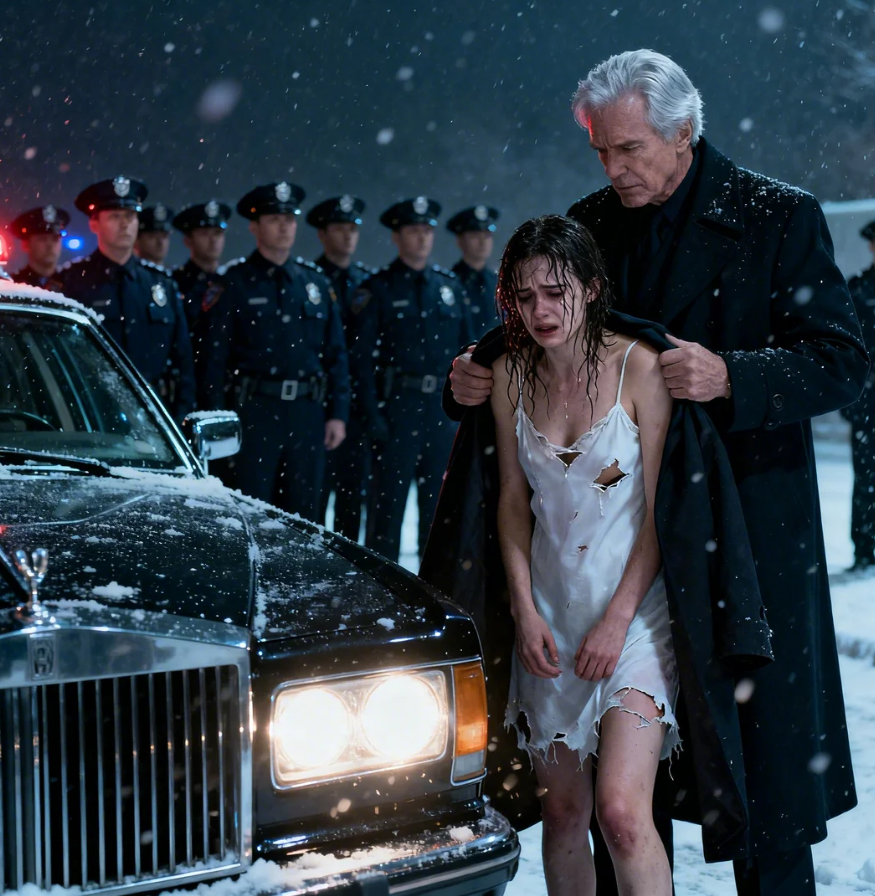
The cold was a kind of truth. It stripped away everything—pride, hope, the illusion of safety—until all that was left was a woman in a nightgown, kneeling on frozen pavement. The slam of the door still vibrated in the air, a final punctuation to a marriage that had ended not with a whisper, but with a violent shout. His mother’s smirk from the window was the final twist of the knife. I was not just cast out; I was an exhibit, a lesson in powerlessness for any neighbor brave enough to look.
My fingers, blue and stiff, closed around a cracked phone. In my memory, a single, forbidden number was etched: LAST RESORT. For years, it was a specter, a promise of a world I had willingly left behind for the simple dream of a normal life. Now, normality was a frozen curb and the taste of my own frozen tears. The phone rang twice before he answered. His voice, deep and familiar, was an anchor in the swirling void of my panic. “Mr. Albright?” I whispered, the words tearing at my raw throat. “It’s me. Please… come.”
I don’t remember the wait. I only remember the light. It wasn’t the harsh glare of a streetlamp, but the warm, golden glow of headlights cutting through the swirling snow. The cars, silent and majestic, moved with a purpose that felt alien to my chaotic world. When Mr. Albright stepped out, he wasn’t just a man; he was an embodiment of order. His eyes, missing nothing, took in the scene—the shivering woman, the mocking house, the bitter cold. He didn’t ask questions. He simply enveloped me in a coat so soft and warm it felt like an embrace. “You’ve suffered enough,” he said, his voice a low rumble of certainty. “It’s time to go home.”
The inside of the Rolls-Royce was a cathedral of silence. The world outside, with its cruelty and cold, was muted behind thick glass. He didn’t fill the space with empty platitudes. He simply let me be, let me feel the warmth seep back into my bones, let me breathe air that wasn’t laced with fear. At his estate, the care was practical and profound: hot tea, soft blankets, a room with a lock on the inside. For the first time in years, the night held no monsters.
The next day, in the quiet hum of his study, my rescue turned into my reinstatement. This was not about hiding; it was about reclaiming. With quiet authority, he marshaled lawyers and police, not as a threat, but as a system of justice. The restraining order was not just a piece of paper; it was a shield. The plan to retrieve my belongings was not a negotiation; it was a statement. In his calm efficiency, I found a reflection of a strength I had forgotten I possessed. The woman who had been discarded was now orchestrating her return, not as a victim, but as a person of consequence.
That night, as I looked out at the pristine snow covering the estate grounds, I understood. The “last resort” wasn’t a sign of failure; it was the ultimate act of self-preservation. Making that call hadn’t been a surrender; it had been the first defiant step I had taken in years. Mr. Albright hadn’t just saved me from the cold; he had handed me the tools to build a fortress around my life. And I knew, with a certainty as solid as the ground beneath my feet, that I would never again allow myself to be left in the cold.