A simple sign at a Wisconsin Dairy Queen became an unlikely battleground in the nation’s ongoing culture wars, illustrating how deeply political and social divisions have permeated everyday American life. The store owner’s declaration of “political incorrectness,” which championed traditional holiday greetings and national symbols, was not just a list of preferences; it was a loaded statement that resonated with a deep-seated conflict over national identity, language, and values.
At the heart of the controversy was a clash over symbolic speech. For the owner, Kevin Scheunemann, phrases like “Merry Christmas” and “In God We Trust” were fundamental expressions of his American and Christian identity. His insistence on using them was a pushback against a perceived pressure to secularize public spaces and language. The sign was his way of reclaiming what he saw as endangered traditions, a stance that many of his supporters found courageous and necessary.
For his critics, however, the same sign was a symbol of exclusion. The insistence on specific religious greetings in a public business can make those of other faiths, or no faith, feel like outsiders. Furthermore, the sign’s use of the term “snowflake”—a popular pejorative in political discourse—transformed it from a statement of belief into an active critique of those with opposing viewpoints. This term, along with the dismissal of “safe spaces,” framed the owner’s stance as not just traditional, but actively oppositional to progressive social values.
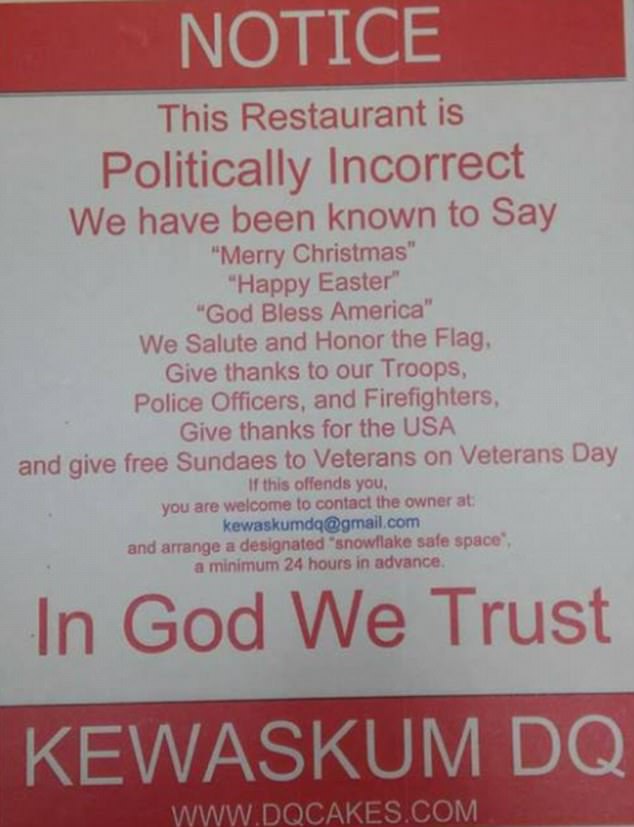
The incident highlights the evolving role of commercial spaces in society. Once seen as neutral grounds for commerce, businesses like this Dairy Queen are increasingly becoming venues for political and cultural expression. Customers on both sides of the issue now often make purchasing decisions based on a company’s perceived values, turning every transaction into a potential political statement. The patrons who traveled to support the owner were doing so as a cultural act, just as those who criticized it were voicing their opposition to its message.
This local dispute, amplified by social media, shows how national divisions are lived out in hyper-local contexts. The Dairy Queen in Kewaskum was no longer just a place for Blizzards and burgers; it was a stage for a larger drama about what it means to be an American, what language is acceptable in public, and who gets to feel at home in their own community. The sign, and the intense reactions it provoked, prove that in today’s America, even the soft-serve machine isn’t safe from the culture wars.